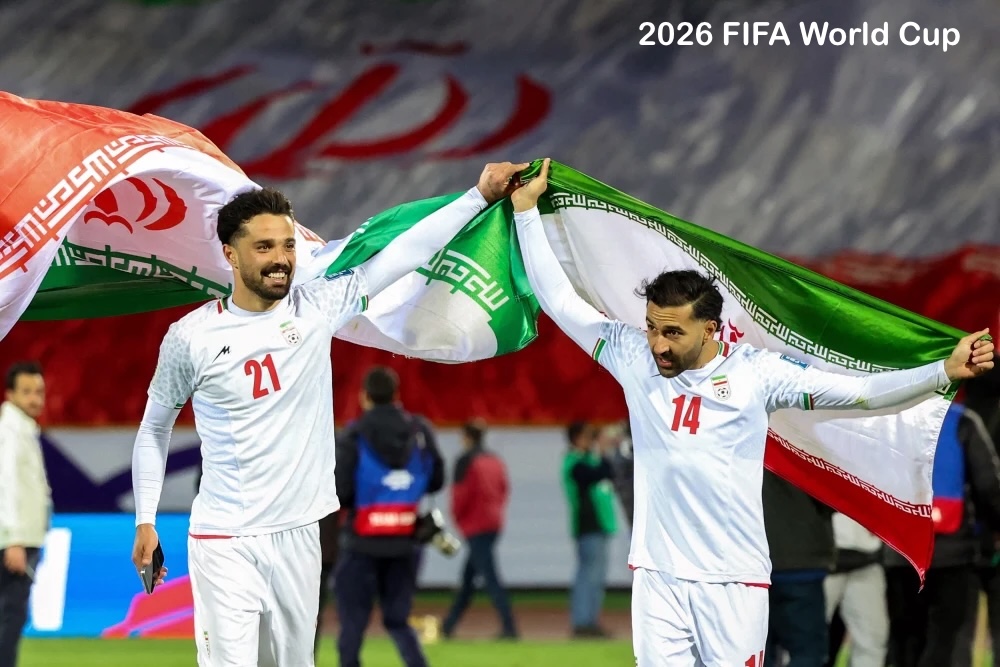
Iran’s 2026 FIFA World Cup Campaign Faces Visa Uncertainty Despite FIFA Approval and Mexico Base Switch
As the countdown to the 2026 FIFA World Cup enters its final weeks, Iran’s national football team finds itself balancing sporting ambition with diplomatic uncertainty. Having secured qualification for a seventh FIFA World Cup appearance, Team Melli is preparing to compete on football’s biggest stage while navigating visa concerns, logistical complications, and heightened geopolitical tensions involving tournament co-host the United States.
Despite the challenges, Iranian football authorities have repeatedly emphasised that the team will participate in the tournament and remain focused on its Group G campaign against New Zealand, Belgium, and Egypt.
Qualified but Facing Unusual Obstacles
Iran booked its place at the 2026 FIFA World Cup through the Asian Football Confederation (AFC) qualifying process, becoming one of the first nations from the region to secure a berth. The qualification marked the country’s seventh appearance at the global tournament and reinforced its status as one of Asia’s most consistent football powers.
However, unlike previous World Cup preparations, Iran’s build-up has been overshadowed by questions surrounding travel arrangements and entry permits for players, coaches, and support staff. Since all three of Iran’s group-stage matches are scheduled to take place in the United States, obtaining visas for the full delegation has become a critical issue ahead of the competition.
Iran is set to open its World Cup campaign against New Zealand on June 15 at SoFi Stadium in Los Angeles. The team will then face Belgium on June 21, also in Los Angeles, before concluding the group stage against Egypt on June 26 at Seattle’s Lumen Field.
With the tournament kicking off on June 11, time is becoming increasingly important for tournament organisers and football officials seeking to finalise travel arrangements.
Base Camp Relocated to Mexico
One of the most significant developments in Iran’s preparations has been the relocation of its training base from the United States to Mexico.
Iran had originally planned to establish its World Cup camp in Tucson, Arizona, a location that would have provided convenient access to its group-stage venues. However, those plans were ultimately revised, and FIFA approved the team’s request to move its operational base to Tijuana, Mexico.
Located near the U.S.-Mexico border, Tijuana offers a practical alternative that allows the Iranian squad to remain close to its match venues while reducing the need for prolonged stays inside the United States. Mexican authorities confirmed their willingness to host the team, and Iranian representatives have reportedly conducted visits to inspect facilities and coordinate security arrangements.
The move has been widely viewed as a pragmatic solution to the logistical challenges facing the team. From Tijuana, Iran can travel relatively quickly to Los Angeles and Seattle for its scheduled fixtures while maintaining a stable training environment.
Visa Concerns Remain Central
Although the relocation issue has largely been resolved, visa processing continues to dominate discussions around Iran’s participation.
Officials from the Football Federation of the Islamic Republic of Iran (FFIRI) have repeatedly called for clear assurances regarding entry permissions for players and support staff. Federation President Mehdi Taj has emphasised the need for multiple-entry visas, arguing that tournament logistics require flexibility for the delegation as it moves between Mexico and the United States during the competition.
Iranian officials have stated that visa applications were submitted through diplomatic channels, but uncertainty surrounding approvals has fuelled concern within the federation. The issue has attracted international attention because the World Cup is jointly hosted by the United States, Canada, and Mexico, and FIFA traditionally seeks to ensure that all qualified teams can participate without administrative barriers.
FIFA has reportedly remained engaged with both football authorities and government agencies to facilitate the process and ensure that tournament operations proceed smoothly.
Ambassador Criticises Situation
The visa issue gained further prominence following comments from Iran’s Ambassador to Mexico, Abolfazl Pasandideh, during a media appearance in Tijuana.
The ambassador expressed frustration over the uncertainty surrounding travel documents and argued that the situation had disrupted the team’s preparations. According to his remarks, the lack of clarity regarding visas has created challenges that other competing nations have not faced.
He also suggested that Iran has been unable to prepare under the same conditions as many of its rivals, pointing to disruptions in training plans and logistical arrangements.
The comments reflected broader concerns within Iranian official circles that political considerations have complicated what should otherwise be a routine sporting event.
Focus Remains on Football
Despite the diplomatic backdrop, Iran’s coaching staff and players continue to focus on football matters.
The team has been training in Turkey and participating in warm-up fixtures as it fine-tunes preparations for the tournament. Iranian football officials have consistently stated that their objective remains unchanged: arriving at the World Cup fully prepared to compete for a place in the knockout rounds.
Iran enters Group G with a blend of experience and expectation. The opening match against New Zealand is widely viewed as a crucial opportunity to secure points and build momentum. Belgium, one of Europe’s traditional football powers, is expected to provide the toughest test in the group, while Egypt promises another highly competitive encounter between two nations with strong football traditions.
For Iran, advancing beyond the group stage would represent a significant achievement and potentially one of the most successful campaigns in the country’s World Cup history.
Waiting for Final Resolution
As the tournament approaches, there is little indication that Iran’s participation itself is in doubt. Both FIFA and Iranian football authorities have reiterated their commitment to ensuring the team competes in the competition.
The remaining challenge is ensuring that administrative and diplomatic issues are resolved quickly enough to allow players and staff to focus entirely on football.
With the World Cup set to begin in June and millions of fans preparing to follow the action, Iran’s journey to the tournament has already become one of the most closely watched off-field stories of the competition. Whether the visa concerns are resolved smoothly or continue to generate headlines, Team Melli’s focus will ultimately be on delivering results when the whistle blows in Group G.
For now, Iran remains firmly on course for the 2026 FIFA World Cup, determined to overcome logistical hurdles and let its performances on the pitch tell the story.
Also Read:
FIFA World Cup 2026 Broadcast Rights in India Nearing Closure as Tournament Approaches
Could the 2026 FIFA World Cup Finally Produce a First-Time Winner?