Pakistan and Saudi Arabia Sign Defense Pact for Joint Protection Against Aggression
September 18, 2025 | Yesterday, Pakistan and Saudi Arabia have signed a landmark mutual defence pact that formalises their long-standing military alliance. The agreement commits both nations to treat any act of aggression against either country as an attack on both, significantly strengthening joint deterrence and defence collaboration amid rising regional tensions. This pact highlights the deep-rooted brotherhood between the two Muslim-majority nuclear-capable nations, emphasising their shared commitment to regional stability and peace.
“This agreement is a culmination of years of discussions. This is not a response to specific countries or specific events but an institutionalisation of longstanding and deep cooperation between our two countries,” a senior Saudi official told when asked about its timing.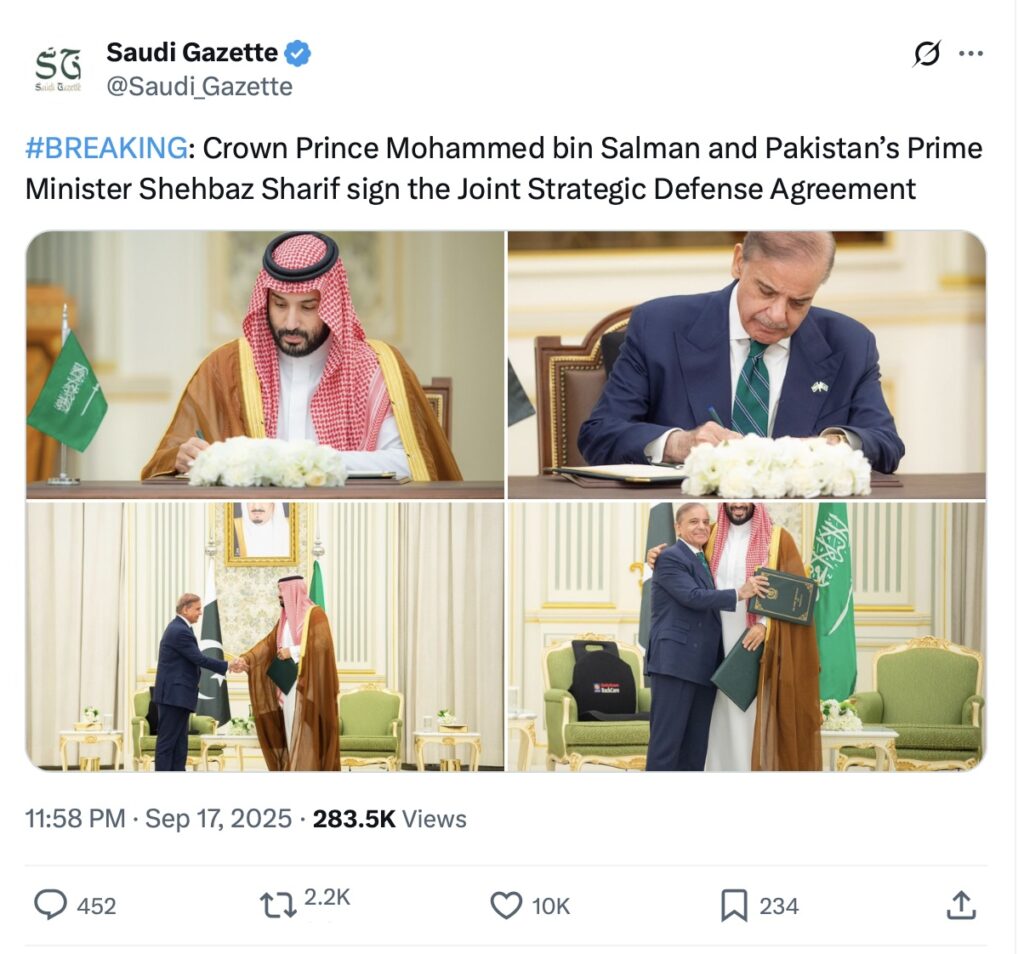
Overview of the Strategic Mutual Defense Agreement
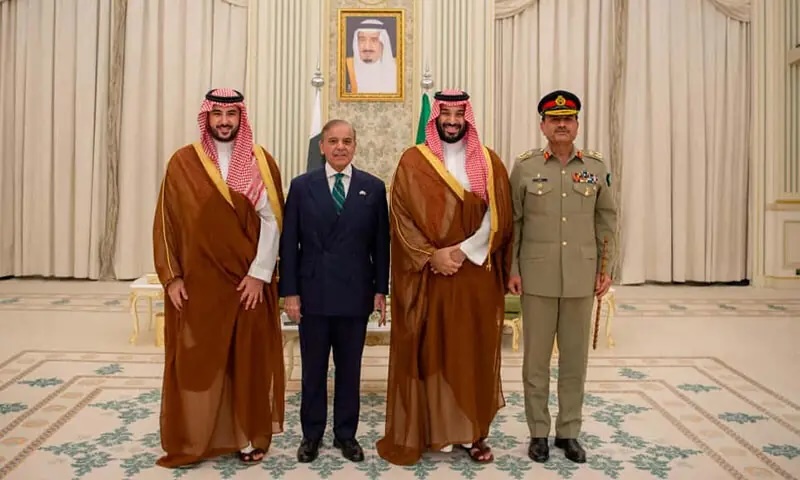
The defence pact, officially titled the “Strategic Mutual Defence Agreement,” was signed in Riyadh by Saudi Crown Prince Mohammed bin Salman and Pakistan’s Prime Minister Shehbaz Sharif during the latter’s official visit. Through this agreement, both countries demonstrate a firm mutual dedication to enhance their defence cooperation and to promote peace in the region and beyond.
The pact explicitly states that any aggression or attack on one nation will be considered aggression against both, illustrating a powerful collective security commitment. It covers all military capabilities, ensuring a comprehensive defensive posture across all domains of warfare. This accord institutionalises decades of military cooperation such as Pakistan’s training of thousands of Saudi personnel and numerous joint military exercises over the years.
A senior Saudi officials when asked whether Pakistan would be obliged to provide Saudi Arabia with a nuclear umbrella under the pact, the official said: “This is a comprehensive defensive agreement that encompasses all military means.”
Historical Context and Timing
The pact was finalized amid heightened regional tensions, notably following an Israeli airstrike on Qatar, which exacerbated security concerns across the Gulf and wider Middle East. The agreement is the culmination of years of dialogue and cooperation rather than a direct reaction to any specific recent events.
A senior Saudi officials emphasised that the pact is not aimed against any particular country but solidifies the strong strategic partnership rooted in shared interests and Islamic solidarity. Despite the strong defence pact with Pakistan, Saudi Arabia continues to maintain robust relations with other regional powers such as nuclear-armed India, highlighting Riyadh’s balanced diplomatic approach.
Broader Military Cooperation with GCC Countries
Pakistan’s military ties with the Gulf do not end with Saudi Arabia. Islamabad has longstanding defense relationships with other GCC members including the United Arab Emirates, Qatar, Oman, Bahrain, and Kuwait. These collaborations involve joint military exercises, training programs, intelligence sharing, and defense consultations.
These alliances bolster Pakistan’s role as a significant security partner in the Gulf region and expand its influence across the MENA (Middle East and North Africa) landscape, enhancing collective security in the volatile regional environment.
Geopolitical Implications of the Pact
The new defence pact between Pakistan and Saudi Arabia reverberates beyond their borders, affecting complex regional dynamics involving Iran, Russia, Israel, and India:
Iran: Pakistan faces a delicate balancing act due to its border with Iran and traditional ties with Saudi Arabia. The pact adds strategic weight to Pakistan’s Gulf relations while requiring careful diplomacy to maintain peaceful ties with Tehran.
Russia: As a major ally of Iran and India, Russia’s entanglements in Middle Eastern and South Asian security mean Pakistan’s Gulf partnerships may complicate Islamabad’s balancing between Western and Russian influences.
Israel: Given Pakistan’s official non-recognition of Israel, expanding defence ties with Gulf states that have pursued relations with Israel places Islamabad in a nuanced position in the evolving Middle East security architecture.
India: Pakistan’s Gulf defence ties serve as a strategic counterbalance against India’s growing diplomatic and military engagement with several Gulf states, preserving Islamabad’s influence in a region critical for trade and security.
A senior Saudi official, acknowledged the need to balance relations with Pakistan’s rival, India, also a nuclear power, mentioned “Our relationship with India is more robust than it has ever been. We will continue to grow this relationship and seek to contribute to regional peace whichever way we can.”
Economic and Strategic Dimensions
While there is no public indication of direct payments related to this pact, Saudi Arabia’s historical economic and oil support to Pakistan underpins the military relationship. The pact enhances defence cooperation without specifying arms transfers but promises deeper security collaboration.
Moreover, Saudi Arabia’s reliance on the United States for advanced military hardware and bases, notably the U.S. Prince Sultan Air Base, complements the region’s layered defence where Pakistan’s new pact adds a further dimension to Saudi Arabia’s security guarantees.
Conclusion
The defense pact between Pakistan and Saudi Arabia marks a milestone in Muslim world military cooperation. By agreeing to defend each other against aggression, the two nations cement a powerful alliance aimed at enhancing regional peace and security. This strategic mutual defence agreement broadens Pakistan’s role as a pivotal security partner in the Gulf and underscores Saudi Arabia’s intent to diversify its defence architecture amid evolving geopolitical challenges.
Together with Pakistan’s broader military ties across the GCC, this pact strengthens the fabric of collective defence in the Middle East, positioning both countries as key players in a highly dynamic and sometimes volatile region.