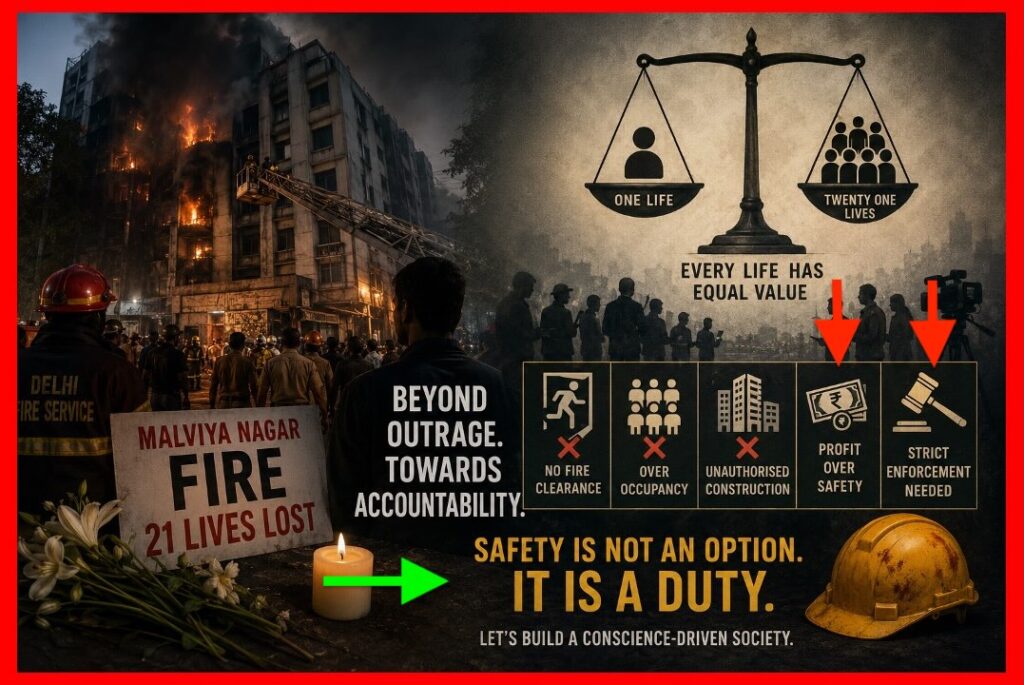
Malviya Nagar Fire Claims 21 Lives: A Grim Reminder of Negligence
The devastating fire that engulfed a bed-and-breakfast facility in Delhi’s Malviya Nagar on 3 June 2026 has left at least 21 people dead and many others injured. Preliminary reports suggest serious violations of safety norms, including alleged overcrowding, unauthorised construction, and the absence of mandatory fire clearances. Many of the victims were out-of-town attendants of patients admitted to nearby hospitals as well as foreign nationals.
As investigations continue, one fact is already painfully clear: tragedies of this scale rarely occur without multiple warning signs being ignored. When safety regulations exist only on paper and commercial interests take precedence over human lives, the consequences can be catastrophic.
Beyond the Headlines
The fire has also prompted questions about how public tragedies are covered and remembered. Certain cases generate weeks of intense national attention, while others involving multiple fatalities often fade from the news cycle much more quickly. Although every story has its own circumstances and public interest factors, the principle remains the same: every preventable death deserves scrutiny, accountability, and sustained public attention.
Systemic failures demand unwavering media attention, even when they lack the personal drama or sensational elements that often drive ratings and social media engagement. Public-interest journalism serves society best when it applies consistent standards, regardless of the number, background, or visibility of the victims involved.
Responsibility Begins with Owners and Operators
While regulatory failures merit deep scrutiny, the primary layer of accountability rests squarely with establishment owners and operators. Fire exits, occupancy limits, electrical safety, structural compliance, and emergency preparedness are not optional administrative hurdles; they are legally mandated safeguards designed to protect human life.
If investigations confirm the allegations of overcrowding and unauthorised modifications, these lapses represent deliberate decisions that prioritised profit over safety. Such actions cannot be dismissed as minor procedural oversights. Businesses that invite the public onto their premises assume an absolute, non-negotiable responsibility for the lives of those who enter.
Government oversight is essential, but no regulatory framework can fully compensate for a conscious disregard of basic safety norms. Ultimately, robust statutory enforcement must be matched by corporate responsibility and professional ethics.
The Safety Culture Gap
India does not lack extensive safety regulations or comprehensive building standards. The systemic challenge lies in inconsistent compliance and selective enforcement. Cultivating a resilient culture of safety requires more than occasional inspections and financial penalties; it demands a fundamental societal shift in how we approach risk, accountability, and public responsibility.
Many developed nations have established ecosystems where strict regulatory enforcement, insurance mandates, civil liability, and public expectations collectively incentivise compliance. While no country is entirely immune to accidents, higher baseline adherence to safety protocols drastically reduces the frequency of mass-casualty incidents.
As India undergoes rapid urbanisation and commercial expansion, closing this compliance gap becomes an urgent necessity. Safety must no longer be viewed as an operational cost to be minimised, but as a foundational civic obligation.
When Profit Overrides Responsibility
The motivations behind various forms of negligence may differ, but they all share a corrosive common thread: the prioritisation of financial gain over human welfare. Whether this manifests as exploitation, workplace misconduct, or the deliberate disregard of public safety standards, the core pathology remains identical: a willingness to compromise human dignity for material interest.
While the consequences vary in scale and context, the underlying ethical failure is entirely comparable. A society that tolerates such systemic indifference in one sphere inevitably risks normalising it across others.
A Call for Consistent Accountability
The twenty-one lives cut short in Malviya Nagar deserve far more than fleeting public outrage. They demand a transparent investigation, strict legal accountability for any violations uncovered, and systemic reforms designed to prevent future tragedies.
India’s true progress cannot be measured solely by towering new infrastructure, commercial expansion, or headline GDP growth. It must also be measured by how fiercely we protect the citizens who live, work, and travel within those spaces. Safety, structural accountability, and an uncompromising respect for human life must become non-negotiable national values.
The victims of the Malviya Nagar fire were not mere statistics. They were individuals whose lives possessed absolute worth and dignity. Honouring their memory requires more than performative mourning; it requires ensuring that the bitter lessons of this tragedy are permanently etched into our governance and never forgotten.
Also Read:
Andhra Bus Fire Kills 14: A Preventable Tragedy Rooted in Enforcement Failure
Tragic Hospital Fire in Cuttack Claims Lives of Ten Patients, Raising Serious Safety Concerns
Why the Kurnool Bus Fire Disaster Can’t Be Blamed on a Single Drunk Rider