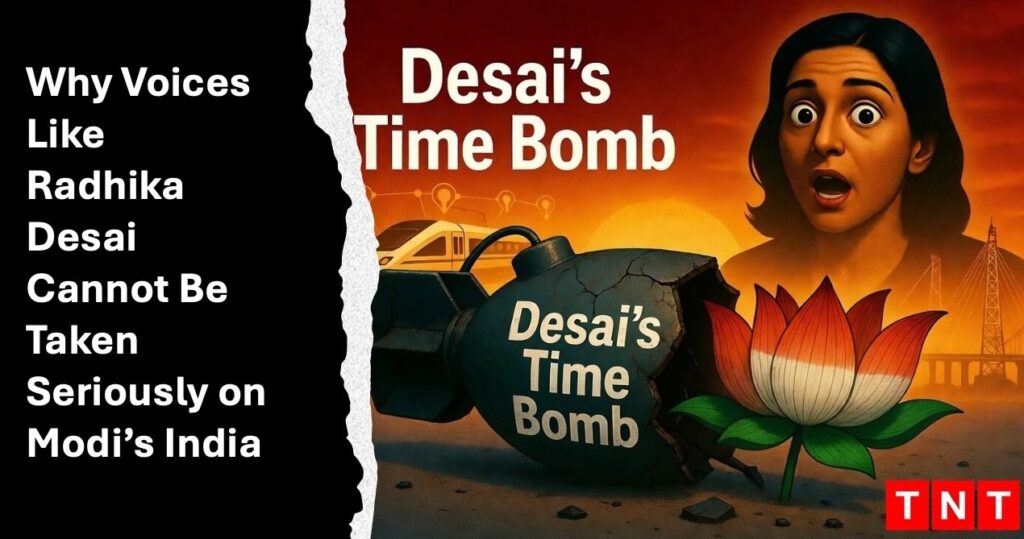
Why Voices Like Radhika Desai Cannot Be Taken Seriously on Modi’s India
This article was prompted by a widely circulated video clip on X featuring Mario Nawfal and political scientist
Radhika Desai (
shared via X). In it, Desai repeats her familiar thesis: Narendra Modi’s India is a crony-capitalist, fascist project driving the country toward economic collapse, farmer despair, and democratic erosion. For anyone who has followed her work — books like
Slouching Towards Ayodhya, her Geopolitical Economy Research Group output, or her
Geopolitical Economy Hour show — the clip is vintage Desai: consistent, passionate, and ideologically locked in.
Yet precisely because her critique is so predictable and one-dimensional, it cannot be taken as serious, objective analysis.
Who is Radhika Desai?
Radhika Desai is a Canadian academic of Indian origin and professor of political studies at the University of Manitoba. She directs the Geopolitical Economy Research Group and hosts the
Geopolitical Economy Hour. For over two decades, she has portrayed the Modi government and the broader BJP-RSS ecosystem as a form of “fascism” driven by crony capitalism, corporate greed, and majoritarian authoritarianism. Her consistent narrative is that India under Modi sits on an economic and social “time bomb” of joblessness, inequality, farmer distress, and democratic erosion.
This grim prognosis, repeated across left-leaning platforms, struggles to hold up when measured against hard data, regional realities, and a simple truth: no large democracy on earth can “manage everything” perfectly.
Ideological Lens First, Evidence Second
Desai operates from an explicit Marxist-geopolitical economy framework that views capitalism as inherently crisis-prone and right-wing nationalism as its latest mask. In this worldview, Hindutva becomes “fascism,” Modi’s economic model is reduced to “neoliberal cronyism” serving a handful of conglomerates, and policies like GST, infrastructure development, and agricultural reforms are seen as tools to enrich elites at the expense of the masses.
This is not neutral analysis — it is ideology seeking confirming facts. When the 2024 election showed rural pushback against the BJP, Desai hailed it as a “revolt of the farmers” and proof that the “Modi miasma” had been rejected. When GDP growth, inflation control, and digital infrastructure numbers improved, she dismissed them as “exaggerated” or stage-managed. The framework never changes; only the headlines are slotted in.
The Economy: Real Pain Points, But Not Collapse
Desai, to some extent, correctly highlights that youth unemployment, rural distress, and wealth concentration remain serious challenges. Corporate influence in certain sectors is visible, and inequality persists. These issues deserve attention.
However, the broader picture contradicts the “time bomb” thesis. As of early 2026, India continues as the world’s fastest-growing major economy. The IMF has raised its FY26 growth forecast to 7.3%, while the World Bank projects around 6.6–7.6% for the period, driven by strong domestic demand and export resilience. Extreme poverty has been nearly eradicated by international benchmarks. According to the Periodic Labour Force Survey (PLFS) 2025, the overall unemployment rate in usual status stood at 3.1% — lower than Canada’s and comparable to the US, with gradual improvements in youth and female workforce participation.
These gains do not erase genuine hardship, but they expose the selective alarmism. Structural pressures — creating quality jobs for 10–12 million young people annually, agrarian stress, and skills mismatch — existed long before 2014. India’s queues for jobs, government services, rations, and opportunities have been a feature of life for 70+ years, rooted in the pre-1991 Licence-Permit Raj, slow post-liberalisation job creation, and massive demographic pressures.
No Country “Manages Everything” — A Global Reality Check
Radhika Desai’s critique implicitly demands perfection from a democracy of 1.4 billion people. No large nation delivers that.
Canada, a preferred destination for skilled Indian migrants, still sees long job queues and elevated immigrant unemployment. The United States grapples with chronic inequality, opioid crises, recessions, and political polarisation. The United Kingdom continues to confront decades-long grooming gang scandals, with a major statutory public inquiry now, decades after the issue surfaced, underway under Baroness Anne Longfield to examine systemic institutional failures. France and Germany have faced periodic suburban unrest and integration challenges. Australia struggles with energy and fuel import dependence amid global supply shocks.
Large, diverse democracies are inherently messy. India’s scale, federal structure, and demographic bulge make flawless management impossible. The 2024 election demonstrated democratic accountability in action: the BJP recalibrated toward more welfare measures after losing its outright majority. This self-correction is absent from Desai’s “fascism” narrative.
Farmer Distress: Regional Variation, Not Uniform Catastrophe
Desai and her allies often cite farmer protests and suicides as proof of systemic failure. Genuine issues — debt, rising input costs, price volatility, and climate shocks — do exist in several regions.
Yet official data reveals sharp regional differences that ideology cannot easily explain. According to the latest comprehensive NCRB report (2023), a total of 10,786 persons in the farming sector (cultivators and agricultural labourers) died by suicide. Maharashtra accounted for 38.5% (~4,151 cases), followed by Karnataka (22.5%). In contrast, Uttar Pradesh and Bihar — which together represent the largest share of India’s farming population — consistently report far lower numbers. Rajasthan’s arid-zone farmers also show lower rates than the cash-crop, rain-fed belts of western and southern India.
If Modi’s policies were uniformly catastrophic, distress would be nationwide. It is not. High-visibility protests (mainly from Punjab, Haryana, Rajasthan, and pockets of western UP in 2024–25) often cluster where strong unions, surplus-oriented wheat-rice economies, and political incentives align. While some grievances are real, they are frequently amplified by organised networks, opposition parties, and logistical support that elevate local discontent into sustained national spectacles. This pattern is not unique to India — protests everywhere gain momentum when politics, funding, and media converge.
Achievements That the Critique Often Ignores
For all the valid scrutiny, Modi-era India has delivered tangible progress. An unprecedented infrastructure revolution — highways, airports, railways, and ports — has reduced logistics costs and improved connectivity. Digital public goods such as UPI, Aadhaar-linked direct benefit transfers, and systems like CoWIN during COVID have reached hundreds of millions, bypassing leaky intermediaries and expanding financial inclusion. Poverty reduction has accelerated, with extreme poverty nearly eliminated by global metrics.
On the cultural front, the BJP and RSS have contributed to a revival of civilisational confidence, most visibly through the completion of the Ram Mandir in Ayodhya. The RSS’s vast grassroots network continues its longstanding tradition of disaster relief, education, and social service in remote areas. In foreign policy, India has adopted a more assertive and multi-aligned approach, giving the country greater global heft than at any time since 1947. These are structural shifts that have improved millions of lives and enhanced India’s standing on the world stage.
The Real Value — and the Real Limit — of Such Criticism
Left-leaning voices like Radhika Desai serve a useful democratic function: they keep inequality, corporate influence, and rural pain in the spotlight. These issues matter and deserve ongoing attention.
But when the same ideological script runs for decades — every growth figure labelled “exaggerated,” every protest treated as proof of impending collapse, and every assertion of cultural identity branded “fascism” — the analysis ceases to be diagnostic and becomes performative. It reveals more about the critic’s worldview than about contemporary India.
India is neither utopia nor dystopia. It is a vast, messy democracy grappling with 80-year-old structural problems while recording impressive macro gains and exercising democratic course-correction. Serious policy debate requires data over dogma, regional nuance over sweeping generalisations, and the recognition that no government anywhere — especially one governing 1.4 billion people — can deliver perfection.
Voices like Radhika Desai deserve to be heard. They do not deserve to be treated as the final, objective truth.