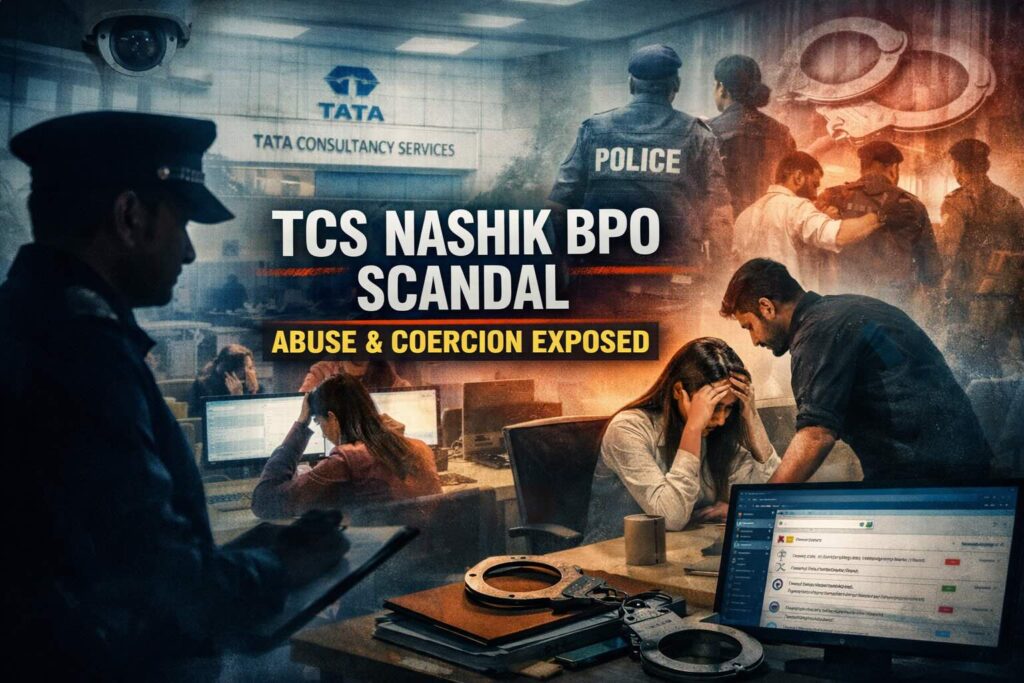
TCS Nashik BPO Scandal: Undercover Police Sting Exposes Alleged Sexual Abuse and Religious Coercion Over Four Years
Nashik, April 16, 2026 – A major controversy has erupted at the Satpur MIDC unit of Tata Consultancy
Services (TCS) in Nashik, where allegations of sustained sexual harassment, mental abuse, stalking, and attempted
religious coercion have led to nine FIRs, seven arrests, and a high-level multi-agency probe. The case, uncovered
after a family complaint and a covert 40-day police operation, has raised serious concerns about workplace safety in
India’s IT-BPO sector. TCS has since suspended on-site operations at the unit and shifted employees to
work-from-home mode.
The scandal involves complaints from at least eight young women (mostly in their early 20s) and one male employee,
detailing incidents allegedly spanning 2022 to early 2026. Victims have accused certain team leaders and senior
staff of inappropriate touching, sexually coloured remarks, body shaming, stalking, intimidation, and blackmail.
Some complaints further allege pressure to adopt Islamic religious practices—such as offering namaz, observing roza,
and altering dietary habits—with a few claims extending to attempted religious conversion.
At least one FIR invokes serious charges under the Bharatiya Nyaya Sanhita, including rape, alongside provisions
related to sexual harassment, outraging modesty, and acts intended to offend religious sentiments.
How the Case Unfolded: From Family Tip to Undercover Operation
The investigation began in early February 2026, when a concerned family approached Nashik police after noticing
abrupt behavioural and lifestyle changes in their daughter, who worked at the facility. Suspecting coercion, they
sought intervention.
Rather than risk alerting suspects through a conventional raid, Police Commissioner Sandeep Karnik
authorised a discreet intelligence-led operation.
A team of six to seven women police personnel was deployed inside the office, posing as housekeeping staff. Over
nearly 40 days of covert surveillance, particularly intensifying from mid-February, they observed workplace
interactions, informal conversations, and behavioural patterns.
The operation reportedly yielded direct observational evidence, corroborated by victim testimonies, digital
communications (emails and chats), and CCTV footage. This groundwork enabled investigators to substantiate the
initial complaint and identify additional victims who had earlier refrained from reporting incidents internally.
FIRs, Arrests, and the Absconding Accused
Between March 26 and April 3, 2026, police registered nine FIRs across Devlali and Mumbai Naka police stations,
followed by multiple arrests in early April.
Seven accused currently in custody include:
- Asif Ansari
- Danish Shaikh
- Shafi Shaikh
- Shahrukh Qureshi
- Raza Memon
- Tausif Attar
- Ashwin Chainani (a senior official and POSH committee member)
Investigators have indicated that Tausif Attar and Nida Khan are suspected to have
played central roles in the alleged pattern of misconduct.
Nida Khan, Assistant General Manager (HR), remains absconding. She faces allegations of suppressing
or downplaying complaints, including reportedly dismissing concerns raised by victims instead of escalating them
under mandatory POSH procedures. Police teams are conducting searches across Nashik and Pune, while she is believed
to be preparing for anticipatory bail.
Digital evidence under examination includes over 70–75 emails and chat records, which may help establish patterns of
behaviour, communication trails, and possible complicity.
A Special Investigation Team (SIT) led by ACP (Crime) Sandeep Mitke is now handling the case. The SIT is examining
compliance failures under workplace harassment laws, potential organisational lapses, and whether the misconduct
reflects an isolated set of incidents or a broader systemic issue.
TCS Response and Corporate Fallout
Tata Consultancy Services has issued a strong response, reiterating its zero-tolerance policy
towards harassment and coercion. The company has:
- Suspended all named accused pending investigation
- Initiated an internal inquiry led by COO Arathi Subramanian under oversight of Chairman N. Chandrasekaran
- Shifted the Nashik unit entirely to work-from-home operations
- Assured full cooperation with law enforcement authorities
The case has also drawn attention from the National Commission for Women, the Union Labour Ministry, and industry
body NASSCOM, which described the episode as an isolated incident but emphasised the need for strict adherence to
workplace safety norms across the sector.
Broader Probe: Possible Links Under Examination
Authorities have shared certain aspects of the investigation with agencies such as the National Investigation Agency
(NIA) and state-level Anti-Terrorism Squad (ATS) to examine possible organised dimensions, including allegations of
coordinated grooming or external influence.
At this stage, officials have not invoked any terrorism-related charges, and caution that these angles remain
preliminary. References to foreign links, including unverified claims involving overseas influences, are under
scrutiny but remain unsubstantiated.
Meanwhile, families of some accused individuals have contested the allegations, suggesting personal disputes may have
escalated into formal complaints. However, investigators maintain that multiple independent victim accounts,
supported by undercover observations and digital evidence, point toward a sustained pattern rather than isolated
incidents.
Public Reaction and Emerging Narrative Debate
The case has also triggered a wave of public reaction beyond the immediate allegations, with sections of civil
society and local groups linking the incident to a broader discourse around organised religious coercion and
so-called “love jihad.” Protests and online campaigns have emerged, particularly among Hindu organisations,
demanding a deeper investigation into whether the alleged acts were part of a larger, coordinated pattern.
While certain FIRs reference elements of religious pressure, investigating agencies have not established the
existence of any organised network or ideological conspiracy. Authorities, including inputs being examined by the
National Investigation Agency and state-level Anti-Terrorism Squad, are treating these aspects with caution,
emphasising that conclusions will depend on evidence emerging from digital records, financial trails, and custodial
interrogation.
The divergence between legal findings and public perception highlights how high-profile cases—particularly those
involving gender, power imbalance, and religious identity—can rapidly evolve into broader societal debates.
A Test Case for Corporate Accountability
As the probe continues, the TCS Nashik case has exposed structural vulnerabilities within BPO environments, including
power asymmetry, extended working hours, and potential weaknesses in internal grievance redressal systems.
The central question now extends beyond individual culpability: whether large corporations can ensure that
institutional mechanisms—especially under POSH frameworks—function effectively, and whether early warnings are acted
upon rather than ignored.
With further evidence analysis and court proceedings underway, the case is likely to evolve significantly in the
coming weeks.
For Tattvam News Today, this remains a developing story centred on accountability, institutional response, and
workplace safety in India’s rapidly expanding services sector.