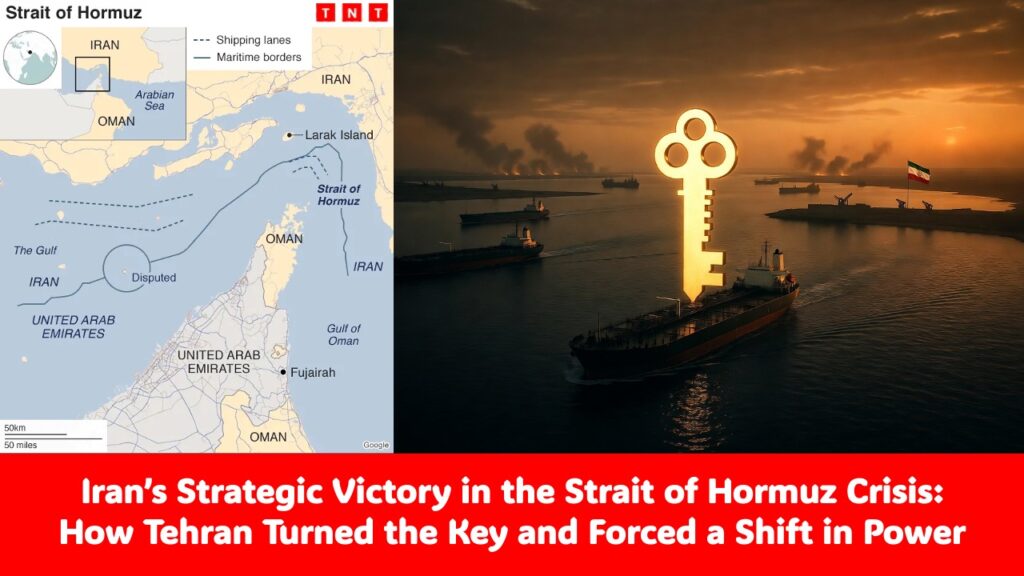
Iran’s Strategic Victory in the Strait of Hormuz Crisis
April 8, 2026 | Today’s ceasefire declarations from both sides indicate Iran’s strategic victory. From Tehran’s perspective — and that of many regional analysts — the scorecard leans decisively in its favour across several key fronts.
Let’s break it down point by point with the latest details as of April 8, 2026.
The Toll on Hormuz: $2 Million Per Ship
Iran has started implementing a “pay-to-pass” system. Reports confirm that some vessels, especially those not linked to the US or Israel and reportedly paid in Chinese Yuan in at least one case, have already been charged up to $2 million for safe passage.
This is not merely wartime extortion. Iranian officials, including lawmakers like Alaeddin Boroujerdi, member of Iranian Parliament, openly frame it as a new “sovereign regime” over the strait that covers war costs and asserts control.
Pre-war traffic through the strait averaged roughly 140–160 ships per day. Even at reduced volumes during the crisis, a few ships paying $2 million each adds up quickly. Full restoration could theoretically generate around $100 billion per year. Iranian economists have floated optimistic figures of $60–80 billion annually, though more realistic estimates, modelled after Suez or Panama Canal fees, might land closer to $20–25 billion.
In the current two-week ceasefire window, passage remains “coordinated with Iran’s Armed Forces” and subject to “technical limitations.” This means Iran still holds the keys and can vet or charge vessels as it sees fit.
This represents a massive shift. The Strait of Hormuz was long treated as an international waterway under implicit US naval protection. Now Iran is monetising it directly — a significant win for Tehran.
Toll Charges at Other Channels
For context on the scale of Iran’s new “pay-to-pass” system in the Strait of Hormuz, typical transit charges at other major global waterways provide a useful benchmark. A large commercial vessel such as an oil tanker or bulk carrier currently pays roughly $300,000 to $700,000+ to transit the Suez Canal, $300,000 to $1,000,000+ through the Panama Canal, tens of thousands to around $200,000 through the Turkish Straits (Bosphorus & Dardanelles), and $50,000 to $200,000+ for a full transit of the St. Lawrence Seaway – Welland Canal system (US/Canada – Great Lakes). In stark contrast, Iran has been charging up to $2 million per ship during the recent crisis — a figure significantly higher than established rates at these strategic chokepoints.
Iran’s 10-Point Proposal vs US 15-Point Plan
Iran rejected the US 15-point proposal, which reportedly included dismantling nuclear facilities, missile limits, a 30-day ceasefire, full reopening of the strait without conditions, and other stringent demands. Tehran described the plan as “maximalist and unreasonable.”
The USA’s 15-point Proposal
The US plan was delivered to Iran via Pakistan in late March 2026. It was described as a “term sheet” or framework for a ceasefire leading to a broader deal, heavily based on earlier 2025 Trump-era nuclear negotiation ideas, which Iran had already rejected once.
The full verbatim list of the US 15-point proposal has not been publicly released in any official document. All reporting from outlets such as AP, The New York Times, The Wall Street Journal, Al Jazeera, and The Times of Israel relies on anonymous briefings and leaks. No outlet has published the complete 15 points word-for-word.
Here is the most detailed key points reconstruction possible from multiple credible sources as of April 8, 2026:
- A temporary ceasefire, initially framed as 30 days (or up to 45 days in some mediator versions), during which negotiations would finalise a permanent agreement.
- Unconditional reopening of the Strait of Hormuz to international maritime traffic, with no Iranian conditions, tolls, or “coordination” requirements.
- Nuclear program rollback, including complete dismantling or severe restrictions on Iran’s three main nuclear sites; a permanent end to uranium enrichment on Iranian soil (zero-enrichment policy); handover or removal of all highly enriched uranium stockpiles (with some reports mentioning shipping them out and down-blending to approximately 3.67 percent); and no path to nuclear weapons, backed by strict verification.
- Limits, curbs, or suspension of Iran’s ballistic missile program development and testing.
- An end to Iranian funding, arming, and support for regional proxies and allies such as Hezbollah and the Houthis, along with cessation of attacks on them.
- Reopening of maritime routes under international norms, implicitly favouring US-led freedom of navigation rather than Iranian control.
- Phased or conditional lifting of nuclear-related sanctions only after verifiable compliance, with restrictions on how Iran could use any released funds.
- Civilian nuclear assistance, in which the US and possibly others would help monitor and support a strictly civilian nuclear program.
- Broader elements inferred from context and similar past frameworks, such as mechanisms to prevent future aggression; de-escalation in Lebanon, Yemen, and other regional fronts; long-term security arrangements (possibly involving Israel); a verification and monitoring regime (IAEA+); and possible additional points on reparations, asset releases, or economic incentives tied to compliance.
The US side presented the proposal as a path to “ending the war,” with strong demands on Iran’s military and nuclear posture while offering incentives such as eventual sanctions relief. However, the core demands were viewed by Iran as “maximalist,” “unrealistic,” and coercive — especially while the country remained under military pressure and sanctions. Iran officially rejected the plan as “extremely ambitious and illogical,” refusing negotiations “under the shadow of threats and sanctions.”
Iran rejected the US plan outright and put forward its own counter-framework, delivered via Pakistan in early April 2026. Trump later called this a “workable basis” for negotiations, while still conditioning the current two-week ceasefire on Hormuz reopening.
Iran’s 10-point Counter Proposal
Iran frames its proposal as the foundation for talks in Islamabad starting around April 10–11. The reported key points are:
- Complete and permanent end to the war on Iran (with no temporary ceasefire or time limit) and cessation of all regional conflicts, including those in Lebanon, Yemen, and Iraq.
- Guarantees of non-aggression from the US and Israel, ensuring no future attacks.
- A protocol for safe passage through the Strait of Hormuz under Iranian coordination and control (with “technical limitations” and a formal new regime — this enables the toll system).
- Lifting of all sanctions (primary and secondary) and release of frozen Iranian assets.
- Reconstruction and compensation for war damages (with funds potentially drawn from Hormuz tolls or other sources).
- Acceptance of Iran’s right to uranium enrichment for peaceful purposes under the NPT, with no dismantling of capabilities.
- An end to attacks on Iranian allies (for example, stopping Israeli actions against Hezbollah).
- Withdrawal of US combat forces from regional bases.
- Removal or end to relevant UN Security Council and IAEA resolutions targeting Iran.
- Broader elements, such as recognition of Iranian sovereignty over Hormuz management and a regional framework for security without external dominance.
Iran has emphasised continued authority over the strait, including the ability to charge fees — which is reportedly being charged at around $2 million per ship in some cases — with proceeds directed toward reconstruction.
The current two-week ceasefire is structured around moving toward finalizing something closer to Iran’s framework in Islamabad. The fact that talks are now proceeding on Iran’s counter-proposal, after Tehran forced the pause, represents a clear diplomatic win for Iran.
Forcing the US to “Stop Fire”
Iran did not fold under President Trump’s escalating deadlines and threats, which included possible strikes on power plants and bridges. Instead, it maintained the blockade long enough to spike global oil prices and inflict real economic pain. Pakistan-brokered mediation then led to the two-week “double-sided” ceasefire, under which Trump suspended attacks while Iran allowed conditional safe passage. There was no regime change and no full capitulation on nuclear or missile issues.
From Iran’s viewpoint, it demonstrated that asymmetric tools — Hormuz leverage, proxies, and coastal defences — can effectively check superior US and Israeli firepower and force negotiations on more favourable terms.
The Harsh Realisation: America and Israel Confront Iran’s Strength
In the end, the United States and Israel were forced to confront the true extent of Iran’s strength and resilience. Despite Iran demonstrating considerable flexibility during the Oman and Geneva talks in late February 2026 — including agreement on zero stockpiling of highly enriched uranium — Washington and Tel Aviv, under strong Israeli pressure and driven by the misconception that Iran was too weak (fuelled in part by the earlier Venezuela episode and prevailing impressions of Iranian vulnerability), opted for military action on February 28, expecting a quick and decisive victory.
After nearly 40 days of intense bombardment that killed top Iranian leaders including Supreme Leader Ali Khamenei, the campaign failed to break the regime or destroy its core capabilities. In response, Iran launched sustained missile and drone barrages that continued striking Israeli cities and military targets for weeks. More critically, Iranian forces inflicted serious damage on multiple US military bases, completely destroying or disabling key radar systems — including advanced THAAD and early-warning radars across Jordan, Qatar, Saudi Arabia, and the UAE — while causing heavy losses of American military aircraft. These setbacks, coupled with the effective blockade of the Strait of Hormuz, created significant economic and strategic pressure that ultimately compelled the US to accept a two-week “double-sided” ceasefire and shift negotiations toward Iran’s 10-point framework.
The Bigger Picture: Victory… With Caveats
This episode represents a net strategic victory for Iran in the short-to-medium term. The two-week “double-sided” ceasefire and the upcoming Islamabad talks are now structured around advancing Iran’s 10-point proposal rather than the original US 15-point demands. Tehran forced a pause in American strikes without capitulating on key nuclear issues or relinquishing control over the Strait of Hormuz. The new toll mechanism and “coordinated passage” have given Iran ongoing leverage and a potential long-term revenue stream. Even President Trump’s shift from issuing ultimatums to calling Iran’s plan “workable” has been spun by Tehran as implicit acceptance.
In essence, Iran “found the key” — proving that dominance over Hormuz is a powerful asymmetric tool capable of generating revenue, inflicting economic pain, and extracting concessions. The regime survived intact and successfully flipped the narrative from US-Israeli dictation to negotiations based on its own terms.
However, it is not a total knockout. The US and Israel retain overwhelming military superiority, and the 15-day negotiation window could still force compromises. The ceasefire remains temporary and fragile; any breakdown in Islamabad could trigger rapid escalation. Long-term enforcement of the toll system also faces major challenges — international pushback, insurance issues, alternative routes, and legal disputes over a natural chokepoint. Recent drops in oil prices further highlight the fragility of Iran’s leverage.
While the immediate crisis has eased, the underlying power balance has clearly shifted in Iran’s favour. The coming days in Islamabad will decide whether this tactical success becomes a lasting strategic advantage — or merely the prelude to the next uncertain chapter.
About the Author
Praveen Chand is an infrastructure and energy professional with over 38 years of experience across large-scale EPCC projects, including oil & gas, civil infrastructure, and emerging sectors such as renewable energy. He has held senior leadership roles such as Project Director, SBU Head, and Country Head, and has worked across West to East Asia in multiple international assignments.
He holds a Bachelor’s degree in Civil Engineering from NIT Trichy and a Master’s degree in Construction Law from Robert Gordon University, Aberdeen (UK), bringing a practitioner’s perspective to global developments at the intersection of geopolitics, energy security, infrastructure, and economic strategy.
Having travelled to over 30 countries, his writing reflects a broad, ground-level understanding of geopolitics, international systems, policy environments, and regional dynamics, along with practical insights into international travel and on-ground logistics.