UAE Rafale Walkout From F5 Funding Over Tech Transfer
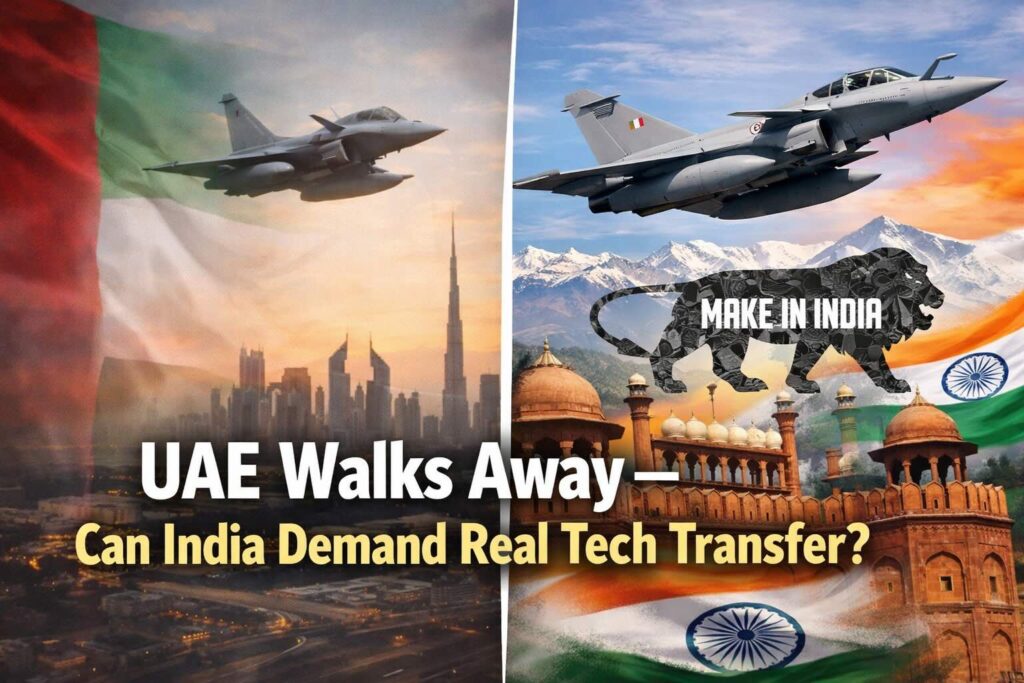
In a stunning setback for France’s defence industry, the United Arab Emirates has pulled the plug on co-financing the next-generation Rafale F5 upgrade programme. Abu Dhabi was poised to inject up to €3.5 billion into the roughly €5 billion project — covering advanced sensors, optronics, electronic warfare upgrades, and integration with drones and hypersonic weapons — but walked away in late December 2025 after Paris refused to share meaningful “black box” technologies. The impasse boiled over during French President Emmanuel Macron’s visit to Abu Dhabi, leaving France to shoulder the entire bill alone and risking delays in a programme critical to keeping the Rafale competitive globally.
For the UAE, it wasn’t about the money. It was about sovereignty. Abu Dhabi wanted real industrial participation and technology transfer — not just shiny jets on a runway. French officials drew a firm line at handing over sensitive optronics and core systems, viewing them as national crown jewels. The result? A high-profile partnership unravelled, exposing a growing trend among buyer nations: premium prices demand more than hardware. They demand know-how.
India’s Long and Rocky Road with the Rafale
India knows this story all too well. Its romance with the Rafale dates back to the 2007 Medium Multi-Role Combat Aircraft (MMRCA) tender, a mammoth bid for 126 jets to modernise the Indian Air Force (IAF). After years of evaluations, Dassault’s Rafale emerged as the frontrunner alongside Eurofighter Typhoon. But negotiations collapsed in 2015 over cost overruns, technology transfer disputes, and offset clauses. Prime Minister Narendra Modi’s government abruptly scrapped the tender and opted for a streamlined government-to-government deal for just 36 jets in 2016 — a ₹59,000 crore emergency infusion delivered between 2019 and 2022.
Fast-forward to 2026, and history is repeating with a twist. The IAF’s squadron strength remains critically low — hovering around 30-32 against a sanctioned 42 — amid rising tensions with China and Pakistan. In February, the Defence Acquisition Council cleared the Acceptance of Necessity (AoN) for 114 more Rafales under the Multi-Role Fighter Aircraft (MRFA) programme, valued at around ₹3.25 lakh crore ($39-40 billion). The plan: 18 in fly-away condition from France, the rest assembled in India by Dassault in partnership with an Indian firm (widely expected to be Tata Advanced Systems), with ambitious targets of 50-60% indigenous content, local fuselage production, and integration of Indian weapons and sensors.
Yet the familiar sticking point persists: technology transfer. French sources indicate Paris is willing to share airframe manufacturing, maintenance, repair, and overhaul (MRO) facilities, and some integration APIs — but not source codes for critical systems like the SPECTRA electronic warfare suite, RBE2 radar, or mission computers. India gets a powerful platform, but remains dependent on Dassault for deep customisation, future upgrades, or sovereign software tweaks.
Can India Emulate the UAE and Walk Away — or at Least Dig In Harder?
In theory, yes. India is no small buyer like the UAE; it’s one of the world’s largest defence importers with genuine leverage. The MRFA deal would be a lifeline for Dassault, boosting its production line and potentially positioning India as a regional hub. New Delhi has already proven it can play tough — the original MMRCA collapse and the scaled-down 36-jet deal show precedent. Atmanirbhar Bharat and “Make in India” provide political cover to demand more: deeper offsets, co-development, or genuine intellectual property access. If France says no to core tech, India could accelerate Tejas Mk1A/Mk2 production, fast-track the Advanced Medium Combat Aircraft (AMCA), or even revisit other options.
But in practice, a full UAE-style refusal looks improbable — and riskier than it seems.
First, urgency trumps leverage. The IAF cannot afford years of delay while squadrons dwindle. The UAE, sitting in a relatively stable neighbourhood with deep pockets and fewer immediate threats, could walk away. India’s borders are hot. Every month without new fighters increases operational strain on ageing MiG-21s and Su-30MKIs.
Second, strategic partnership depth. France isn’t just a supplier — it’s a key defence collaborator on Scorpene submarines, BrahMos missiles, and nuclear cooperation. Straining ties over one deal could ripple across the Indo-Pacific strategy. Macron has repeatedly framed the Rafale as a cornerstone of bilateral trust.
Third, partial wins are already in play. Negotiations are advanced. India has secured more localisation than in the 2016 deal: Indian assembly, weapon integration, and MRO setup. Demanding “genuine” ToT (full source codes) might be a bridge too far — no exporter (France, US, or Russia) typically hands those over without ironclad alliances. France’s red line on optronics with the UAE suggests it won’t budge easily here either.
Finally, economic realism. The deal’s scale offers India massive offsets — jobs, skills, and supply chain growth. Walking away entirely could mean higher costs elsewhere and slower indigenisation.
The Smart Path Forward
India doesn’t need to mimic the UAE’s dramatic exit. It can — and should — leverage the moment. With the UAE precedent fresh in everyone’s mind, New Delhi can push for enhanced clauses: guaranteed APIs for Indian systems, joint R&D on specific upgrades, or performance-based milestones tied to tech milestones. Parallel investments in AMCA and Tejas will naturally reduce future dependence.
The Rafale saga is no longer just about buying jets. It’s about buying futures. Buyers worldwide are waking up: platforms without sovereignty are expensive paper tigers. France’s Rafale F5 funding headache is a cautionary tale. For India, the real test isn’t whether it can do what the UAE did — but whether it negotiates a deal that delivers real self-reliance without compromising readiness. The coming months in Paris and New Delhi will decide if this becomes another incremental step or a genuine leap toward aerospace independence.
Also Read:
About the Author
Praveen Chand is an infrastructure and energy professional with over 38 years of experience across large-scale EPCC projects, including oil & gas, civil infrastructure, and emerging sectors such as renewable energy. He has held senior leadership roles such as Project Director, SBU Head, and Country Head, and has worked across West to East Asia in multiple international assignments.
He holds a Bachelor’s degree in Civil Engineering from NIT Trichy and a Master’s degree in Construction Law from Robert Gordon University, Aberdeen (UK), bringing a practitioner’s perspective to global developments at the intersection of geopolitics, energy security, infrastructure, and economic strategy.
Having travelled to over 30 countries, his writing reflects a broad, ground-level understanding of geopolitics, international systems, policy environments, and regional dynamics, along with practical insights into international travel and on-ground logistics.