India vs Pakistan T20 World Cup: Tactical Brilliance on Colombo’s Sticky Pitch
Colombo, February 15, 2026 — The India vs Pakistan T20 World Cup encounter at R. Premadasa Stadium was never going to be ordinary. India’s emphatic 61-run victory, after posting 175/7 and dismissing Pakistan for 114, was not merely about numbers. It was about tactical intelligence, adaptability under pressure, and mental clarity in the most scrutinised rivalry in world cricket.
On a surface that demanded nuance rather than muscle, India executed better plans at every phase. Pakistan, by contrast, remained trapped in rigid thinking.
The “Sticky Pitch” Narrative and Tactical Shifts: When Pace Trumped Spin
The Colombo surface behaved exactly as expected. The black-soil pitch was slow, tacky, and increasingly abrasive as the night progressed. Pakistan, after winning the toss, chose to bowl and committed almost entirely to spin. Eighteen of their twenty overs came from slow bowlers.
The decision was rooted in history. At the same venue in 2012, Pakistan had stunned Australia with a spin-heavy attack led by Saeed Ajmal and Abdur Rehman. However, cricket has evolved, and so have batters.
While Saim Ayub returned figures of 3/25 and briefly disrupted momentum, India refused to retreat. Pakistan’s spinners conceded at 8.75 runs per over, leaking boundaries when precision was essential. The pitch rewarded variation, not volume.
India’s response with the ball was more layered. Jasprit Bumrah and Hardik Pandya attacked early, exploiting seam and bounce before the surface slowed further. Pakistan were reduced to 13/3 inside three overs.
Only then did India deploy spin through Axar Patel and Varun Chakravarthy, once grip replaced carry. The sequence mattered. Recent IPL and Asia Cup trends have shown that early pace, followed by controlled spin, is the winning formula on such tracks. Pakistan, committed to a single plan, never adjusted.
Ishan Kishan’s Redemption Arc Under Rivalry Pressure
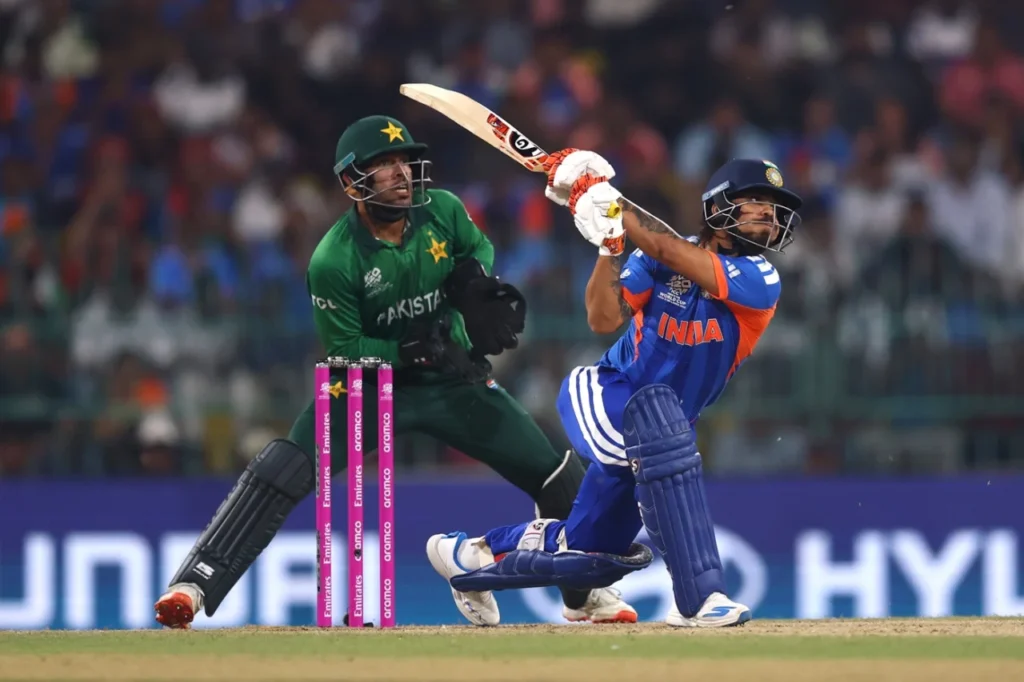
Few innings in the India vs Pakistan T20 World Cup history have carried as much personal weight as Ishan Kishan’s 77 off 40 balls. Entering the match under scrutiny for form and selection consistency, Kishan responded with intent rather than caution.
On a pitch where timing was unreliable, he trusted stroke-play. Sweeps, reverse hits, and lofted drives dismantled Pakistan’s spin trap. Even when Saim Ayub dismissed him with sharp turn, the damage was irreversible. India were already 88/2 in the ninth over.
More importantly, this was an innings built on mental resolve. India-Pakistan matches punish hesitation. Kishan displayed none. His knock stabilised the middle order and allowed Suryakumar Yadav and the finishers to build freely. For India, it reaffirmed depth. For Kishan, it reset narratives.
The Hype Around Usman Tariq and India’s Read
Much pre-match attention focused on Usman Tariq, touted as Pakistan’s mystery weapon. His sling-arm action and delayed release were expected to unsettle India’s batters.
Instead, India decoded him quickly. His four overs cost 24 runs and produced one wicket. The pause became predictable. Lengths were targeted. Mystery faded into manageability.
It reflected the wider contest. Pakistan arrived with flair and expectation. India arrived with preparation and adaptability.
Pakistan’s Top-Order Collapse: A Repeating Pattern
Pakistan’s chase never developed rhythm. Sahibzada Farhan fell first ball. Saim Ayub and captain Salman Aghafollowed soon after. At 13/3, the contest was effectively settled.
Usman Khan fought with a 44 off 34 balls, but resistance was isolated. The recurring weakness against high-quality pace in big matches resurfaced.
While Pakistan’s batters flourish on flatter PSL tracks, global tournaments expose mental and technical gaps. Pre-match claims of being “relaxed” did not translate into clarity under pressure. Execution, not temperament, determines survival at this level.
Colombo as a Neutral Venue: A Strategic Blueprint
Colombo offered balance. The crowd was split. The atmosphere was intense but not hostile. Historically, Sri Lanka has been a fair battleground for this rivalry, including the memorable 2012 Asia Cup final.
India appeared liberated by the neutral setting. Pakistan, meanwhile, seemed disconnected. With ICC tournaments increasingly favouring politically neutral venues, Colombo 2026 may represent a future template. It reduces off-field noise while preserving competitive theatre.