India’s Pursuit of Indigenous Aero-Engine Capability: Rolls-Royce, Safran and the AMCA Engine Race
New Delhi, February 13, 2026 — India’s long-running effort to achieve self-reliance in fighter jet engine technology has entered a critical phase following a fresh proposal by Rolls-Royce to co-develop a 120 kN-class turbofan engine for the Advanced Medium Combat Aircraft (AMCA) programme.
The British aerospace major has offered full intellectual property ownership and comprehensive technology transfer to India, positioning itself as a direct competitor to France’s Safran, which has been in advanced discussions with New Delhi for a similar partnership. The development reflects growing international interest in India’s defence manufacturing ecosystem amid its push for strategic autonomy.
The proposal was unveiled by Rolls-Royce Chief Executive Tufan Erginbilgic shortly after his meeting with Prime Minister Narendra Modi. Company officials described the offer as a long-term industrial partnership aimed at making India a global hub for advanced combat aircraft engines.
According to officials familiar with the discussions, the plan includes establishing a dedicated engine design centre and large-scale manufacturing facilities in India. The project is expected to generate thousands of skilled jobs and integrate Indian suppliers into global aerospace supply chains.
AMCA and India’s Engine Requirements
The AMCA programme, led by the Aeronautical Development Agency under the Defence Research and Development Organisation, is India’s most ambitious indigenous fighter project to date.
The stealth aircraft is planned in two main variants. The first, AMCA Mk1, will use imported GE F414 engines. The more advanced AMCA Mk2, expected in the mid-2030s, requires a new-generation engine producing between 110 and 120 kN of thrust to support supercruise, enhanced stealth, and heavier payloads.
Meeting this requirement has become central to India’s long-term airpower strategy, especially as regional military competition intensifies.
Legacy of the Kaveri Programme
India’s pursuit of indigenous jet engine capability dates back to the GTX-35VS Kaveri programme launched in the 1980s. Although the engine represented a major technological effort, it failed to meet performance targets for the Light Combat Aircraft Tejas.
Persistent problems in metallurgy, turbine blade manufacturing, and high-temperature operation limited its thrust output. By the mid-2010s, the engine was delinked from frontline fighter applications.
While derivatives of Kaveri continue for unmanned platforms, the programme’s limitations highlighted the depth of expertise required in modern aero-engine development. As a result, India has increasingly turned to foreign collaboration for critical propulsion technologies.
Safran’s Earlier Advantage
Safran emerged as a leading contender by 2024, leveraging experience from its M88 engine used on the Rafale fighter. The French firm proposed a co-development model based on its core technology, offering joint intellectual property rights and extensive technology transfer.
In 2025, Indian officials indicated that Safran’s proposal had an estimated development timeline of around ten years. This aligned more closely with AMCA Mk2 production plans, giving the company an early advantage.
The French offer was structured under a government-to-government framework, providing assurances on export rights and long-term support.
Rolls-Royce’s Strategic Push
Rolls-Royce’s latest proposal seeks to challenge that lead by offering a clean-sheet engine design rather than a derivative platform. Company executives have emphasised that India would retain full ownership of intellectual property, an area that has historically limited the depth of defence partnerships.
The company has also highlighted the adaptability of the proposed engine for future sixth-generation platforms. Officials say the design will be scalable, allowing upgrades as India’s requirements evolve.
In addition, Rolls-Royce has committed to treating India as a “home market” for defence engine production, alongside the United Kingdom and the United States. This status would give Indian facilities priority in manufacturing and global supply chains.
However, analysts note that earlier discussions with the company suggested a longer development cycle of around 13 years. This remains a concern given the Indian Air Force’s operational timelines.
GE and Broader Competition
The competition extends beyond Europe. General Electric continues to engage with India through its F414 engine programme for Tejas Mk2 and AMCA Mk1.
While GE has transferred significant manufacturing technology, critical hot-section components remain restricted. This has limited India’s ability to achieve full independence in engine production.
Rolls-Royce’s emphasis on unrestricted IP transfer is therefore seen as a key differentiator in the current negotiations.
F130 Engine and Technical Credentials
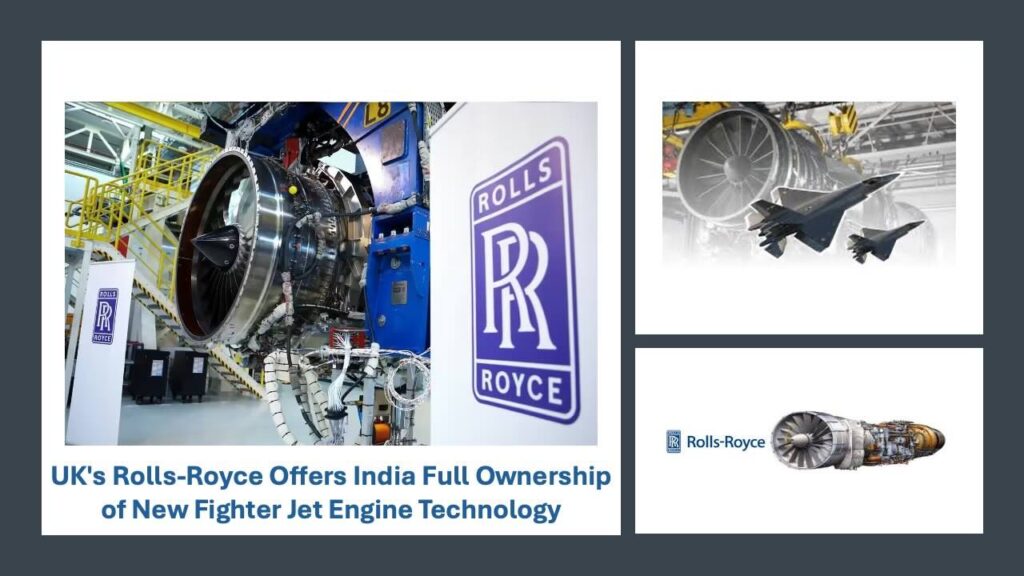
The image circulating with the latest proposal shows Rolls-Royce’s F130 turbofan engine, developed for the United States Air Force’s B-52 Stratofortress fleet.
The F130 programme demonstrates the company’s capability in high-thrust military engines and long-term sustainment contracts. Defence officials view this as evidence of Rolls-Royce’s ability to manage complex propulsion projects at scale.
Policy Framework and Self-Reliance Goals
The renewed competition reflects changes in India’s defence procurement policy under updated Defence Acquisition Procedure (DAP) guidelines. These reforms prioritise joint development, technology absorption, and intellectual property safeguards under the Atmanirbhar Bharat initiative.
Under this framework, foreign collaboration is encouraged when it leads to lasting domestic capability rather than long-term dependence.
Senior defence officials say the AMCA engine partnership will be evaluated not only on cost and timelines but also on the depth of knowledge transfer and industrial integration.
Strategic Stakes Ahead
With negotiations continuing, the choice of engine partner will shape India’s aerospace sector for decades. A successful programme could enable indigenous fighter production, strengthen export potential, and lay the foundation for future sixth-generation aircraft.
At the same time, historical challenges in implementing full technology transfer agreements remain a concern. Past defence deals have often fallen short in delivering unrestricted access to core technologies.
As India weighs competing proposals from Rolls-Royce, Safran, and others, policymakers face a strategic trade-off between speed, technological sovereignty, and long-term industrial capability.
The outcome will determine whether India can finally close one of the most critical gaps in its defence manufacturing ecosystem — the ability to design, build, and sustain world-class fighter jet engines independently.