India’s Fourth Arihant-Class SSBN Begins Sea Trials
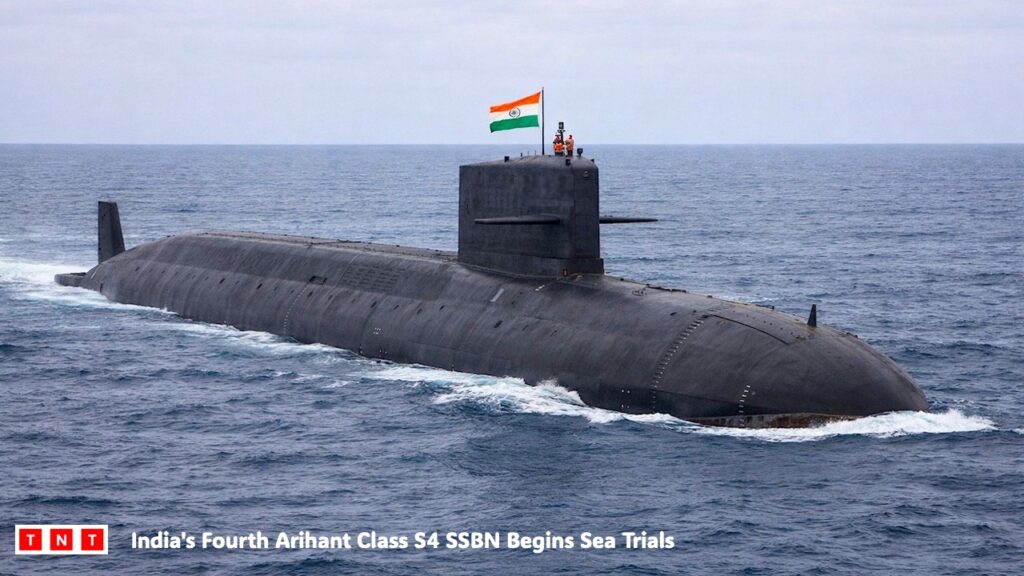
India’s Arihant-class SSBN programme reaches a pivotal stage as the fourth nuclear-powered ballistic missile submarine, codenamed S4, commenced sea trials from Visakhapatnam’s Ship Building Centre in late December 2025. Therefore, this development enables the Indian Navy to sustain continuous strengthened deterrence at-sea by late 2026. The boat features a stretched hull design that significantly enhances missile capacity over earlier vessels.
Reports confirm that sea trials validate propulsion systems, stealth features, and weapons integration ahead of commissioning in late 2026. In addition, the S4 submarine carries approximately 75% indigenous content, including an 83 MW pressurised light-water reactor. As a result, it achieves submerged speeds of 24-30 knots with a crew of around 100 personnel.
Arihant-Class Evolution from First to Fourth Boat
The Arihant-class SSBN series began with INS Arihant (S2/S73), launched in 2009 and commissioned on August 19, 2016. This lead boat displaced about 6,000 tonnes and accommodated 12 K-15 Sagarika SLBMs (750 km range) or four K-4 missiles (3,500 km). However, its compact design limited extended patrols, so it primarily validated India’s sea-based nuclear leg.
India commissioned the second boat, INS Arighaat (S3/S81), on August 29, 2024, with improved reactor reliability and 70% indigenous systems. Arighaat supports eight K-4 SLBMs and demonstrated operational maturity through submerged K-4 tests in November 2024 and December 2025 from the Bay of Bengal. Therefore, these firings confirmed medium-range nuclear strike capability from secure waters.
The third submarine, INS Aridhaman (S4), launched in November 2021, completed sea trials in late 2025 and awaits induction in early 2026. Like Arighaat, it fields eight K-4 missiles while refining endurance for prolonged submerged operations. In addition, these advancements address early Arihant limitations in reactor output and hull fatigue.
S4 Capabilities Mark Strategic Leap Forward
The fourth Arihant-class SSBN, S4, extends the hull to approximately 125 metres with a 10-metre plug, increasing displacement beyond 7,000 tonnes. Consequently, it is reported to house 8-24 K-4/K-6 SLBMs, torpedoes, and decoys in vertical launch tubes, far surpassing Arihant’s four-missile limit. Powered by enriched uranium fuel, the boat ensures stealthy patrols across the Indo-Pacific without surfacing for weeks.
Sea trials, which started around December 23-29, 2025, test full systems integration over the next year. As a result, successful validation positions S4 for service entry by early 2027, completing a four-boat fleet capable of two-boat patrols while others refit. This redundancy transforms India’s nuclear triad from symbolic to operationally credible.
How Fourth Arihant-Class SSBN Expands Indian Navy Reach
With S4 operational, the Indian Navy projects power from Indian Ocean bastions, targeting all of China and Pakistan using K-4’s 3,500 km range (or upcoming K-6’s 8,000 km range). Therefore, submarines avoid vulnerable chokepoints like the Malacca Strait or South China Sea edges. In addition, continuous deterrence aligns with India’s no-first-use policy, ensuring survivable second-strike against preemptive threats.
Earlier boats like Arihant required closer positioning for coverage, exposing them to anti-submarine warfare. However, the quartet enables rotation, maintenance cycles, and training without capability gaps. As a result, this fleet counters PLA Navy SSBN expansion while complementing Agni-series land ICBMs and air vectors.
Future S5 Class and K-6 SLBM Integration
Beyond Arihant-class completion, India advances the larger S5-class SSBNs at around 13,000 tonnes with 16 missile tubes. Construction of the lead S5 has begun at SBC Visakhapatnam. Therefore, these boats pair with K-5 (5,000-6,000 km) and K-6 SLBMs (8,000 km hypersonic MIRV), enabling strikes across Eurasia from central Indian Ocean patrols.
The K-6, nearing tests post-K-4 success, delivers intercontinental reach covertly, reshaping regional balance amid Chinese JL-3 deployments. In addition, six planned S5s promise fleet maturity by 2035. Thus, India’s SSBN programme solidifies strategic autonomy and minimum credible deterrence for decades ahead.