Ramjet Artillery Shell: How India Is Redefining the Future of 155 mm Firepower
India is on the threshold of a decisive shift in conventional artillery warfare with the development of a ramjet artillery shell for its 155 mm gun systems. The project, executed in collaboration with IIT Madras under the aegis of the Indian Army’s technology initiatives, aims to deliver the world’s first operationally deployed ramjet-powered tube artillery ammunition. If inducted as planned, it would significantly extend the reach of existing Indian artillery without requiring new gun platforms.
Unlike incremental improvements such as base-bleed or rocket-assisted projectiles, the ramjet artillery shell introduces sustained powered flight into a domain traditionally governed by ballistic physics alone. As a result, it promises a step-change rather than a marginal upgrade.
What Makes the Ramjet Artillery Shell Different
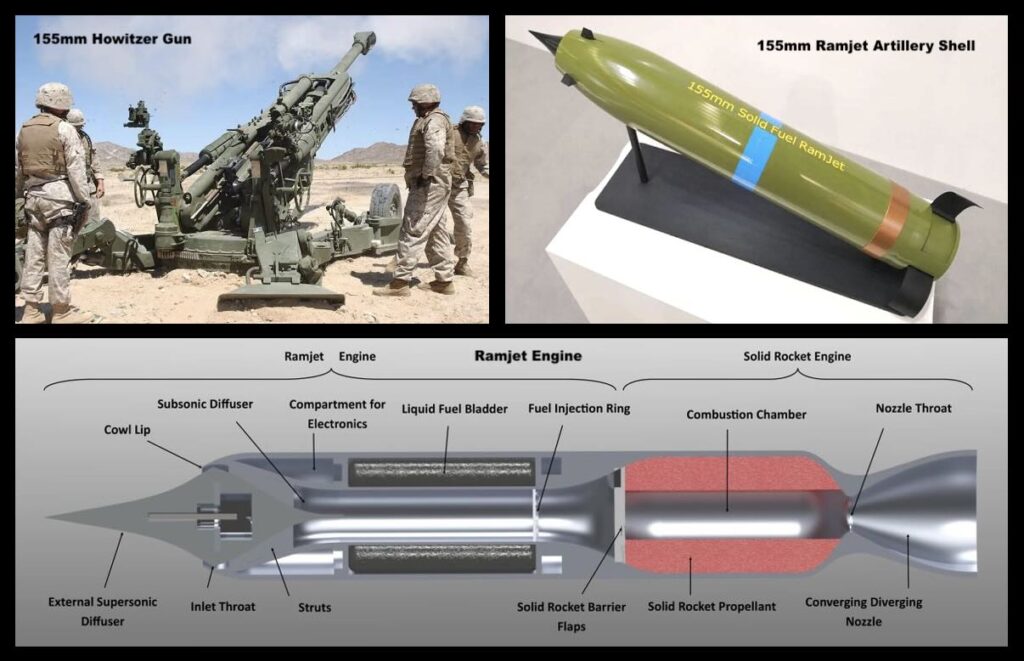
The defining feature of the ramjet artillery shell is its air-breathing propulsion system. After the shell is fired from a standard 155 mm howitzer and reaches supersonic speed, the ramjet engine activates. It draws in atmospheric air, compresses it through forward motion, and burns solid fuel to generate continuous thrust during flight.
This approach differs fundamentally from rocket-assisted shells, which rely on a brief boost phase. In contrast, the ramjet sustains velocity over a longer portion of the trajectory. Therefore, it increases range while preserving a full-sized, lethal warhead. This balance between reach and payload is what gives the system its strategic relevance.
Range Expansion Without New Guns
Indian assessments indicate a 30 to 50% increase in range over existing extended-range 155 mm ammunition. Importantly, the ramjet artillery shell is being designed as a retrofit solution, allowing compatibility with guns already in Indian Army service.
These include the M777 ultra-light howitzer, Dhanush, K9 Vajra, upgraded Bofors FH-77 variants, and the indigenous ATAGS. Consequently, the Army can extract substantially higher performance from its current artillery inventory without embarking on an entirely new procurement cycle.
Testing Status and Developmental Progress
Successful developmental tests of the ramjet artillery shell at the Pokhran Field Firing Ranges have been reported as part of the ongoing trials through late 2025. These trials focused on validating ignition reliability, aerodynamic stability, and structural survivability under extreme launch stresses. Artillery projectiles experience acceleration forces exceeding tens of thousands of g, making propulsion integration particularly challenging.
According to project disclosures, the current phase involves refinement of propulsion efficiency, thermal management, and fire-control integration. Induction timelines being discussed within defence circles place initial operational deployment in the 2026-27 timeframe, subject to successful user trials.
Why Ramjet Artillery Matters on the Battlefield
Extended-range tube artillery has direct tactical and operational consequences. Deeper reach allows gun batteries to operate from safer stand-off distances, complicating enemy counter-battery fire and drone-assisted targeting. This is especially relevant in high-altitude sectors where mobility and survivability are critical.
Moreover, by pushing conventional artillery into ranges traditionally associated with tactical missiles, the ramjet artillery shell blurs the boundary between guns and missiles. It offers commanders a more economical option for long-range interdiction while retaining the high rates of fire inherent to artillery systems.
How the Ramjet Artillery Shell Changes Range Benchmarks
At present, the Indian Army’s M777 155 mm/39-calibre howitzers achieve about 24–30 km with standard high-explosive ammunition, extending to roughly 40 km with precision-guided or extended-range shells. Indigenous Indian systems in the 155 mm/52-calibre class, such as ATAGS, Dhanush, and K9 Vajra, routinely reach 45–48 km using extended-range base-bleed ammunition.
The ramjet artillery shell is designed to lift these limits substantially. For the M777, the shorter barrel constrains initial velocity, yet ramjet assistance is expected to push effective ranges into the 60–70 km class. For longer-barrel Indian 155/52 systems, higher muzzle velocity allows more efficient ramjet ignition and sustained thrust, placing projected ranges in the 80–100 km bracket under developmental configurations. These gains move conventional tube artillery into a reach band previously associated with tactical missiles, without requiring new gun platforms.
Global Context: India Versus Western Programmes
Several advanced militaries are experimenting with ramjet-powered artillery projectiles. Norway’s Nammo, in partnership with Western defence firms, has demonstrated a 155 mm ramjet shell with extremely long-range potential. However, these programmes remain in advanced testing or demonstrator stages.
What distinguishes the Indian effort is its focus on near-term operational deployment rather than technology demonstration alone. If India succeeds, it would become the first country to field ramjet artillery as a regular inventory item rather than a limited experimental capability.
Technical Challenges Still Ahead
Despite promising progress, the ramjet artillery shell faces complex engineering hurdles. Ensuring consistent ramjet ignition after gun launch shock, maintaining stable airflow in a spinning projectile, and managing intense thermal loads are all non-trivial tasks. Additionally, artillery fire-control systems must be updated with new ballistic models to account for powered flight.
Nevertheless, these challenges are being addressed within a controlled development framework that leverages academic expertise and military user feedback in parallel.
Strategic and Industrial Significance
Beyond battlefield performance, the ramjet artillery shell aligns squarely with India’s Atmanirbhar defence manufacturing strategy. Indigenous design, coupled with retrofit compatibility, reduces long-term dependence on imported advanced ammunition. Over time, it could also open an export niche for cost-effective long-range artillery solutions.
In strategic terms, the project signals India’s intent to leapfrog legacy artillery limitations rather than merely match existing global benchmarks. If successfully inducted, the ramjet artillery shell will stand as one of the most consequential advances in tube artillery since the adoption of extended-range and precision-guided munitions.