Sports Recap 2025: Global Battles, Indian Breakthroughs and a Year of Transition
The year 2025 will be remembered as a transitional year in global sport. It was not defined by one single mega-event, but by a series of decisive shifts. Long-standing champions were challenged, generational legends edged closer to farewell, women’s sport expanded its global footprint, and emerging nations — including India — asserted themselves with greater confidence.
The Sports Recap 2025 is therefore not about isolated highlights. It is about how sport across disciplines evolved, how power structures shifted, and how India increasingly featured as more than a peripheral spectator.
Global Cricket: Titles, Transitions and Tactical Evolution
Cricket in 2025 reinforced its multi-format complexity.
India’s victory in the ICC Champions Trophy 2025 re-asserted their depth across white-ball cricket. Unlike past triumphs driven by individual brilliance, this campaign reflected squad balance, adaptability, and mental resilience.
The most emotionally charged global cricketing moment, however, belonged to South Africa. Their ICC World Test Championship win at Lord’s, defeating Australia, ended decades of psychological burden. The victory altered how South African cricket is viewed globally — from perennial underachievers to legitimate champions.
Bilateral series across the year underlined a broader trend. Test cricket became more result-oriented. Tactical aggression increased. Teams like England, New Zealand, and India pushed tempo rather than tradition.
Indian Cricket: Men, Women and Bilateral Dominance
Indian cricket’s 2025 story extended well beyond ICC trophies.
The Indian men’s team maintained dominance in bilateral series across formats, both home and away. Young batters adapted to pace and spin conditions, while fast bowlers delivered consistency overseas — a long-standing weakness finally addressed.
More significantly, Indian women’s cricket reached a new level.
India’s performance at the Women’s World Cup marked a watershed moment. Tactical maturity, fielding standards, and depth beyond senior stars signalled that Indian women’s cricket had moved from promise to performance. Bilateral series victories against top teams reinforced this shift.
Women’s cricket in India in 2025 was no longer inspirational alone. It was competitive.
India clinched the Asia Cup in Dubai after defeating Pakistan, and the Indian U-19 girls were crowned ICC U-19 Women World Champions in Kuala Lumpur.
Football: Club Power, National Anticipation and Structural Change
Football in 2025 unfolded on multiple layers.
At club level, Paris Saint-Germain’s UEFA Champions League triumph finally justified years of ambition. Their victory symbolised a changing European hierarchy where financial power alone no longer guaranteed success, but strategic balance could deliver results.
Domestic leagues across Europe became increasingly competitive. Traditional giants remained influential, yet mid-table and emerging clubs challenged established dominance. Tactical diversity flourished.
Internationally, the FIFA World Cup 2026 draw dominated headlines. The expanded format and North American hosting reshaped expectations. More nations sensed opportunity. Fans sensed unpredictability.
FIFA introduced the award in 2025 as the FIFA Peace Prize – Football Unites the World, intended to recognise individuals whom it says have taken “exceptional and extraordinary actions for peace and unity.” Trump received the inaugural prize during the 2026 FIFA World Cup final draw ceremony in Washington, D.C. 2025 IFA Peace Prize was awarded to U.S. President Donald Trump, making him the first recipient of the honour.
For legends such as Ronaldo, Messi, Modrić, and Neymar, 2025 served as a prelude to final chapters rather than closure.
Indian Football: Progress Without Illusion
Indian football did not produce miracles in 2025, but it produced incremental realism.
The national team remained competitive regionally without breaking continental ceilings. The ISL continued to grow in visibility, though structural weaknesses persisted.
Importantly, grassroots conversations shifted from hype to reform. Youth development, coaching quality, and league integration became central themes. Progress remained slow, but the discourse matured.
Tennis: Generational Change Accelerates
Men’s tennis in 2025 conclusively confirmed the post-Big Three era. Jannik Sinner captured the Australian Open and Wimbledon, while Carlos Alcaraz lifted the French Open and US Open. Their dominance was built on consistency, physical durability, and tactical intelligence rather than sporadic brilliance, signalling a stable generational shift at the top of the men’s game.
The women’s circuit continued to reflect competitive depth and volatility. Madison Keys won the Australian Open, Coco Gauff claimed the French Open, Iga Świątek triumphed at Wimbledon, and Aryna Sabalenka secured the US Open. Success depended less on reputation and more on adaptability across surfaces and conditions.
Across all four Grand Slams, no single figure monopolised the season. Instead, rivalry, balance, and sustained elite competition defined tennis in 2025, marking the sport’s full transition into a genuinely open era.
Motorsport: Formula One in 2025
Formula One in 2025 was led once again by Max Verstappen and Red Bull Racing, who continued their dominance of the championship. Red Bull’s consistency across circuits ensured Verstappen remained the reference point of the season.
Behind them, Ferrari and Mercedes remained competitive without displacing Red Bull at the top, while McLarenemerged as a regular podium contender. Several younger drivers, including Lando Norris and Oscar Piastri, delivered breakthrough performances, signalling a gradual generational shift within the grid.
Overall, the 2025 Formula One season confirmed stability at the top and increasing competition behind it, rather than a fundamental reshaping of the sport.
Athletics: Records and Established Leaders
Athletics in 2025 was defined by clear dominance at the top.
Armand “Mondo” Duplantis remained the sport’s standout figure, winning major international pole vault titles and extending his hold as the world’s leading vaulter. He continued competing at heights unmatched by the rest of the field, reinforcing his status as the event’s benchmark athlete.
For India, Neeraj Chopra’s throw beyond the 90-metre mark remained the defining athletics moment of the year. The achievement placed him firmly among the elite javelin throwers globally and confirmed that his Olympic and world-level success was not isolated but sustained. Indian athletics, through Chopra, retained a regular presence at the top level of international competition.
Olympic Sports and India’s Multi-Discipline Results
India’s progress across Olympic disciplines in 2025 was visible through results rather than rhetoric.
Indian athletes secured podium finishes across badminton, wrestling, boxing, shooting, and archery at major international tournaments, including World Cups, Asian Championships, and elite invitational events. These results were spread across both individual and team formats, indicating broader competitive depth.
Women athletes contributed significantly to this performance. Indian boxers and shooters featured regularly in medal rounds at international competitions, while badminton and wrestling continued to deliver consistent results through established and emerging names.
The outcomes did not indicate dominance, but they confirmed sustained competitiveness across multiple Olympic sports.
Women’s Sport: Results Driving Attention
Women’s sport in 2025 expanded primarily because of results, not promotion.
Globally, women’s football and cricket continued to draw strong viewership during major tournaments, while athletics maintained parity in competitive standards between men’s and women’s events.
For India, women athletes were central to the year’s most credible international performances. The Indian women’s cricket team’s campaign at the ICC World Cup, along with consistent results in bilateral series, reinforced their position among the leading sides. In Olympic sports, women competitors delivered a substantial share of India’s podium finishes.
By the end of the year, women’s sport in India was no longer treated as supplementary. Expectations were performance-based.
Team Achievements – India in 2025
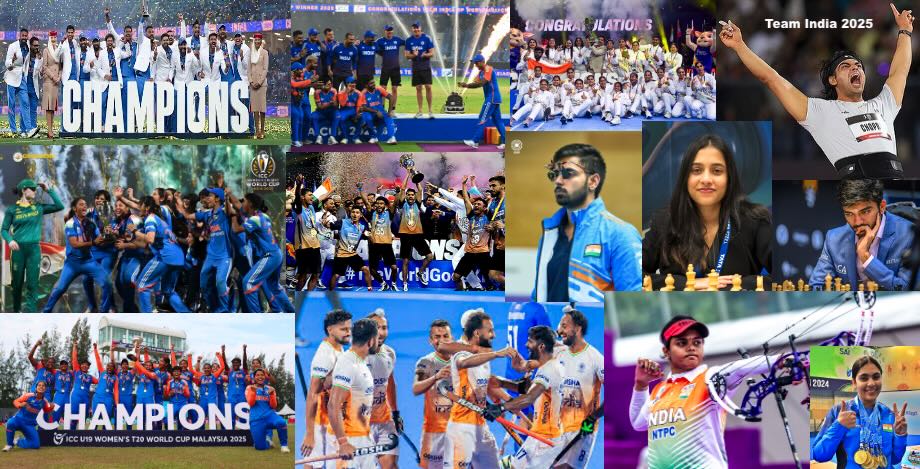
India recorded a landmark year in team sports, securing historic titles across cricket, hockey, kho kho, and delivering strong performances at major multi-sport events.
Cricket (Men’s Team)
ICC Champions Trophy 2025: Winners (third title overall), defeating New Zealand in the final in Dubai; completed an undefeated campaign under Rohit Sharma.
Asia Cup T20: Winners (ninth title), defeating Pakistan in the final.
Cricket (Women’s Team)
ICC Women’s ODI World Cup 2025: Winners (first-ever title), defeating South Africa in the final under Harmanpreet Kaur.
Field Hockey (Men’s Team)
Hockey Asia Cup: Winners after an eight-year gap, defeating South Korea in the final; qualified for the 2026 Hockey World Cup.
Kho Kho
Kho Kho World Cup (Inaugural Edition): India completed a clean sweep, winning both titles.
Men’s Team: Champions
Women’s Team: Champions
Multi-Sport Events
World Games, Chengdu: 3 medals (1 silver, 2 bronze) – best-ever haul.
Asian Youth Games: 48 medals (13 gold, 18 silver, 17 bronze) – best performance to date.
Asian Youth Para Games: 2nd overall, with 102 medals including 36 gold.
Individual Achievements – India in 2025
Indian athletes delivered standout performances across athletics, shooting, chess, archery, and para-sports.
Athletics
Neeraj Chopra: Breached the 90-metre mark (90.23m at the Doha Diamond League); continued elite-level dominance in javelin.
Shooting
Samrat Rana: World Champion in men’s 10m air pistol; also contributed to team and mixed-team medals at the ISSF World Championships. India recorded multiple podium finishes across ISSF World Cups and Finals.
Chess
Divya Deshmukh: Winner of the FIDE Women’s World Cup; became the first Indian woman to achieve this feat and earned the Grandmaster title directly.
- Gukesh: Continued strong performances following the 2024 World Championship cycle; awarded the Major Dhyan Chand Khel Ratna.
Archery
Jyothi Surekha Vennam: Bronze medal at the World Cup Finals, becoming the first Indian woman to medal at this level in compound archery.
Para-Athletics
World Para Athletics Championships (Hosted in India):
India’s best-ever tally with 22 medals (6 gold, 9 silver, 7 bronze).
Standout performances included Sumit Antil and other leading para-athletes.
Other Notable Performances
World Games:
- Namrata Batra – Silver (Wushu Sanda)
- Rishabh Yadav – Bronze (Compound Archery)
- Anandkumar Velkumar – Bronze (Roller Sports)
What 2025 Ultimately Represented
Sports Recap 2025 reflects a year defined by outcomes rather than spectacle.
It closed long-standing gaps, confirmed new leaders, and reinforced India’s presence across multiple sports without exaggeration. The year did not mark an endpoint. It clarified where global sport stands and where India realistically fits within it.
As 2026 approaches, the foundations are visible. The test will be whether consistency follows momentum.