R-37M Deal: World’s Fastest AAM at 7400 KMPH Boosts IAF Su-30MKI
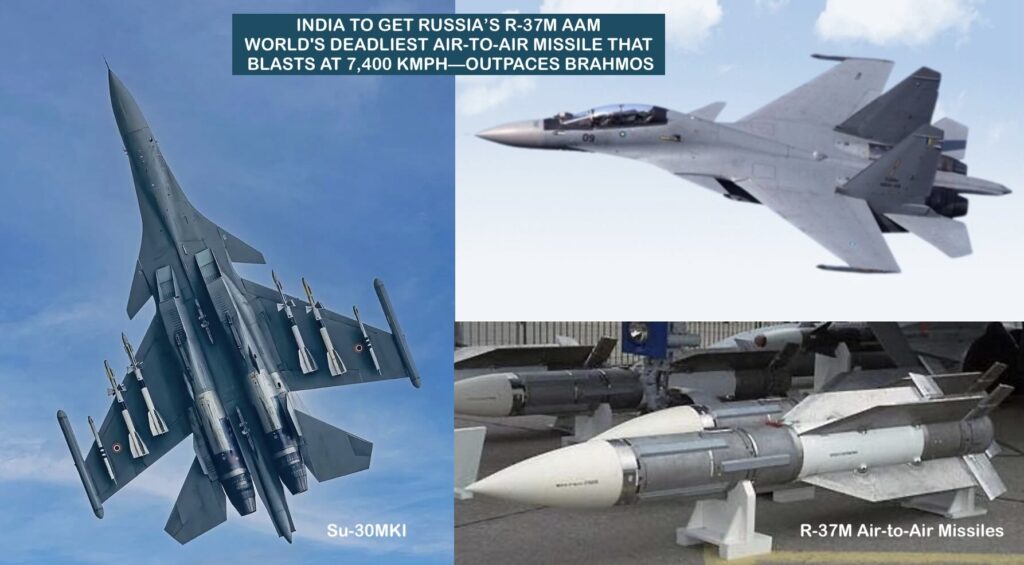
India advances towards a major deal with Russia for over 300+ R-37M AAM (air-to-air missiles). This hypersonic weapon, dubbed the world’s deadliest AAM, reaches speeds of 7,400 kmph in its terminal phase. Therefore, it equips Su-30MKI fighters with enhanced beyond-visual-range (BVR) capability. In addition, the integration aims to counter China’s PL-15 and strengthen IAF air-combat capability. Deliveries are expected to begin within 12–18 months as a bridge to indigenous Astra Mk3.
The R-37M AAM, also known as AA-13 Axehead, features an active radar seeker and inertial guidance. It can engage targets at 300–400 km, including AWACS aircraft, tankers, and other high-value aerial assets. As a result, Su-30MKI pilots gain the ability to target strategic platforms at extended distances. Russia has also indicated willingness for local production discussions, further strengthening Indo-Russian defence cooperation.
R-37M Missile Key Specifications
The R-37M AAM achieves Mach 6 speeds, making it one of the fastest operational air-to-air missiles. Its high-explosive fragmentation warhead is designed for large aerial targets. Therefore, the Su-30MKI’s radar and fire-control systems would require only limited integration modifications.
Russian Su-35S and Su-30SM aircraft already deploy the missile operationally. India is evaluating similar capabilities against potential aerial threats. As a result, IAF simulations increasingly focus on networked BVR engagement tactics.
Speed and Range Advantages with R-37M AAM
R-37M uses a solid-fuel propulsion system that allows sustained high-speed flight. Its combination of range, manoeuvrability, and terminal speed increases interception probability against fast-moving targets.
Long-range air combat increasingly prioritises detecting and neutralising support assets such as airborne radar aircraft and tankers. Therefore, weapons like R-37M are designed to shift engagement ranges further away from frontline fighters.
BrahMos Comparison: Roles Differ Sharply
Comparisons between R-37M and BrahMos should be viewed in the context of different missions. BrahMos is a cruise missile designed for land and anti-ship strikes, while R-37M serves an air-to-air role.
BrahMos operates at approximately Mach 3 with extended strike range, while R-37M focuses on rapid interception of airborne targets. Therefore, the two systems complement rather than replace each other.
Performance Insights of R-37M AAM
R-37M performs most effectively during high-altitude interceptions where long-range radar tracking and missile energy retention are maximised. BrahMos, in contrast, remains optimised for precision surface attack missions.
Therefore, combining multiple missile categories expands overall combat flexibility.
IAF Su-30MKI Integration Plans
The Su-30MKI fleet is expected to receive phased upgrades. Russia would supply missiles while Indian agencies manage software integration and mission-system adjustments. Future upgrades may also integrate newer radar systems.
The reported package includes more than 300 missiles initially. Discussions on local assembly under the Make in India initiative could reduce long-term dependence on imports.
Operational Tactics Shift
Long-range engagement capability would allow pilots to employ “shoot-and-forget” tactics at extended stand-off distances. Airborne warning and control systems could provide targeting information for coordinated missile launches.
Electronic counter-countermeasure upgrades would also remain critical for maintaining missile effectiveness in contested environments.
Strategic Edge Against Regional Rivals
The acquisition is viewed as part of India’s broader effort to maintain technological parity in regional air warfare. China and Pakistan continue to expand their long-range missile inventories and networked combat systems.
Additional long-range missiles could enhance the survivability of support aircraft while expanding operational flexibility along sensitive sectors.
Countering PL-15 Capability
The Chinese PL-15 missile is estimated to possess long-range engagement capability. R-37M’s combination of speed and reach is intended to provide a response within that evolving competitive environment.
Future indigenous programmes, including Astra Mk3, are expected to provide a long-term domestic alternative.
Deal Timeline and Indigenisation Push
Negotiations are reportedly continuing, though final contract details remain subject to approval. Initial deliveries could be followed by greater local participation in manufacturing and subsystem integration.
Technology partnerships and industrial participation may support India’s wider defence manufacturing ecosystem.
Production and Export Potential
Any future domestic production arrangement could strengthen India’s missile manufacturing base and support further research into advanced air-to-air systems.
The R-37M programme, if finalised, would represent another step in strengthening long-range aerial combat capability while balancing immediate operational needs with long-term indigenous development.