India GDP Growth 2025 Hits 8.2% in Q2 FY26, Powered by Manufacturing and Strong Government CAPEX
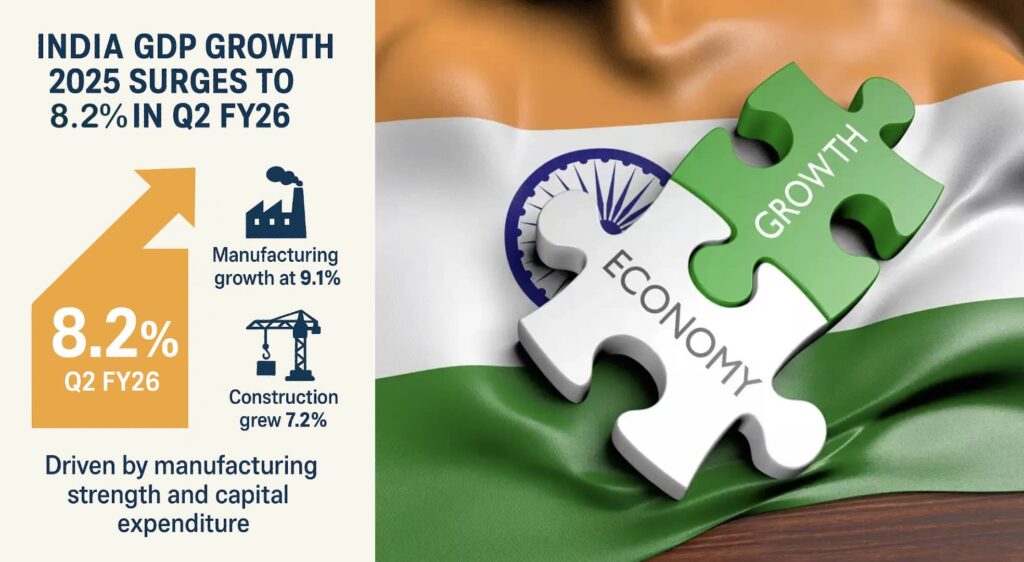
India GDP growth 2025 registered a robust 8.2% expansion in the second quarter of FY26, marking the fastest pace in six quarters and reaffirming the economy’s resilience amid a challenging global environment. The impressive rise reflects strong manufacturing performance, steady construction activity, and elevated government capital expenditure. The results stand out at a time when global growth patterns remain uneven and many economies continue to grapple with policy uncertainty and trade disruptions.
India’s Q2 FY26 Performance
Manufacturing Momentum Leads the Upswing
Manufacturing output surged by 9.1% year-on-year, delivering the sector’s strongest showing in recent quarters. Improved capacity utilisation, policy reforms encouraging domestic production, and stable demand conditions contributed to the expansion. India’s industrial recovery continues to benefit from targeted incentives under programmes such as Make in India, which have supported investment across electronics, automotive, and capital goods.
Construction Growth Sustains Infrastructure Push
Construction activity grew 7.2% during the quarter. Large-scale infrastructure projects in transport, housing, and logistics contributed to steady demand for steel, cement, and other core materials. The government’s consistent focus on capital expenditure has strengthened multiplier effects, creating jobs and stimulating allied industries. Analysts note that construction remains one of the anchors of India’s post-pandemic economic resurgence.
Role of Government Expenditure and Policy Support
Government capital expenditure increased meaningfully, reinforcing India’s investment-led growth strategy. Higher allocations to national highway development, railway modernisation, defence manufacturing, and renewable energy corridors have supported both demand and productivity improvements. In addition, targeted credit schemes and production-linked incentives have helped mitigate pressures arising from external uncertainties, including trade-related disruptions.
Economic observers highlight that India’s growth is becoming more broad-based, with investment and manufacturing sharing the lead previously held primarily by consumption.
External Environment and Softened Global Context
Uneven International Trends Without Firm Numbers
While several major global economies have shown signs of recovery, their growth patterns remain mixed. Official, harmonised, and finalised data for many countries for the same period is either not available publicly or varies across preliminary estimates. However, broad indications suggest that many advanced economies are experiencing moderate or slow-paced expansions, reflecting inflation pressures, monetary tightening, and subdued investment cycles.
India’s performance, therefore, is notable not because of precise comparative figures but because it demonstrates resilience at a time when global conditions remain volatile. Economists observe that India continues to draw strength from its domestic drivers rather than relying solely on external demand.
Trade Headwinds and Policy Realignment
India’s export-sensitive sectors faced challenges due to shifting global trade dynamics, including tariff measures introduced by the Trump administration in the United States. Despite these pressures, domestic demand, manufacturing output, and government spending contributed to India’s ability to maintain a strong growth trajectory. This highlights the increasing importance of internal stabilisers within the Indian economy.
Domestic Drivers Strengthening India’s Economic Position
Investments, Consumption, and Reforms
Investment activity has strengthened, driven by both government spending and selective private-sector expansion. Consumption patterns remain stable, supported by urban demand and early signs of rural recovery. Structural reforms in taxation, labour, logistics, and financial markets continue to improve the operating environment for businesses.
Sectoral Diversification as a Growth Engine
India’s growth is no longer dependent on a single sector. Manufacturing, construction, services, and public administration have all played meaningful roles in shaping the 8.2% expansion. This diversified base enhances India’s ability to absorb external shocks and maintain steady momentum.
Final Analysis
India GDP growth 2025 at 8.2% in Q2 FY26 confirms the country’s strengthening economic footing at a time of international uncertainty. Verified data highlights the importance of manufacturing, construction, and sustained government capital expenditure in driving this performance. Although global conditions remain soft and external benchmarks lack consistent public verification, India’s domestic economic engines continue to operate with resilience and purpose. The result positions India as one of the more stable and growth-oriented economies entering the next fiscal cycle.