Libya Re-Enters Global Energy Markets with 2025 Oil Exploration Auction
Tripoli Revives Oil Exploration with First Auction in 18 Years
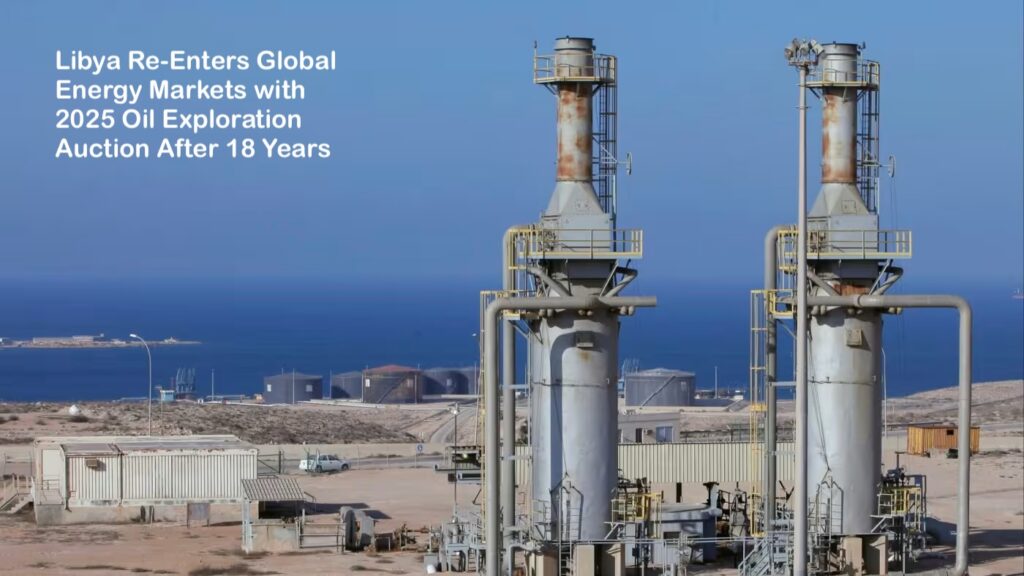
Libya’s much-anticipated oil exploration auction for 2025 marks its formal return to the global energy stage after nearly two decades. The Tripoli government launched the country’s first offshore and onshore licensing round in 18 years, offering 22 blocks—11 offshore and 11 onshore—spread across prolific basins such as Sirte and Ghadames. These regions contain proven reserves estimated in the billions of barrels. As a result, major energy companies including Eni, TotalEnergies, Shell, Chevron, and ExxonMobil have pre-qualified, signalling a surge of international confidence in Libya’s re-emerging oil sector.
The renewed focus follows years of political fragmentation, stalled investment, and chronic underdevelopment of key reservoirs. However, 2025 has seen a convergence of political stability, improved fiscal terms, and a strategic resolve to restore Libya’s long-term production capacity. Therefore, the new auction stands at the centre of Libya’s economic revival and its ambition to reclaim a significant place in global oil markets.
A 2025 Process Reaching Maturity as Bidding Nears Final Stages
Although the initial announcement of the bid round occurred in early 2025, the story resurfaced prominently in November due to the auction entering its final stages. With plans to close the licensing round in early 2026, the process has become more concrete. Developments such as ExxonMobil’s new offshore gas exploration agreement, feasibility studies, and fresh memoranda of understanding signed by BP and Shell to redevelop old oilfields illustrate the practical momentum behind Libya’s energy sector revival.
Tripoli has also introduced more attractive fiscal incentives and production-sharing arrangements to lure investment. These mechanisms aim to unlock over $10 billion in suspended projects that stalled during years of instability. As a result, Libya is now positioned to transition from stalled ambitions to tangible upstream activity.
Strong International Participation Signals Renewed Stability
Several factors explain why the auction has returned to international headlines. First, Libya’s National Oil Corporation (NOC) is finalising the licensing framework, with more than 40 companies pre-qualified—a remarkable shift after years of low participation. This milestone serves as a testament to growing business confidence, despite continued factional divides and the risk of rival auctions being announced by eastern administrations.
In addition, the Tripoli government is keen to demonstrate improved governance and regulatory clarity. Therefore, the strong international presence reflects both geological promise and a cautiously improving political climate. The 2025 round is widely interpreted as a test of Libya’s capability to manage large-scale foreign investment under fragile national conditions.
Production Targets and Global Supply Dynamics
Libya aims to increase its oil output by approximately 20 per cent, targeting 1.6 million barrels per day by the end of 2026. This ambition is essential for national revenue and equally important for global oil supply stability, especially at a time of tightening markets and rising geopolitical tensions.
Industry analysts argue that Libya’s vast yet underdeveloped resources remain crucial for supply diversification. The new auction, therefore, holds implications beyond national boundaries. Increased Libyan output could help moderate price volatility and reduce pressure on major producers already balancing multiple geopolitical risks.
New Discoveries Reinforce Geological Potential
Recent announcements of significant onshore oil discoveries have strengthened optimism around Libya’s upstream prospects. These finds reaffirm the country’s immense untapped potential and provide international companies with substantial incentives to expand exploration. In addition, improved regulatory stability and the presence of global majors contribute to building a more dependable investment ecosystem.
Consequently, Libya’s renewed exploration push is not merely a symbolic reopening but a substantive step forward backed by geology, policy reforms, and market demand.
Conclusion
The resurgence of Libya’s 2025 oil exploration auction reflects a maturing licensing process, stronger investor appetite, and a strategic push to boost output amid shifting global energy dynamics. Although challenges persist, Tripoli’s efforts have brought Libya back into the centre of regional and global energy discussions. With major companies engaged, improved fiscal terms, and new discoveries emerging, Libya is positioned to play a more influential role in stabilising regional supply and contributing to global oil markets in the years ahead.