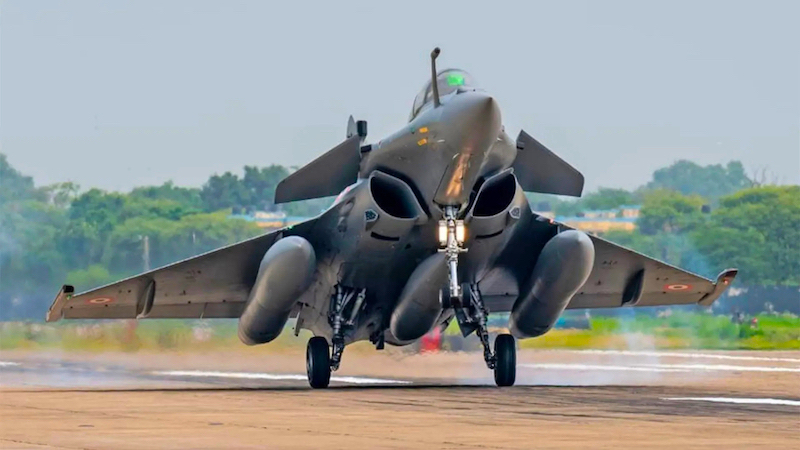
Rafale-Meteor Integration: Facts, Delay and the Story Behind India’s Airpower Gap
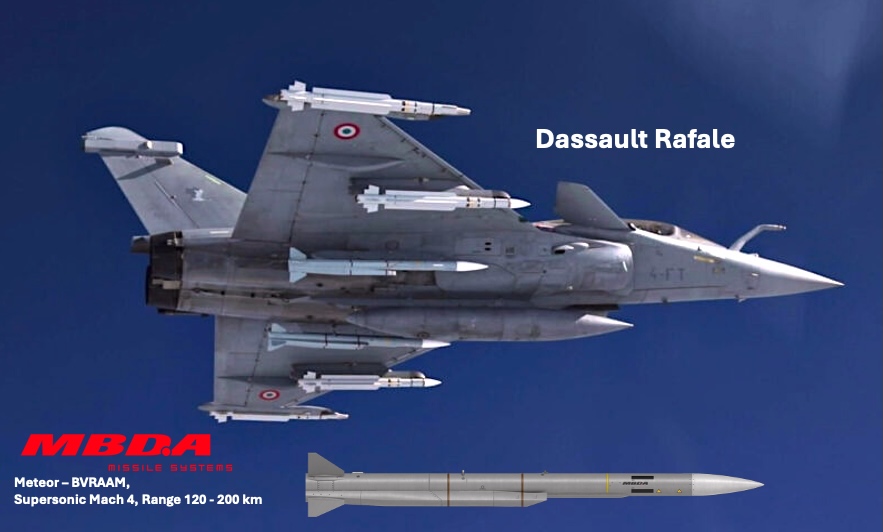
The debate around Rafale-Meteor Integration has returned to the centre of India’s defence conversation, fuelled by a mix of verified developments, unconfirmed reports, and persistent speculation surrounding the Indian Air Force’s (IAF) use—or perceived underuse—of its most advanced beyond-visual-range weapon. The Meteor missile, famed for its 150+ km class engagement range and lethal 60 km no-escape zone, was meant to cement India’s air dominance. Instead, the delay in its operational deployment created a narrative of missed opportunity, especially during tense cross-border episodes in May 2025.
As the dust settles, it becomes essential to examine what was confirmed, what remains unverified, and how India is now moving to bridge the gap.
The Meteor Promise and the Rafale Edge
When India signed the 2016 inter-governmental agreement with France for 36 Rafale fighters, the Meteor was advertised as the crown jewel of the weapons package. Its ramjet propulsion and sustained kinetic energy were meant to outclass adversary missiles such as Pakistan’s AIM-120C and China’s PL-15.
In theory, India secured one of the most decisive BVR advantages in the region. Yet, in practice, several issues—both confirmed and speculative—would cloud this advantage over the next decade.
Where the Facts End and Speculation Begins
The most persistent claim has been that India received Meteor missiles but struggled for years to fully integrate them onto its Rafale fleet. Some reports alleged that the Rafales flew “blind” in long-range engagements and depended primarily on the shorter-range MICA missile (60-80 km range).
However, verified information paints a more balanced picture.
Confirmed realities:
- The Rafale was always designed for Meteor use.
- India received the missiles as part of the original weapons package.
- Both Rafale jets and Meteor missiles were delivered in roughly the same 2020–2021 window.
- India-specific enhancements on the Rafale required additional software work.
- Meteor integration did take longer than expected, though no official timeline was ever published.
Speculative/unverified claims:
- That “no Rafale squadron” was Meteor-ready until 2025.
- That India deliberately skipped full Meteor rollout due to offset complications.
- That Rafales could not load Meteors during the May 2025 standoff because the system was uncertified.
- That 3 Indian Rafale fighter jets were lost during Operation Sindoor due to the absence of Meteor cover.
These claims circulate widely on defence forums and social media but remain unverified by the IAF or the Ministry of Defence. Therefore, they must be treated strictly as “speculations” or “propaganda” rather than established fact.
The 2025 Flashpoint: Combat Tension and Narrative Confusion
Much of the “goof-up” story surrounding Rafale-Meteor Integration stems from the brief but intense India–Pakistan flare-up in May 2025-India’s ‘Operation Sindoor‘. India conducted precision strikes in Pakistan-occupied territory following a terror attack, while Pakistan claimed long-range engagements using its PL-15-equipped J-10C fighters.
A swirl of claims emerged online suggesting that Indian Rafales were flying without Meteors during these missions. Analysts pointed to open-source images of Rafales armed with SCALP cruise missiles and MICA EM missiles—standard load outs for air-to-ground missions.
This is where fact and speculation diverge sharply:
– It is true that Rafales flying strike missions typically carry SCALP or HAMMER weapons, not Meteors.
– It is unconfirmed that Rafales were unable to mount Meteors at the time.
– It is speculative to assert that the absence of Meteor caused operational setbacks.
No official after-action report has stated that Meteor integration was the reason for any tactical limitation. The louder claims exist mainly in analyst commentary and online discussions, not in verified defence documentation.
India’s use of SCALP and MICA EM during the May 2025 Operation Sindoor confirms that these weapons were fully integrated on the upgraded Indian Rafale by that time. Given that MICA, SCALP, and Meteor all originate from the same European missile consortium, MBDA, it is logically possible that Meteor integration had also been completed around the same period as the MICA and SCALP validations.
India’s Bigger Picture: Technical Complexity Slowed the Rollout
The slow rollout of the Meteor missile on India’s Rafales was never about a procurement lapse—it was about engineering reality. India did not buy the standard French Rafale; it ordered a uniquely customised upgraded variant fitted with an extensive suite of India-Specific Enhancements (ISEs). These enhancements included Israeli helmet-mounted displays, indigenous secure communication systems, customised electronic warfare packages, mission-computer changes, and datalink adaptations that do not exist on any other Rafale fleet in the world.
Although the Meteor was already fully integrated on the French Rafale, the missile had to be revalidated on the IndianRafale because the avionics, EW environment, and software architecture were fundamentally different. In practical terms, the IAF’s Rafale became a new sub-type requiring fresh weapon-systems integration. As a result, MBDA and Dassault had to re-run captive-carry flights, radar-fusion checks, mid-course guidance validation, and datalink testing specifically for India’s configuration.
Compounding this, the complete ISE standard was delivered only with the final aircraft in 2022, meaning Meteor integration could not be finalised earlier. Earlier COVID-19 disruptions, restricted test-team mobility, and parallel priorities of IAF such as SCALP and HAMMER operationalisation further stretched the timeline. What emerged was an integration process that naturally spilled into 2023–2025.
Seen through this lens, the delay was not exceptional. Customised combat jets routinely undergo multi-year integration cycles for advanced weapons; even European air forces have taken years to certify new missiles on upgraded Rafale and Eurofighter variants. The Indian case followed that same pattern. The real story, therefore, is not scandal, oversight or “goof-up”—it is the predictable complexity of marrying a highly customised fighter with one of the world’s most advanced air-to-air missiles.
Verification of the Latest Procurement: A Confirmed Development
Unlike earlier claims, one new development is firmly grounded in verified reporting. As of November 2025, India is planning a ₹1,500-crore acquisition of additional Meteor missiles, valued at around €165–170 million. This new order, expected to include 400–500 missiles, aligns with India’s effort to replenish stockpiles and prepare for future Rafale variants, including the upcoming Rafale-M for naval operations. In April 2025, India signed a deal with France to acquire 26 Rafale-M (naval variant) jets for the Indian Navy.
According to reports circulating in October–November 2025:
– The proposal has been fast-tracked under emergency procurement powers.
– The Defence Acquisition Council (DAC) approval is anticipated by late 2025 or early 2026.
– Deliveries may commence within a 24–36 month window.
– The Meteor will remain exclusive to the Rafale in India, as MBDA has declined integration on Su-30MKI and Tejas variants.
This is the only part of the broader Meteor narrative that stands on clearly verified ground and fits naturally into India’s long-term BVR roadmap that includes the indigenous Astra Mk2.
Astra Mk2: The Parallel Track of Indian Self-Reliance
India is not putting all its long-range air combat hopes on the Meteor. The DRDO’s Astra Mk2 programme is progressing through trials and is expected to complement the Meteor by 2026.
This dual-track approach—import to meet immediate needs, and indigenous development for sustainability—brings India closer to its Aatmanirbhar Bharat objectives.
The Road Ahead: From Controversy to Capability
The debate around Rafale-Meteor Integration highlights a persistent challenge in India’s defence ecosystem: large purchases often move faster than the integration cycles they depend on. The result is a capability that exists on paper before reaching its full combat potential.
Yet India’s renewed Meteor procurement, combined with its domestic Astra programme, signals a clear strategic shift. The IAF is closing the gap between acquisition and readiness, ensuring that high-value systems do not sit in the shadow of technical delays or unverified narratives.
As India enters the second half of the decade, the Rafale-Meteor pairing—long promised—finally appears to be aligning with the operational reality the IAF envisioned nearly ten years ago.
Conclusion
The Meteor missile remains one of the most potent assets in India’s air arsenal. While the integration timeline sparked both controversy and speculation, only a portion of the claims withstands scrutiny. What is clear, however, is that India is now accelerating its BVR preparedness with a fresh Meteor order and parallel indigenous development.
In the evolving skies of South Asia, air dominance will depend not only on buying the best systems but also on integrating them seamlessly. With the Rafale-Meteor programme now stabilising, India seems determined to avoid past delays and sharpen its edge for the future.