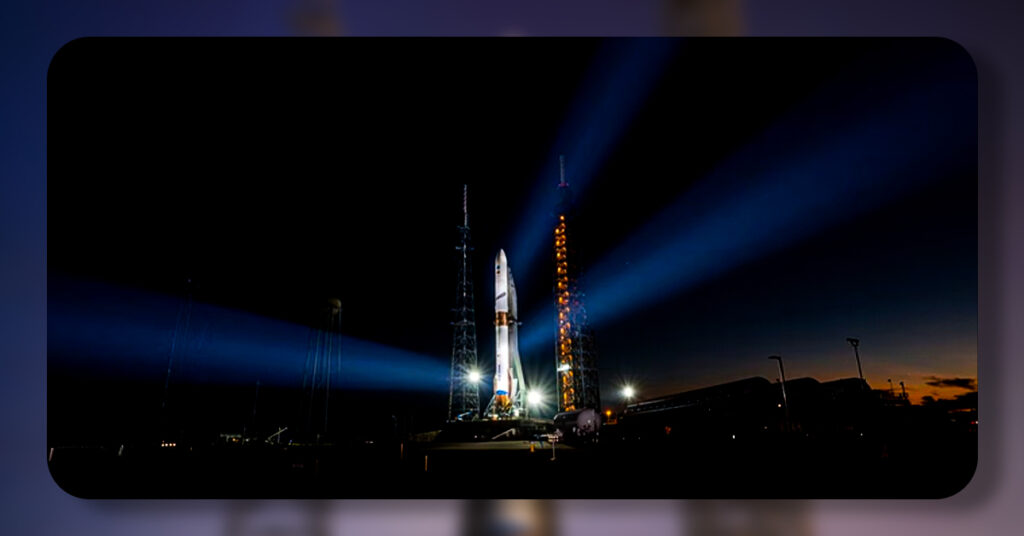
NASA’s Escapade Mars Mission Set to Launch Tonight as Jeff Bezos Prepares for Rocket Landing
A night of significant events for space exploration is highlighted by NASA, which is going to launch its long-awaited Escapade Mars mission, and at the same time Jeff Bezos’ Blue Origin is prepared for its daring rocket’s landing test.
The two events are significant for the global space industry, one being driven by scientific interest and the other by commercial aspirations. They in unison reflect the human race’s increasing urge to extend its territory to other planets and play a part in the shaping of future exploration of the Solar System.
What Is NASA’s Escapade Mission?
Under the name of Escape and Plasma Acceleration and Dynamics Explorers, NASA has put together the Escapade mission, which is probably a Scientific mission with the least cost. The mission entails sending two identical small satellites, which are supposed to be like “twin spacecraft” into Martian orbit. They will continue to study the interaction of solar wind with the Martian atmosphere and produce absolute data that will be used to explain Mars’ atmosphere loss through time.
The twin satellites will highly coordinate circle Mars to watch the planet’s magnetic field, solar radiation and charged particles taking place. By observing these interactions, scientists anticipate revealing new insights into Mars’ atmospheric escape, a process that has turned a planet once rich in water into the cold and dry world we see today.
What differentiates Escapade from others is the small-satellite design and a low-cost strategy. Unlike its giant interplanetary missions, Escapade is going to make use of little technology and very good communication systems. It will do very complex science at a very small percentage of the normal cost. The small spacecraft model could change the way future space missions are planned; especially, for universities and startups that are eager to take part in planetary research.
The Technology Behind Escapade
Each of the Escapade satellites is around 200 kilograms in weight and is equipped with cutting-edge tools to assess ions, electrons, and magnetic fields in the Martian vicinity. The mission will be based on photon propulsion and state-of-the-art plasma sensors capable of collecting live dynamic data.
NASA’s Small Innovative Missions for Planetary Exploration (SIMPLEx) program is behind the funding for this venture, thereby proving that even small-scale missions can bring about large-scale benefits. Besides NASA, the mission involves the University of California, Berkeley, which is the designer of the two spacecraft and is in charge of their scientific instruments.
The satellites are slated to go along with Rocket Lab’s Electron rocket, which signifies another essential achievement for private spaceflight cooperation with NASA. The spacecraft, once launched, will take approximately 11 months to reach Mars’ orbit.
Why Escapade Matters
The Escapade mission has profound scientific as well as symbolic implications. In giving the planet’s surface and atmosphere studies more or less the same level of attention, the smaller-scale Mars missions like Escapade, however, will be targeting completely different areas of investigation namely space weather and magnetospheric dynamics.
By studying the process of solar wind removal of gas from the atmosphere, not only will the scientists be able to predict the habitability dynamics on other planets but also the knowledge will be directly applicable to future human Mars missions. Radiation, communication, and spacecraft design for astronauts will all be based on the charge particle behavior knowledge around the planet, making it more effective.
Blue Origin’s Rocket Landing Attempt
On the same night as NASA’s Mars mission, Jeff Bezos’ Blue Origin will attempt to land its New Shepard rocket—a suborbital vehicle designed to carry both payloads and passengers to the edge of space.
This launch and landing attempt will mark a critical return for Blue Origin after a long pause in flight operations. The company aims to demonstrate improved flight performance and enhanced safety measures following previous test missions.
Unlike orbital missions like Escapade, Blue Origin’s New Shepard focuses on space tourism and suborbital research. However, successful precision landings are essential for the company’s future goal—developing New Glenn, a much larger rocket intended for orbital missions and cargo deliveries to the Moon and beyond.
The Race Between Science and Commerce
The timing of these two launches highlights how space exploration is evolving into a blend of scientific discovery and commercial enterprise. NASA’s Escapade represents government-backed, research-driven exploration, while Bezos’ Blue Origin embodies private ambition and reusable space technology.
Both missions, though different in purpose, share one goal—to make space more accessible, sustainable, and meaningful for future generations. The collaboration between public agencies and private players continues to redefine how missions are launched, funded, and executed.
How Escapade Differs from Previous Mars Missions
Unlike NASA’s earlier Mars missions that relied on large orbiters and rovers, Escapade’s twin-satellite system introduces a dual-observation approach. By having two spacecraft simultaneously measuring plasma and magnetic activity from different points, scientists can build three-dimensional models of the planet’s magnetosphere.
This design allows researchers to study changes in real time and map variations across both hemispheres of Mars. Previous missions, such as MAVEN, provided single-point observations. Escapade takes that foundation further by offering parallel measurements, improving accuracy and scientific depth.
The Broader Implications of Escapade
If successful, Escapade will not just advance Mars science—it will also transform how small satellites are used in deep space. Until now, CubeSats and mini-satellites were mainly limited to Earth’s orbit or lunar missions. Escapade is among the first small-satellite missions to go interplanetary, paving the way for cost-effective planetary studies in the future.
For academic researchers and smaller nations, this could be revolutionary. The ability to send affordable spacecraft to Mars, Venus, or asteroids could democratize access to space science, allowing more countries and universities to contribute to planetary exploration.
What Comes Next
After tonight’s launch, NASA’s mission team will monitor the twin satellites as they begin their long journey toward Mars. The first few weeks of flight will focus on system checks, trajectory adjustments, and deep-space communication tests.
Blue Origin, meanwhile, will assess how its New Shepard rocket performs during landing. If successful, this test could restart the company’s passenger flights and bring it closer to its long-term goals, including participation in lunar supply missions under NASA’s Artemis program.
Also Read:
Why This Night Matters
Tonight’s double event is more than just a coincidence—it’s a sign of the new space age we’re living in. Scientific agencies and private companies are no longer competitors; they are becoming partners in a shared vision. NASA depends on private launch providers to reduce costs and improve access to space, while private firms like Blue Origin rely on NASA’s experience and credibility to guide their innovations.
Conclusion
The simultaneous launch of NASA’s Escapade Mars mission and Jeff Bezos’ rocket landing test underscores how space exploration is expanding on two fronts—scientific and commercial. Escapade will explore Mars’ atmospheric mysteries and help humanity understand how planets evolve, while Blue Origin continues to push for reusable rockets that make space travel more routine.
Together, these missions reflect humanity’s unending curiosity and determination to explore beyond the familiar. Whether it’s a government-led study or a privately funded landing, every launch brings us one step closer to a deeper connection with the cosmos.