India’s Strategic Reassessment in West Africa
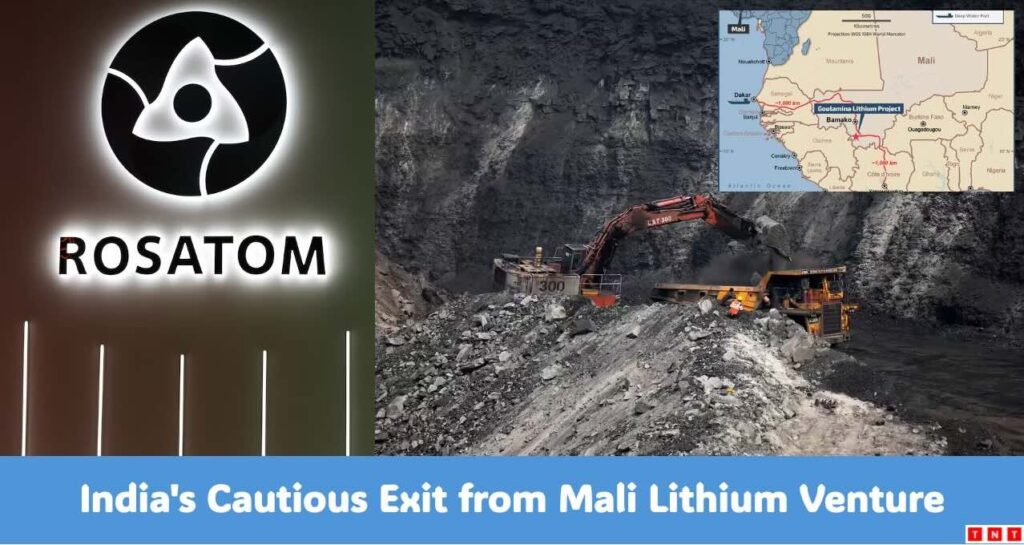
New Delhi, February 2026 |India’s Mali lithium exit has emerged as a significant signal of New Delhi’s evolving approach to overseas investments in high-risk regions. The decision to pause participation in a lithium exploration project in Mali reflects a growing emphasis on security, fiscal responsibility, and long-term sustainability.
According to reporting by Reuters, Indian government-backed firms stepped back from the venture after assessing the worsening security environment. Although the project promised access to a critical resource for electric vehicle batteries, officials concluded that operational risks outweighed potential gains.
This move aligns with India’s broader policy of engaging globally while avoiding exposure to unstable political environments. Therefore, the India Mali lithium exit should be viewed as a strategic adjustment rather than a retreat from Africa.
Lithium and India’s Critical Minerals Strategy
Lithium has become central to India’s clean energy ambitions. As electric mobility expands, demand for lithium-ion batteries continues to rise. Consequently, New Delhi has prioritised securing overseas mineral assets to reduce dependence on China-dominated supply chains.
The Mali initiative originated from cooperation with Rosatom, which invited Indian participation in 2025. India’s involvement came through Khanij Bidesh India Ltd and NLC India Ltd.
Khanij Bidesh India Ltd was established to support India’s overseas mineral acquisitions. It already holds stakes in projects in Argentina and is exploring opportunities in Australia and Africa. In this context, Mali appeared attractive due to its untapped potential.
However, the project remained at the exploration stage. No major capital investment had been committed. As a result, the withdrawal primarily prevented future losses rather than recovering sunk costs.
Partnership with Russia and Shared Strategic Interests
India’s cooperation with Russia in Mali extended beyond minerals. It reflected the long-standing strategic partnership between New Delhi and Moscow, which covers defence, nuclear energy, and hydrocarbons.
The lithium project complemented cooperation on systems such as the S-400 missile defence platform and projects like the Kudankulam nuclear plant. Therefore, the partnership carried symbolic as well as economic value.
From Russia’s perspective, India’s participation would have enhanced credibility for its African engagements. It would also have diversified financial and technical risk. However, India’s decision demonstrated that economic alignment does not override security assessments.
Despite the India Mali lithium exit, bilateral relations remain strong. Energy trade continues to grow, and platforms such as BRICS still provide diplomatic convergence.
Mali’s Deepening Security and Political Crisis
Mali’s instability forms the core rationale behind India’s withdrawal. Since 2012, the country has faced repeated insurgencies, coups, and governance breakdowns. Military takeovers in 2020 and 2021 further weakened institutional capacity.
Armed groups linked to Jama’at Nusrat al-Islam wal-Muslimin have expanded territorial influence. These groups now dominate large rural areas and threaten major transport corridors.
By late 2025, insurgents had imposed economic blockades on several cities. Fuel shortages, power disruptions, and inflation followed. Mining convoys and foreign installations became frequent targets.
Humanitarian agencies estimate that nearly two million people have been displaced. In addition, supply routes for essential goods remain under constant threat. Therefore, maintaining a long-term industrial project under such conditions is extremely difficult.
Russia’s Military Presence and Its Limitations
After expelling French and UN forces, Mali’s junta turned to Russian security support. The country now hosts Russia’s Africa Corps, the successor to the Wagner Group, tasked with training and protecting government forces.
Although these units provide tactical assistance, their capacity remains limited. Casualties have increased, and insurgent advances continue in several regions.
Independent assessments by organisations such as the International Crisis Group and the Soufan Center warn of prolonged instability and possible state fragmentation.
Western governments, including the United States and France, have issued strict travel advisories. These warnings underline the risks faced by foreign personnel and investors.
Under these circumstances, India’s lithium venture faced structural constraints that no commercial strategy could easily overcome.
Economic Prudence and Policy Rationality
Officials familiar with the project have indicated that India’s withdrawal stemmed from concerns over asset security and investment recovery. Public sector companies operate under strict accountability norms. Therefore, exposure to unpredictable environments is closely scrutinised.
The India Mali lithium exit reflects this institutional discipline. It prioritises taxpayer protection and reputational stability. In addition, it reinforces India’s image as a cautious yet reliable international partner.
Rather than pursuing high-risk ventures, India is redirecting focus to relatively stable jurisdictions. Latin America and Australia now feature prominently in mineral diplomacy.
This approach supports the broader “multi-alignment” doctrine, which balances strategic autonomy with economic pragmatism.
Implications for Indo-Russian Relations
Some observers have interpreted the withdrawal as a diplomatic setback. However, evidence suggests otherwise. Defence cooperation, crude oil imports, and nuclear collaboration remain unaffected.
The Mali episode represents a tactical divergence rather than a strategic rupture. Russia continues its African engagement based on its own risk calculations. India, meanwhile, calibrates involvement based on domestic accountability.
As one senior official remarked privately, security considerations cannot be subordinated to political symbolism. This principle now guides India’s overseas resource strategy.
Looking Ahead: Pragmatism Over Symbolism
The India Mali lithium exit illustrates a broader shift in New Delhi’s external economic policy. Access to resources remains vital. However, sustainability and security now shape investment decisions.
In the coming years, India is likely to deepen partnerships in politically stable regions. It will also strengthen domestic recycling and alternative battery technologies to reduce external dependence.
For Russia, Mali remains a high-stakes frontier. For India, it serves as a reminder that geopolitical ambition must align with operational realities.
As global competition for critical minerals intensifies, prudent risk management will remain central to India’s foreign economic engagement.
In an increasingly volatile world, strategic restraint has become as valuable as strategic reach.