US Military Strikes on Merchant Tankers Kills Three Indian Seafarers
Chronology of Events
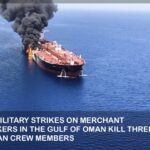
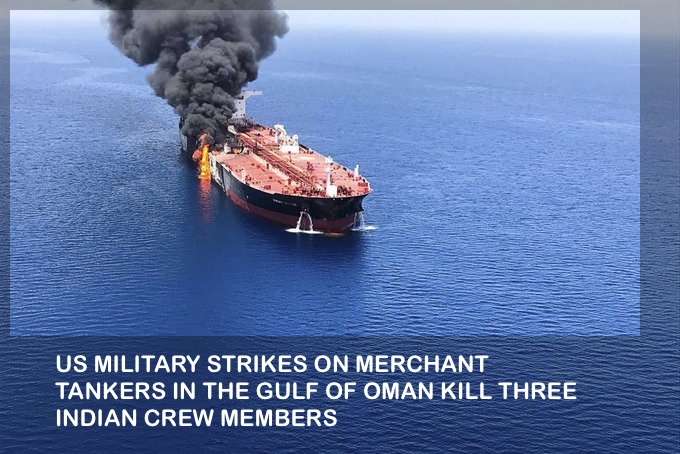
Three separate maritime strikes were conducted by US forces against commercial oil tankers crewed by Indian seafarers in international waters.
Incident A: MT Marivex [Struck on June 8, 2026]
The Action: A US Navy F/A-18 Super Hornet, launched from the aircraft carrier USS Abraham Lincoln, fired precision munitions directly into the engine and steering spaces of the Palau-flagged tanker MT Marivex.
The Consequence: A major fire broke out, disabling the ship and causing it to take on water.
Casualties & Rescue: All 24 Indian seafarers were successfully evacuated and airlifted by Omani military helicopters in coordination with the Indian Coast Guard. The crew was safely transferred to Masirah Island, Oman.
Incident B: MT Sette Bello [Struck on June 9/10, 2026]
The Action: US aircraft fired precision munitions into the engine room of the Palau-flagged MT Sette Bello.
The Consequence: The vessel was severely damaged and completely disabled.
Casualties & Rescue: Out of 24 Indian crew members, 21 were rescued. Union Shipping Minister Sarbananda Sonowal officially confirmed that the 3 missing Indian sailors are dead after their bodies were located and identified. The deceased are identified as Deck Cadet Aditya Sharma, Engine Fitter Shivanand Chaurasiya, and Chief Engineer Patnala Suresh.
Incident C: M/T Jalveer [Struck Overnight, June 10/11, 2026] NEW DEVELOPMENT
The Action: US aircraft fired two Hellfire missiles directly into the engine room of the Guinea-Bissau-flagged tanker M/T Jalveer.
The Consequence: The vessel was instantly disabled in the Gulf of Oman.
Current Status: This strike marks a rapid escalation, occurring less than 48 hours after the fatal hit on the MT Sette Bello. Emergency response and damage assessments regarding the 20 Indian crew members on board are currently unfolding.
The US Military (CENTCOM) Stance
The US Central Command (CENTCOM) has assumed full responsibility for all three reported strikes, framing them as strict enforcement of an active maritime blockade.
Enforcing the Blockade: The US instituted a rigid naval blockade on Iranian ports after Tehran closed the Strait of Hormuz. CENTCOM claims both ships were in direct violation of this blockade by attempting to transport oil to or from Iranian ports.
Claim of Non-Compliance: According to American military logs, both the MT Marivex and MT Sette Bello were given multiple, explicit maritime warnings. CENTCOM asserts that the use of precision ordnance against the engine rooms was a deliberate, measured action to disable the vessels’ propulsion only after the crews “repeatedly failed to comply with directions”.
Sanctions Background: The US Treasury Department highlighted that the MT Marivex had already been officially blacklisted and sanctioned for its involvement in illicit Iranian crude shipping.
Scale of Operation: This marks the first known use of lethal force by the US against non-Iranians during this blockade. In total, 9 non-compliant ships have been “disabled” since mid-April.
The New MEA Press Briefing & Government of India Stance
During an inter-ministerial press briefing led by MEA Spokesperson Randhir Jaiswal, New Delhi sharply clarified its diplomatic and operational position on the escalating crisis:
Direct Warning Exchange Acknowledged: The MEA clarified that there was an active radio communication exchange between the crew of the MT Marivex and the US Navy immediately before American forces fired upon and disabled the ship.
The Attacks Must Cease: The MEA reiterated India’s deep concern about the safety of its sailors. Spokesperson Jaiswal stated explicitly: “These attacks must cease, and we reiterate our call for dialogue and diplomacy to ensure an early return to peace and stability in the region.”
Summoning of the US Envoy: The MEA confirmed it formally summoned the US Chargé d’Affaires, Jason Meeks, in New Delhi to lodge a “strong protest” over the strike on the MT Sette Bello and the resulting loss of Indian lives.
Repatriation Efforts: Minister Sarbananda Sonowal announced that the Indian government has fast-tracked the repatriation of the 21 Sette Bello survivors and is coordinating the swift return of the bodies of the 3 deceased sailors to their families.
Shipping Companies & Registry Clarifications
Corporate and flag-state entities have issued crucial technical clarifications regarding the status and compliance records of the targeted vessels:
Palau Ship Registry Disavowal: The Palau Ship Registry (PSR) issued an official statement clarifying that the MT Marivex was not under their flag at the time of the incident. PSR stated that the ship’s registration had been formally closed and deleted from its registry on March 6, 2026, meaning any tracking data listing it as Palau-flagged was outdated.
Compliance Record Claims: Shipping records from the managers of MT Marivex (Panama-based Arihant Shipping Inc.) indicated the vessel had successfully complied with and turned away from US blockade warnings three separate times earlier in the week. However, automated tracking data suggests the ship’s transponder was deactivated on its final approach, which triggered the US response.
Lack of Prior Sanctions on Sette Bello: Representatives for the commercial managers of MT Sette Bello (IOS Marine – FZE) pointed out that unlike the Marivex, the Sette Bello was not officially listed on the US Office of Foreign Assets Control (OFAC) sanctions blacklist prior to being fired upon. This specific clarification has intensified the Indian government’s outrage regarding the proportionality of the strike.
The Seamen’s Union Counter-Narrative
Union Challenges CENTCOM: FSUI General Secretary Manoj Yadav stated to Sputnik India that the US narrative is completely misleading. The union contends the vessels were targeted at anchor, leaving the crew with no realistic opportunity to respond or comply.
Excessive Force Against Civilians: The FSUI alleges US forces knew the workforce was civilian and Indian. They argue that firing high-yield munitions directly into engine spaces where engineering crews are actively stationed constitutes an egregious, non-proportional use of force.
Distress Logs: The union released desperate SOS audio transmissions from the MT Marivex crew. In the recordings, panicked sailors shout about a massive “hole at the bottom” of the ship, contradicting the US description of a routine tactical disabling.
Why the Mainstream Indian Media is Quiet
While international networks, specialised maritime journals, and digital outlets like Sputnik India and The Wire are tracking this closely, domestic mainstream television media has handled the story with noticeable restraint. This is driven by deep geopolitical calculations:
The Geopolitical Tightrope: The US is India’s most critical economic and counter-balance partner against China. Mainstream media often takes cues from the government’s initial strategy, which tried to avoid naming the US directly in public briefings to prevent an overt public frenzy while executing harsh diplomacy behind closed doors.
The Iran-Russia-China Matrix: A massive media escalation could inflame domestic public opinion, pressuring the government toward the exact radical pivot you mentioned aligning rigidly with a Russia-Iran-China bloc to counter US presence in West Asia. India heavily relies on a balanced strategic autonomy and actively avoids being forced into hard, single-bloc alliances.
The Core Questions Raised by the Incident
Beyond the immediate diplomatic fallout, the incidents involving MT Marivex and MT Sette Bello raise serious legal and policy questions from an Indian perspective.
The central issue is whether international law permits the use of force against commercial vessels crewed by citizens of a neutral state in international waters.
Several facts appear difficult to dispute.
First, Indian sailors were aboard both vessels.
Second, casualties occurred, including the deaths of Indian nationals.
Third, US Central Command (CENTCOM) has publicly accepted responsibility for the disabling operations.
Fourth, the Government of India has formally protested the incidents and summoned the senior US diplomatic representative in New Delhi.
These facts alone elevate the matter beyond a routine sanctions-enforcement dispute and into a significant international incident involving the deaths of citizens of a non-belligerent state.
From New Delhi’s perspective, several legal arguments may emerge.
Freedom of Navigation
India may argue that freedom of navigation in international waters is a foundational principle of the modern maritime order. Any attempt by a state to unilaterally restrict commercial traffic through the use of force raises serious concerns regarding the rights of neutral shipping.
Civilian Character of the Vessels
The vessels involved were commercial merchant tankers rather than military assets. India may contend that civilian merchant shipping enjoys special protection and that the threshold for employing military force against such vessels must be exceptionally high.
Status of India as a Non-Belligerent State
India is not a participant in the conflict between the United States and Iran. Consequently, New Delhi may question the legal basis upon which Indian citizens operating aboard civilian vessels became exposed to direct military action.
Necessity and Proportionality
Even if a state asserts a right to enforce a blockade or sanctions regime, questions remain regarding whether the use of explosive ordnance against engineering spaces occupied by civilian crew members satisfied the principles of necessity and proportionality.
Accountability for Loss of Life
The deaths of Indian nationals create a separate issue of accountability. New Delhi may seek a transparent investigation, disclosure of operational records, clarification of warning procedures, and appropriate compensation where responsibility is established.
These are not fringe or exceptional arguments. They are the kinds of legal and diplomatic positions states routinely advance when their citizens are injured or killed in international maritime incidents.
The broader concern for India is that acceptance of such actions without challenge could establish a precedent under which commercial vessels crewed by Indian nationals become vulnerable whenever major powers seek to enforce geopolitical objectives through military means.
For a country whose economy depends heavily on maritime trade and whose citizens constitute a substantial portion of the global merchant marine workforce, that precedent carries implications far beyond the immediate crisis in the Gulf of Oman.
Also Read: