The Last Citadels of Lutyens’ Delhi? Inside the Elite Clubs That Defined Power, Privilege and Access in India’s Capital
In Delhi, power has never operated only from Parliament, North Block, or the Prime Minister’s Office.
For more than a century, another republic existed quietly behind hedges, colonial facades, polo lawns and teak-panelled bars, a parallel ecosystem where generals, diplomats, judges, bureaucrats, industrialists and political insiders mingled away from public view.
The address was rarely written on official letterheads. Yet everyone in Delhi’s establishment knew it.
The clubs of Lutyens’ Delhi.
Today, that old order appears to be under unprecedented pressure.
The dramatic eviction notice issued to the historic Delhi Gymkhana Club has triggered a wider national debate over privilege, public land, exclusivity and the future of colonial-era institutions in democratic India.
But Gymkhana is only the beginning.
Behind the legal battle lies a much larger question: Is the Indian state finally reconsidering the enormous islands of privilege that survived Independence almost untouched?
The Empire’s Drawing Rooms
When the British shifted India’s capital from Calcutta to Delhi in 1911, they did not merely build government buildings. They designed an imperial social order.
Lutyens’ Delhi was planned as a city of controlled access, broad avenues, bungalows, ceremonial architecture and elite recreational institutions meant for colonial administrators and military officers.
The clubs became extensions of governance itself.
Deals were discussed over whisky before they entered files. Careers were shaped over billiards tables. Military officers, ICS administrators and judges socialised within insulated circles far removed from the chaos of Old Delhi beyond the imperial axis.
After 1947, the British left.
The ecosystem did not.
The names changed. ‘Imperial’ disappeared. But the structure of access remained remarkably intact.
India’s post-colonial elite simply inherited the clubs.
The Crown Jewel: Delhi Gymkhana Club
Delhi Gymkhana Club remains the most iconic of them all.
Founded on July 3, 1913 as the Imperial Delhi Gymkhana Club, it eventually moved to its present 27.3-acre site on Safdarjung Road in the 1930s. The elegant colonial complex was designed by British architect Robert Tor Russell, the same architect behind Connaught Place.
Its lease terms became legendary.
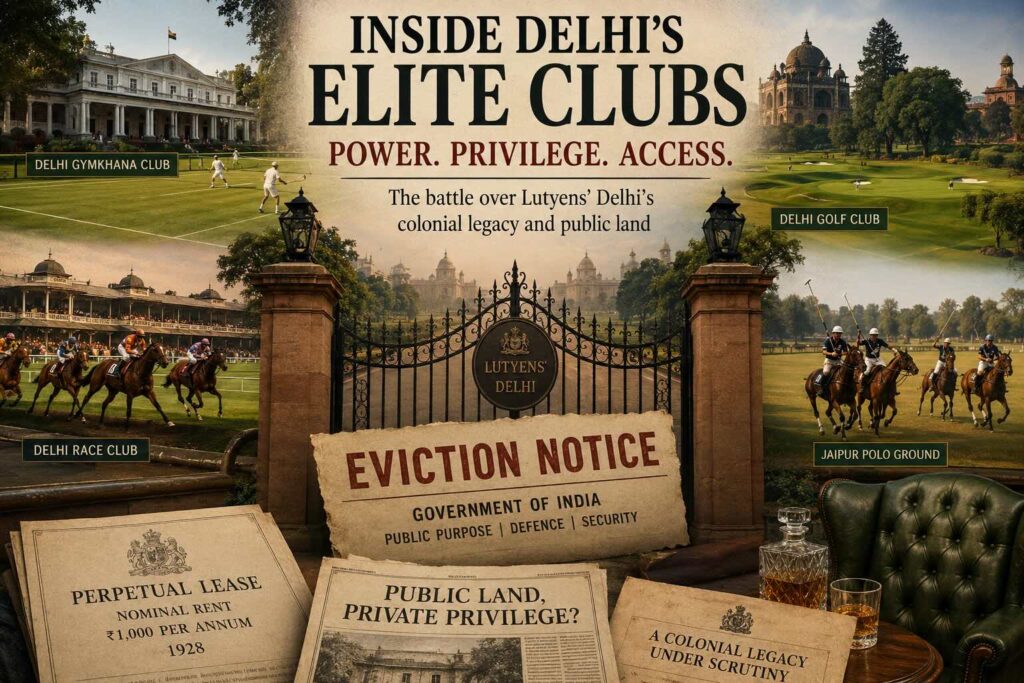
The land was granted under a 1928 perpetual lease at a nominal annual rent reportedly close to ₹1,000.
In the decades that followed, the club transformed into the unofficial social nerve centre of the Indian establishment.
Membership itself became a status symbol more powerful than wealth.
Cabinet secretaries, retired generals, Supreme Court judges, ambassadors, senior IAS and IPS officers, and old Delhi families dominated its rolls. Entry was governed not merely by money, but by lineage, references and networks.
For outsiders, the wait became almost mythical.
Reports suggest waiting periods stretched from 30 to even 40 years.
One controversial system, the so-called Green Card mechanism, allegedly gave preferential pathways to adult dependents of existing members, reinforcing perceptions of hereditary privilege.
Its sporting infrastructure alone is staggering for central Delhi real estate:
- 26 grass tennis courts
- 7 clay tennis courts
- 3 squash courts
- Multiple badminton courts
- Temperature-controlled swimming pool complex
- Exclusive bars and members-only lounges
- Formal dining halls
- Card rooms and billiards rooms
- Banquet and reception halls
- Expansive ceremonial lawns and landscaped gardens
- Library and reading rooms and quiet lounges
- 43 resident cottages: accommodation suites and guest rooms
- Children’s recreation areas and family sections
Formal dress codes survived deep into the modern era. Bills were often signed instead of instantly paid. Conversations still carried the cadence of an older bureaucracy.
For many Delhi residents, Gymkhana was not just a club.
It was a social passport.
The Shockwave of 2026
Then came May 2026.
The Union government issued a re-entry and eviction order directing the club to vacate the premises, citing defence, governance and security requirements because of the club’s proximity to the Prime Minister’s residence and sensitive installations.
The legal battle escalated rapidly to the Delhi High Court.
Suddenly, a club that symbolised permanence looked vulnerable.
The public reaction revealed how sharply India itself has changed.
On one side were defenders who described Gymkhana as a heritage institution central to Delhi’s cultural fabric.
On the other were critics asking an uncomfortable question:
Why should vast tracts of prime public land remain reserved for tiny elite circles under colonial-era lease structures?
Social media reactions became particularly brutal.
For many younger Indians, Gymkhana represented not heritage, but inherited exclusion.
The Other Giants of Lutyens’ Delhi
The Gymkhana controversy has now dragged other elite institutions into the spotlight.
Delhi Golf Club
Spread over nearly 179 acres near Lodhi-era monuments, the Delhi Golf Club is arguably India’s most visually spectacular golf institution.
Originally developed in the 1930s as the Lodhi Golf Club, it was reorganised after Independence in 1950-51 after Indian civil servants reportedly persuaded Jawaharlal Nehru to preserve it through concessional leasing arrangements.
The course itself is extraordinary:
- 18-hole Lodhi Course
- 9-hole Peacock Course
- Comprehensive amenities including fitness centre, tennis courts, swimming pool, multiple dining and bar options
- Mughal and Lodhi tombs embedded within the fairways
- Thick tree cover and ecological zones in central Delhi
The club today combines heritage, sport and elite networking in one of the capital’s greenest landscapes.
Membership remains highly difficult and expensive, often involving long waiting periods and extensive screening.
Although its lease was extended till 2050, the Gymkhana controversy has intensified scrutiny around the sheer scale of public land occupied by such institutions.
Delhi Race Club
Horse racing once represented the height of colonial aristocratic culture.
The Delhi Race Club, with roots in the 1920s and formalised lease arrangements around 1926, became the capital’s premier racing institution.
Located on nearly 53 acres close to Lok Kalyan Marg, the club sits in one of the country’s most sensitive power corridors.
Its facilities historically included:
- racing tracks
- horse stables
- members’ enclosures betting infrastructure
- hospitality and viewing galleries
- equestrian training facilities
But unlike Gymkhana, the Race Club’s lease reportedly expired decades ago, around 1994.
In March 2026, eviction proceedings began. The Delhi High Court later granted temporary relief while the matter remains under litigation.
The stakes here are not merely elite recreation.
The club ecosystem also supports trainers, stable workers, jockeys, breeders and associated labour networks.
Indian Polo Association and Jaipur Polo Ground
Adjacent to the Race Club lies the Jaipur Polo Ground, another symbol of old imperial sporting culture.
Polo, once deeply associated with princely India and cavalry traditions, still survives here through military and elite sporting networks.
The grounds host:
- polo tournaments
- equestrian training
- ceremonial and military-linked events
- social gatherings of diplomatic and business elites
Like the Race Club, the polo grounds also received eviction notices earlier this year and remain under judicial protection for now.
The Intellectual Clubs
Not every elite institution in Lutyens’ Delhi operates through inherited aristocratic culture alone.
Some evolved into softer centres of influence.
India International Centre
Established in the 1960s, the IIC became Delhi’s intellectual republic.
Unlike Gymkhana’s bureaucratic aura, IIC cultivated scholars, diplomats, artists, journalists, academics and policy thinkers.
Its facilities include libraries, lecture halls, art galleries, cultural events, residential guest rooms, fine dining halls and cafes.
Though more open in spirit, it too occupies prime public land and periodically faces questions over access and institutional privilege.
Constitution Club of India
Located close to Parliament, the Constitution Club became one of Delhi’s most influential political networking venues.
Its halls have hosted political negotiations, party meetings, media briefings, parliamentary gatherings, and private strategy sessions
If Gymkhana was the social club of the bureaucracy, Constitution Club became the informal salon of politicians.
The Real Debate: Heritage or Entitlement?
The emotional divide over these clubs reflects two competing visions of India.
One side argues:
These clubs are living heritage institutions.
They preserve architecture, sporting traditions, social culture and urban green spaces that would otherwise vanish under commercial development.
Many members insist these institutions are not merely playgrounds for the rich, but spaces of continuity, diplomacy, sport and civic networking.
The opposing side asks:
Can democratic India continue subsidising exclusion?
Can prime public land in the heart of the national capital remain inaccessible to ordinary citizens while operating under deeply preferential lease structures created during colonial rule?
Why should waiting lists run into decades while public land remains effectively privatised for elite recreation?
The anger is not only about land.
It is about symbolism.
In a country where millions struggle for urban housing and public recreational spaces, the existence of heavily insulated elite enclaves increasingly feels politically difficult to justify.
The End of the Old Delhi Order?
For decades, membership in clubs like Gymkhana or Delhi Golf Club functioned almost like unofficial state honours.
They signified arrival into India’s governing ecosystem.
But India in 2026 is no longer the India of the 1950s.
The old bureaucratic aristocracy has weakened. Social media has democratised visibility. Public patience for inherited privilege has sharply declined.
The idea that power should remain hidden behind colonial hedges no longer enjoys automatic legitimacy.
Whether these clubs survive legally is still uncertain.
But something larger may already be ending:
The unquestioned moral authority of Lutyens’ exclusivity itself.
And perhaps that is why the battle over a few acres in central Delhi suddenly feels far bigger than a property dispute.