The Fall of Delhi Gymkhana? How India’s Most Exclusive Club Reached the Edge of Eviction
For more than a century, behind the guarded gates of Delhi Gymkhana Club, another version of Delhi existed.
It was a city within a city, quieter, greener, slower, insulated from the chaos beyond Lutyens’ boulevards. Bureaucrats negotiated careers over whisky. Retired generals played billiards under colonial chandeliers. Diplomats gathered at manicured lawns while waiters in starched uniforms moved silently between tables. Entry was not merely membership; it was admission into India’s most enduring power network.
Now, that world may be ending.
In a dramatic move that has shaken Delhi’s elite establishment, the Ministry of Housing and Urban Affairs, through the Land & Development Office (L&DO), has ordered the 113-year-old club to vacate its iconic 27.3-acre Safdarjung Road premises by June 5, 2026. The government says the land, situated adjacent to the Prime Minister’s residence and within one of India’s most sensitive security zones is urgently required for defence infrastructure and vital public security purposes.
The order goes far beyond administrative restructuring. It demands complete re-entry of the land. Buildings, lawns, sports facilities, bars, cottages, furniture, and fixtures would all revert to the government.
For the first time in its long and privileged history, Delhi Gymkhana Club faces an existential question: can the institution survive without the land that defined it?
The answer may determine not just the future of a club, but the fate of a colonial-era ecosystem that shaped the culture of power in independent India.
A Club Born for Empire
Delhi Gymkhana Club was never intended to be democratic.
Founded on July 3, 1913, as the Imperial Delhi Gymkhana Club, it emerged during the British Raj as a recreational enclave for colonial officers and administrators. The word Gymkhana itself came from Anglo-Indian vocabulary, a hybrid of sport, leisure, and imperial exclusivity.
The club first operated from the Coronation Grounds before shifting in the early 1930s to its present location on Safdarjung Road, in the newly designed imperial capital of New Delhi. Some structures were associated with architect Robert Tor Russell, who helped shape much of Lutyens’ Delhi.
Like most British clubs of the era, the institution reflected the racial and social hierarchy of empire. Indians were largely excluded. It was a space built for governors, military officers, ICS officials, and the colonial elite to dine, network, play tennis, and reinforce power relationships away from public scrutiny.
Independence changed the flag, but not entirely the culture.
After 1947, ‘Imperial’ quietly disappeared from the name, and the club was Indianised. Yet the social structure remained remarkably similar. The British bureaucrat gave way to the Indian bureaucrat. Colonial military officers were replaced by Indian generals. Diplomats, judges, ministers, public sector chiefs, and eventually corporate elites entered the ecosystem.
The club became a social headquarters for what came to be known as Lutyens’ Delhi India’s ruling establishment.
For decades, a rough and unofficial 40-40-20 structure shaped membership: civil servants, armed forces personnel, and everyone else.
In theory, it was a sports and recreation institution. In practice, it became one of the capital’s most important informal power corridors.
The Fortress of Exclusivity
Nothing symbolised Delhi Gymkhana’s aura more than its waiting list.
Membership was not bought quickly; it was inherited socially.
Applications often remained pending for 30 to 37 years. Some applicants who applied in the late 1970s reportedly continued waiting decades later. Becoming a permanent member was treated almost like receiving a state honour.
The Green Card system deepened this exclusivity. Adult children of existing members received preferential treatment, creating what critics described as a semi-hereditary structure. Outsiders waited endlessly while elite families retained continuity across generations.
The numbers reveal the scale of exclusivity.
The club has roughly 14,000 members including dependents, though core permanent membership is far smaller. Corporate memberships reportedly ran into ₹15-20 lakh or more. Non-government civilian categories cost several lakhs, while government-linked categories were substantially cheaper.
This pricing disparity fuelled a perception that prime public land was subsidising elite privilege.
Inside the club, however, the experience remained seductive.
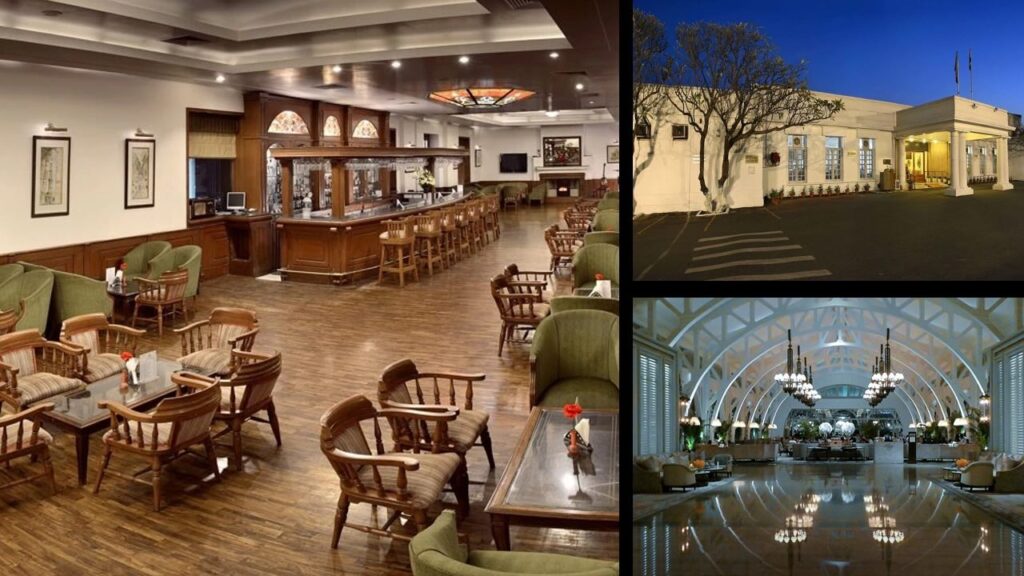
There were clay and grass tennis courts, squash courts, billiards rooms, a swimming pool, cottages, rose gardens, bars, libraries, banquet halls, and colonial-style dining rooms. The ballroom with its stained-glass dome became part of Delhi’s institutional mythology.
For retired civil servants and military officers, the club represented continuity, companionship, and prestige. For younger aspirants, it represented arrival into India’s governing class.
In many ways, Delhi Gymkhana Club became less a club and more a social credential.
The Myth of Nation-Building
Defenders of the Delhi Gymkhana Club often portray it as an institution woven into India’s administrative history. There is some truth to that, but only partially.
After Partition in 1947, the club reportedly hosted farewell gatherings between Indian and Pakistani officers whose regiments were splitting amid enormous violence and emotional upheaval. In the early years of the Republic, it became an informal meeting ground where civil servants, diplomats, military officers, and judges interacted beyond official protocol.
Supporters argue such spaces fostered trust among those running a fragile new nation.
But the broader claim that Delhi Gymkhana significantly contributed to nation-building is difficult to sustain.
India was built in Parliament, courts, ministries, villages, factories, farms, laboratories, universities, and military frontiers, not in elite drawing rooms.
The club did not lead social reform movements. It did not build public infrastructure. It was not a crucible of democratic participation. It was fundamentally a recreational and networking institution for those already close to power.
And that perception now sits at the heart of the current public debate.
To critics, the club represents a taxpayer-subsidised colonial relic, an island of privilege occupying some of the most valuable land in India’s capital while ordinary citizens struggle with housing shortages, urban congestion, and shrinking public space.
The symbolism matters.
At a time when governments increasingly speak the language of efficiency, national security, and anti-VIP culture, Delhi Gymkhana appears to many as an outdated remnant of another era.
The Slow Unravelling
The present crisis did not emerge suddenly.
For years, allegations of financial irregularities, governance failures, and lease violations hovered around the institution.
The turning point came through investigations initiated by the Ministry of Corporate Affairs between 2019 and 2020. These inquiries reportedly uncovered what authorities described as systemic mismanagement and conduct prejudicial to public interest.
The allegations were extensive.
Investigators raised questions over:
- preferential membership practices,
- financial handling of waiting-list fees,
- deviations from the club’s non-profit objectives,
- excessive expenditure on catering and liquor compared to sports,
- governance conflicts,
- audit irregularities, and
- unauthorised commercial activities.
The National Company Law Tribunal (NCLT) soon entered the picture.
In June 2020, the tribunal found prima facie evidence warranting government oversight. By April 2022, the NCLT effectively superseded the elected management and installed a 15-member government-nominated General Committee to run the club.
The order was extraordinary.
A private elite institution, long insulated by status and influence, had effectively been taken over by the state in the name of public interest.
The National Company Law Appellate Tribunal later upheld the intervention while directing reforms and eventual elections.
Yet even as governance battles unfolded internally, another threat was growing outside: the lease itself.
The Land Beneath the Club
The real battle was always about land.
Delhi Gymkhana Club occupies one of the most strategically valuable parcels in India.
The 27.3-acre property sits in the heart of Lutyens’ Delhi, adjacent to the Prime Minister’s residence and within a tightly controlled security zone. Few institutions enjoy such prime real estate.
The club operated under a perpetual lease granted in 1928. But perpetual does not mean unconditional.
Government records reportedly documented dozens of alleged lease breaches:
- unauthorised constructions,
- telecom towers,
- commercial misuse,
- subletting without approval, and
- substantial unpaid dues.
Authorities cited arrears exceeding ₹47 crore, including revised ground rent, penalties, and misuse charges.
Three notices were reportedly issued between September 2025 and April 2026 demanding payment and warning of re-entry proceedings.
Then came the decisive blow.
On or around May 22, 2026, the L&DO formally ordered the club to vacate the premises by June 5, 2026.
The reason cited was national interest.
The government declared the area strategically sensitive and urgently required for defence infrastructure and public security purposes.
The message was unmistakable: elite heritage could no longer outweigh state priorities.
Panic Behind the Gates
The reaction inside the club was immediate.
Members, employees, and administrators scrambled to respond as panic spread across Delhi’s establishment circles.
Would the government actually take over the land within two weeks?
What would happen to thousands of members? To the staff? To decades of accumulated infrastructure? To the institution’s identity itself?
The government-appointed General Committee wrote urgently to the L&DO seeking clarification.
The letter reportedly asked:
- whether alternate land would be allotted,
- how the government proposed to handle relocation,
- whether employees would be protected, and
- why such a drastic timeline had been imposed.
The committee emphasised the enormous investments made over decades into sports and social infrastructure. Rebuilding a comparable institution elsewhere would require huge financial resources.
More importantly, members feared that relocation itself could destroy the club’s identity.
Delhi Gymkhana is not merely its membership list; it is its geography.
Its proximity to the corridors of power is part of its value. Shift it to the outskirts of Delhi, and many believe the institution ceases to be what it historically represented.
“It will not remain Delhi Gymkhana,” became a recurring sentiment among members.
The Courtroom Battle
Petitions soon reached the Delhi High Court.
Members and employees challenged the eviction order on multiple grounds:
- lack of adequate notice,
- absence of due process,
- livelihood concerns for approximately 500-600 employees, and
- the broader impact on thousands of members.
The petitions also questioned the abrupt timeline and sought relief against immediate dispossession.
But the court did not grant the stay many had hoped for.
On May 26, 2026, the Delhi High Court declined interim relief, refusing to halt the eviction process at this stage.
However, the court did record important government assurances:
- there would be no forcible takeover on June 5 without due process,
- and prior notice would be given before any coercive action.
Legally, the government retained the upper hand.
The lease terms, combined with the public-purpose doctrine and national security justification, create a formidable framework for the state.
Still, the proceedings bought the club something valuable: time.
And time may now determine whether the institution negotiates survival or slides toward dissolution.
What Next for Delhi Gymkhana?
The central question now is whether the Delhi Gymkhana Club can survive without its iconic Safdarjung Road address.
The most likely outcome remains full government re-entry, with the Centre reclaiming the strategically sensitive land for defence and security infrastructure. The club’s preferred option is relocation, but shifting elsewhere in Delhi or the NCR would come with enormous rebuilding costs and could fundamentally dilute the institution’s elite identity and centrality.
A prolonged legal battle may delay final possession, though courts traditionally give considerable weight to national security and public-purpose claims tied to lease agreements. Even without immediate closure, the uncertainty itself threatens the club’s long-term future. Membership confidence, waiting-list prestige, financial planning, and staff morale may gradually weaken a serious blow for an institution built as much on perception and exclusivity as on physical infrastructure.
What makes the crisis especially significant is the changing public mood. Unlike earlier decades, there is little universal sympathy for the club. Many now see it as a colonial-era enclave of inherited privilege occupying prime public land under highly favourable historical arrangements. Critics argue that such institutions symbolised exclusivity rather than public service, even while benefiting from state patronage.
At the same time, the club undeniably holds heritage value. Its architecture, traditions, and social history form part of the larger story of Lutyens’ Delhi and the evolution of India’s post-Independence elite culture. But in modern India, heritage alone no longer guarantees protection.
The possible fall of Delhi Gymkhana therefore represents more than the fate of a single club. It signals a broader shift in how India views old centres of privilege and informal power. For decades, institutions like Gymkhana clubs functioned as networking spaces for bureaucrats, military officers, diplomats, and political insiders. Delhi Gymkhana stood apart because of its extraordinary proximity to national power.
If the government ultimately reclaims the land, it will mark one of the clearest symbolic redefinitions of elite space in contemporary India.
For now, the club continues to function while court proceedings and negotiations continue. Yet even if the institution survives through relocation or restructuring, its era of unquestioned permanence appears to be ending. The century-old world of imperial lawns, bureaucratic networking, and inherited exclusivity at the heart of Lutyens’ Delhi may soon pass into history.