IAF’s 60-Aircraft Medium Transport Aircraft Plan Cleared in Major Boost
The India Defence Acquisition Council ₹2.38 trillion package places significant emphasis on modernising airlift capability through India’s Medium Transport Aircraft (MTA) Programme, a long-pending requirement of the Indian Air Force.
Background and Strategic Approval
India’s transport fleet overhaul has become urgent due to the ageing Antonov An-32 and Ilyushin Il-76 aircraft, many of which face rising maintenance challenges and operational risks. The An-32 fleet, with a payload capacity of 6–7 tonnes, has been the backbone of tactical airlift for decades but is now nearing the end of its service life.
An earlier Indo-Russian joint development programme collapsed in 2016, forcing India to restart the process. In December 2022, the Ministry of Defence issued a Request for Information (RFI) for aircraft in the 18–30 tonne payload category, reflecting evolving operational needs.
Earlier, on 2 March 2026, the Defence Procurement Board had cleared the acquisition of 60 Medium Transport Aircraft, estimated at around ₹1 lakh crore (approximately $11–13 billion), under the “Buy and Make (Indian)” category. The structure includes 12 aircraft in fly-away condition and 48 to be manufactured domestically, reinforcing indigenous production goals.
With the DAC now moving forward under the India Defence Acquisition Council ₹2.38 trillion package, the proposal advances toward final approvals from the Cabinet Committee on Security (CCS), followed by the issuance of the Request for Proposal (RFP) and competitive trials.
The Ministry of Defence has emphasised that the Medium Transport Aircraft (MTA) programme will bridge both tactical and strategic airlift gaps, enhancing India’s ability to operate across diverse terrains and mission profiles.
Global Contenders in the MTA Race
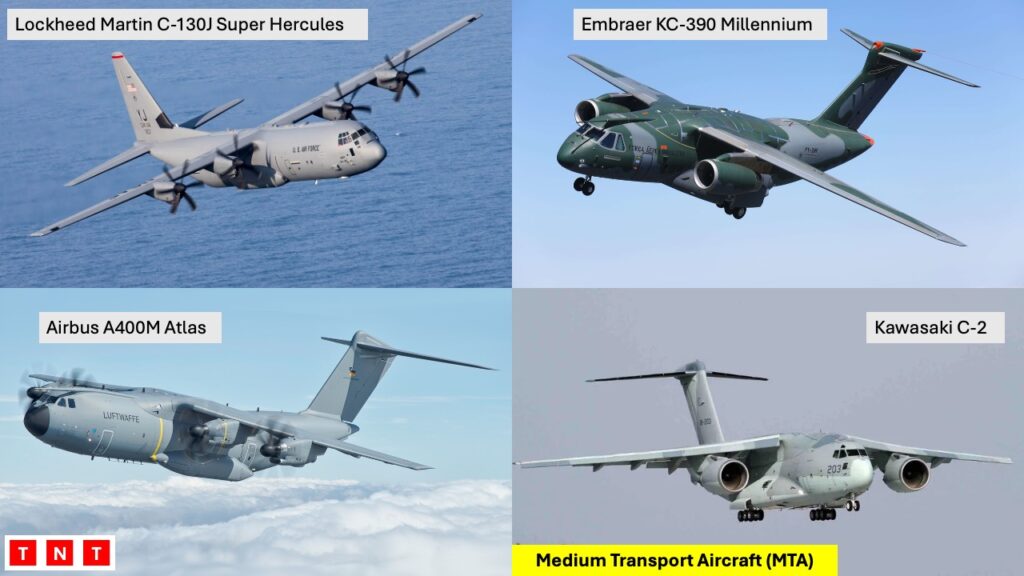
Four major Medium Transport Aircraft platforms are currently under consideration, each offering a distinct operational and industrial proposition.
The Embraer KC-390 Millennium, backed by a partnership with Mahindra, is a modern jet-powered transport aircraft with a payload capacity of around 26 tonnes. It offers a range of approximately 2,800 km and multi-role capabilities, including aerial refuelling. Embraer has proposed an aggressive transfer of technology and positioning India as a manufacturing hub, making it a strong contender in terms of cost and industrial benefits.
The Lockheed Martin C-130J Super Hercules, in collaboration with Tata, is already proven in Indian Air Force service. With a payload capacity of around 20 tonnes, this turboprop aircraft is renowned for its ability to operate from short, unprepared runways and in high-altitude conditions. Its interoperability with Quad partners also adds strategic value.
The Airbus A400M Atlas represents the higher end of the capability spectrum, offering a payload of around 37 tonnes and a range of approximately 3,300 km. Its versatility allows both tactical and strategic missions, though its higher cost and more limited transfer of technology could influence decision-making.
Japan’s Kawasaki C-2 has emerged as a potential dark horse. This twin-turbofan aircraft offers a payload capacity of approximately 37.6 tonnes and can cover over 4,500 km with heavy loads, with a ferry range approaching 9,800 km. Its high cruising speed and ability to operate from short or semi-prepared runways make it particularly attractive for rapid deployment scenarios. However, its limited export track record remains a consideration.
What Will Drive the Final Selection
The final decision under the India Defence Acquisition Council ₹2.38 trillion package will depend on multiple operational and strategic factors. These include payload capacity, range, performance in high-altitude environments, depth of transfer of technology, lifecycle costs, and the extent of domestic manufacturing commitments.
Equally important will be alignment with India’s Aatmanirbhar Bharat initiative, ensuring that the programme contributes to long-term industrial capability rather than just immediate procurement.
A Critical Step in Airlift Modernisation
The Medium Transport Aircraft programme represents a pivotal component of the India Defence Acquisition Council ₹2.38 trillion package. By replacing ageing platforms and introducing versatile, modern aircraft, India is positioning itself to respond rapidly to military, humanitarian, and disaster-relief scenarios.
As the programme moves toward the RFP stage, the competition remains open, with each contender offering a unique mix of capability, cost, and strategic partnership. The outcome will shape the Indian Air Force’s airlift capability for decades to come.
ALso Read:
C-295 Assembly in Vadodara by 2026: A Step Forward in India’s Defence Production