Andhra Bus Fire Accident: How Lapses Turned a Crash Fatal
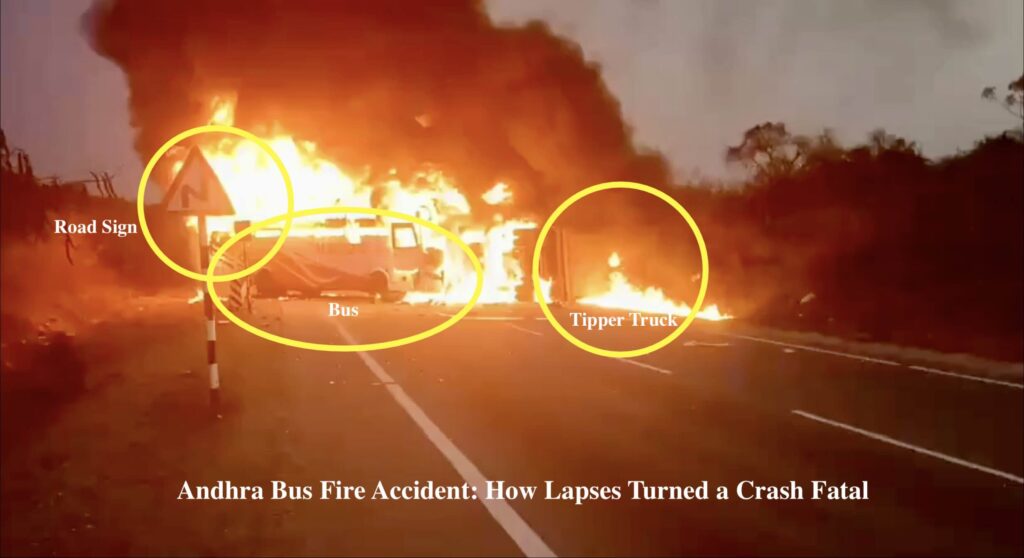
The Andhra bus fire accident that killed at least 14 passengers in Andhra Pradesh’s Markapuram region on March 26 has once again highlighted how lapses in enforcement can turn a road crash into a mass-casualty tragedy. What began as a collision between a private bus and a tipper truck escalated within minutes into a deadly fire, trapping passengers and leaving little room for escape.
According to initial police reports, the private bus was travelling from Jagityal in Telangana to Kaligiri in Nellore district when it collided with the tipper vehicle. The impact was followed by a rapid fire that engulfed the bus. Around 35 passengers were onboard at the time. While 14 lost their lives, at least 23 others sustained injuries, many of them suffering severe burns.
Officials indicated that several victims were unable to exit the vehicle in time, pointing to possible failures in emergency evacuation systems. The accident is under investigation, but early findings suggest that the fire, rather than the collision itself, was responsible for the high number of fatalities.
Accident Under Probe for Suspected Wrong-Side Driving
The Andhra bus fire accident has also brought attention to a critical angle now under probe. While there is no official confirmation yet, emerging reports suggest that the tipper vehicle may have been driving on the wrong side of the road at the time of the crash.
Wrong-side driving is a persistent and dangerous violation on Indian highways, especially involving heavy vehicles such as tippers and dumpers attempting to shorten routes or bypass tolls. Despite strict legal provisions, enforcement remains inconsistent. If confirmed in this case, it would indicate not just driver negligence but a broader breakdown in traffic discipline and monitoring systems.
At the same time, even if the tipper driver is found at fault, it does not fully explain the scale of fatalities. The fire and the inability of passengers to escape remain central to the tragedy.
Bus Fire Accidents Raises Questions on Safety Compliance
The Andhra bus fire accident has renewed scrutiny on whether private bus operators comply with mandated safety norms. Indian regulations require passenger buses to have functional emergency exits, fire extinguishers, and valid fitness certifications. However, enforcement is often uneven, particularly in long-distance private transport operations.
Survivors described scenes of panic as smoke filled the bus and visibility dropped. Passengers reportedly struggled to locate exits as flames spread quickly. In many such incidents, emergency doors are either blocked, poorly maintained, or not easily accessible under stress.
Authorities are yet to confirm whether the bus involved in the Andhra bus fire accident met all safety requirements. These details are expected to emerge as part of the ongoing inquiry.
Fire Risk a Critical Factor in Andhra Bus Fire Accident
One of the most alarming aspects of the Andhra bus fire accident is how quickly the fire intensified. Experts suggest that factors such as fuel leakage or electrical faults may have contributed, although the exact cause remains unconfirmed.
Bus fires are less frequent than collisions but tend to be far more lethal due to rapid flame spread and limited escape options. Many buses in India lack fire-retardant materials or automatic fire suppression systems, which are standard safety features in several countries.
The accident underscores the need to strengthen fire safety checks, particularly for private operators who may compromise on maintenance to reduce costs.
Enforcement Gaps Behind Andhra Bus Fire Accident
The accident reflects a deeper systemic issue: the gap between regulation and enforcement. The Motor Vehicles (Amendment) Act, 2019 introduced stricter penalties for violations such as unsafe driving and lack of permits. However, without consistent monitoring, these penalties often fail to act as deterrents.
Interstate bus operations between Andhra Pradesh and Telangana further complicate enforcement. Vehicles frequently cross jurisdictions, and coordination between transport authorities is limited. This allows non-compliant vehicles to continue operating with minimal oversight.
If wrong-side driving is confirmed in this case, it would highlight failures in real-time highway monitoring, weak deterrence, and lack of immediate enforcement against high-risk violations.
Andhra Bus Fire Accident Highlights Need for Legal Reform
The accident has also revived calls for stricter legal treatment of dangerous driving violations. Wrong-side driving, if proven in fatal crashes, is currently treated as a traffic offence with penalties. However, experts argue that such actions should attract far more severe consequences.
There is a growing demand to strengthen provisions under the Bharatiya Nyaya Sanhita (BNS) to classify extreme violations like wrong-side driving leading to death as equivalent to culpable homicide. Such a shift would place greater accountability on offenders and potentially act as a stronger deterrent.
At the same time, enforcement agencies must ensure that safety compliance, vehicle fitness, and emergency preparedness are treated as equally critical factors.
Andhra Bus Fire Accident Reflects a Recurring Pattern
This accident is not an isolated incident but part of a recurring pattern across India. Investigations into similar accidents have repeatedly revealed issues such as poor maintenance, lack of safety equipment, and weak enforcement.
While inquiries are routinely ordered after such tragedies, long-term corrective action often remains limited. Responsibility tends to focus on individual drivers, while systemic failures receive less attention.
As the investigation into the Andhra bus fire accident continues, it now hinges on two key questions: what caused the collision, and why the fire proved so deadly. Until official findings are released, assigning definitive blame would be premature. However, the incident once again demonstrates how preventable lapses continue to cost lives on Indian roads.