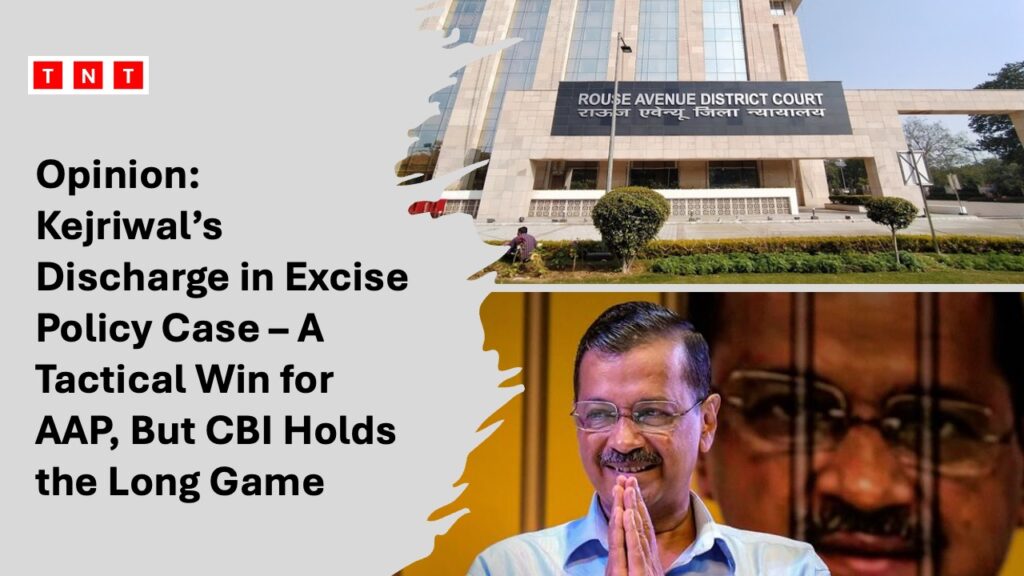
Kejriwal Excise Policy Case Verdict, Political Impact and CBI’s Long Game
February 28, 2026 | In the high-stakes drama of Indian politics, where legal battles often double as electoral
ammunition, the recent discharge in the Kejriwal excise policy case has emerged as a defining moment. The ruling
involving Arvind Kejriwal and his associates in the CBI’s Delhi Excise Policy corruption probe highlights the
clash between judicial scrutiny and investigative overreach.
On February 27, 2026, a special court at Rouse Avenue ‘discharged’ Kejriwal, former Deputy Chief Minister Manish
Sisodia, BRS leader K. Kavitha, and 20 others. The court criticised the Central Bureau of
Investigation (CBI) probe as “premeditated and choreographed.”
The 598-page order cited serious flaws. These included internal contradictions, reliance on hearsay, speculative
evidence, procedural lapses, and absence of admissible proof of bribery, quid pro quo, or criminal conspiracy. Moreover,
the court ordered an inquiry into the “erring investigating officer,” signalling institutional embarrassment for the
agency.
Predictably, AAP supporters celebrated the verdict on social media and public speeches. However, confusion soon
followed, with many equating “discharge” with “acquittal.” This raised a critical question. Is this truly a decisive
victory for Kejriwal, or merely a temporary political reprieve?
Legal Nuances: ‘Discharge’ Versus ‘Acquittal’
To understand the implications of the Kejriwal excise policy case verdict, legal distinctions must be clarified.
Under the Code of Criminal Procedure, discharge under Section 227 occurs before trial. It applies when the court finds
insufficient prima facie evidence to frame charges. In effect, it prevents weak prosecutions from proceeding.
An acquittal, under Sections 232 or 235, follows a full trial. Evidence is tested through cross-examination. The accused
is declared not guilty beyond reasonable doubt. Such a verdict triggers double jeopardy protection under Article 20(2)
of the Constitution, preventing retrial.
Therefore, discharge offers relief but lacks finality. It halts proceedings temporarily. However, it does not
conclusively establish innocence.
In Kejriwal’s case, the discharge spares him a prolonged trial. It also reduces immediate political pressure. At a time
when the Aam Aadmi Party (AAP) is preparing for electoral battles, this ruling provides strategic breathing
space.
Politically, it strengthens Kejriwal’s narrative of victimhood. He has framed the case as part of a “biggest conspiracy”
by rivals. Furthermore, the ruling weakens the parallel Enforcement Directorate probe under PMLA. Supreme Court
precedents indicate that money-laundering cases often collapse if predicate offences fail.
CBI’s Appeal Strategy and Long-Term Consequences
Despite celebratory reactions, the verdict leaves room for institutional pushback. The CBI has already filed a petition
before the Delhi High Court on February 28. It argues that the trial court ignored key aspects of the case.
If successful, the High Court could overturn the discharge, frame charges, and order a trial. Further appeals before the
Supreme Court of India also remain possible.
Additionally, under Section 173(8) CrPC, the CBI may submit a supplementary chargesheet if new evidence emerges.
However, given the court’s strong criticism, this appears unlikely without substantial fresh material.
From the agency’s perspective, discharge is preferable to acquittal. Appeals against discharge are easier to sustain. In
contrast, overturning acquittals requires proving grave judicial error. Therefore, the case remains alive, maintaining
pressure on AAP and its leadership.
This reflects a broader structural concern. Investigative agencies in India are frequently perceived as instruments of
political power. Weakly grounded cases may fail in court. Yet, the prolonged process itself damages reputations and
drains political capital.
Meanwhile, rivals, including leaders from the Bharatiya Janata Party (BJP), continue to cite the allegations to
sustain corruption narratives.
A Tactical Reprieve, Not a Final Closure
From an editorial standpoint, the Kejriwal excise policy case discharge represents a tactical win rather than a
definitive triumph.
For Kejriwal, it reinforces his underdog image. It also allows him to pivot towards governance and electoral messaging.
However, it does not provide the clean slate that an acquittal would have ensured.
For the CBI and the ruling establishment, the setback is recoverable. The appeals process enables them to prolong
scrutiny. As a result, political uncertainty continues.
More broadly, the case exposes the dangers of politicised investigations. It highlights the need for institutional
reforms that safeguard investigative autonomy. Without such reforms, legal processes risk becoming instruments of
political contestation.
In Indian democracy, courtrooms increasingly resemble battlegrounds. Until systemic safeguards are strengthened, cases
like this will remain fixtures in political discourse.
ALSO READ:
Delhi
Excise Policy Corruption Case: Court Discharge Kejriwal and Sisodia, Rebukes CBI