Unbalanced Contracts in India’s Oil & Gas Sector PSUs: Time for Reform?
Contractors are the operational backbone of India’s Oil & Gas sector—mobilising labor, machinery, and engineering expertise to turn the nation’s complex energy infrastructure visions into reality. Yet, behind the public milestones and ribbon-cuttings lies a difficult truth: these contractors work within a system that often penalises them for client delays, suppresses their ability to raise legitimate claims, and enforces silence through contractual coercion.
The Oil & Gas Sector’s PSU Dominance
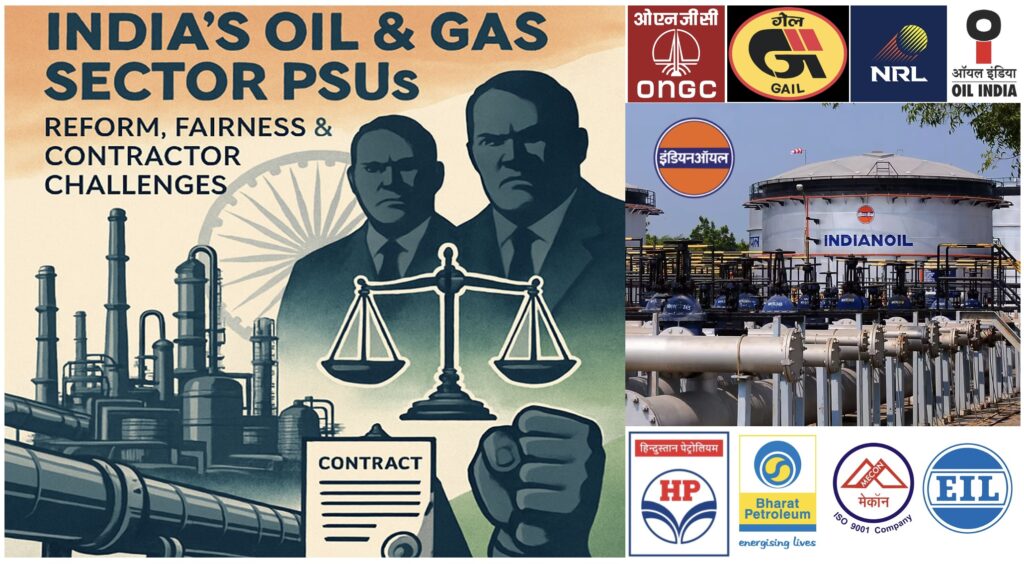
India’s energy infrastructure is largely built by a handful of powerful Public Sector Undertakings (PSUs) such as Indian Oil Corporation Limited (IOCL), Oil and Natural Gas Corporation (ONGC), Bharat Petroleum (BPCL), Hindustan Petroleum (HPCL), Gas Authority of India Limited (GAIL), Oil India Limited (OIL), and consultancy PMCs like Engineers India Limited (EIL) and MECON Limited. These PSUs handle pipelines, refineries, petrochemical plants, and gas terminals, contracting out the physical work through competitive bidding.
Despite contractors’ crucial role in executing these projects, PSUs exercise institutional power that places contractors at a structural disadvantage.
When Client Delays Become Contractor Burdens
A common but overlooked problem is how contractors bear the financial brunt of delays caused entirely by the client. These include:
Delays in handing over Right of Way (ROW) due to land compensation issues or local disputes
Slow approvals of contractor deliverables or mid-project changes
Non-availability or quality issues of free-issue materials like pipes and valves
Workfronts not ready because of administrative hurdles
While Indian Contract Law allows contractors to claim compensation and extensions in such cases, contractors face contract wordings and PSUs’ institutional practices that often block their claims. Contractors end up paying for idle manpower and machinery costs, sometimes pressured to withdraw their claims altogether.
Technical Submissions Used as Enforcement Tools
Technical submissions, such as resource deployment plans submitted during bidding, are meant to demonstrate contractor’s understanding of the scope of works and his readiness. However, PSUs often use these original bid plans rigidly as enforcement instruments—penalizing contractors for deviations even when caused by client delays or lack of site access. Threats of penalties, delayed payments, or blacklisting are common tactics that coercively enforce compliance, regardless of the contractor’s actual performance or obstacles created by the client.
This misuse of bid-stage commitments creates an unfair dynamic where contractors bear disproportionate risks and losses.
A Culture of Silence and Fear
This environment has bred a culture where contractors are afraid to speak up. Project managers hesitate to document client defaults for fear of retaliation. Letters with claims often remain unsent; correspondence becomes verbal, informal. The unspoken rule is: “Don’t rock the boat if you want timely payments or future work.” Removal clauses intended for disciplinary reasons are instead sometimes wielded to intimidate staff who raise legitimate project concerns.
Skewed Arbitration and Dispute Resolution
Even if contractors escalate disputes, the arbitration process is heavily skewed. PSU clients control the selection of arbitrators from curated panels, compromising neutrality. Fixed venues and mandatory conciliation under PSU procedural rules further tilt outcomes in favor of PSUs. This leaves contractors with little choice but to accept settlements, no matter how unfavorable.
Legal Rights Exist, But Enforcement Is Difficult
India’s courts have recognized contractors’ statutory rights to claim damages for employer-caused delays and have ruled against arbitrary blacklisting. However, enforcing these rights through arbitration or litigation is slow and costly. For many contractors, survival means compliance rather than confrontation.
Five Reforms to Restore Balance
To align contracting practices with modern infrastructure delivery needs, PSUs must move beyond outdated coercive cultures by adopting these reforms:
Independent Dispute Redressal: Establish time-bound, impartial mechanisms free from PSU influence, ensuring fair compensation for contractor losses attributable to client delays.
Fair Contract Templates: Remove exclusionary clauses that bar contractors from claiming damages for client delays or restrict claims only to certain notified events. Additional works clearly outside original scope must be compensated.
Accountability for Right of Way Delays: PSUs should own delays stemming from land acquisition or access issues and compensate contractors fairly for associated impacts.
Protect Project Staff: Ensure removal clauses target genuine performance issues only—not as tools to silence contractors or suppress claims.
Enforce a Code of Integrity in PSU Procurement: Embed transparency and fairness as non-negotiable standards beyond mere administrative checkboxes.
Conclusion
India’s PSUs have been central to nation-building. But as the sector enters a new growth phase, it’s equally critical to build fairer contracting frameworks. Contractors are not merely vendors; they are partners in progress. Suppressing their voices and penalizing them for client-side lapses is not just unjust—it is unsustainable.
Without contractors, there is no pipeline, no plant, no progress.