Greenland, Denmark Reject Trump’s Security Rhetoric as Allies Weigh U.S. Intent
Washington / Copenhagen / Nuuk, 5 January 2026 — U.S. President Donald Trump has renewed his assertion that the United States “needs” Greenland for national security reasons, citing increased Russian and Chinese activity in the Arctic. The remarks have triggered firm diplomatic rejection from Denmark and Greenland, while reopening debate over whether the statements reflect a genuine strategic shift or a familiar negotiating tactic.
Trump’s comments, delivered in interviews and public remarks in early January, framed Greenland’s geographic position and resources as critical to U.S. defence planning. He again questioned Denmark’s ability to secure the vast Arctic territory and did not explicitly rule out stronger measures, reviving language that first surfaced during his presidency in 2019.
Denmark and Greenland Reject U.S. Rhetoric
Danish Prime Minister Mette Frederiksen responded by stating that the United States “has no right to take over Greenland,” urging Washington to respect the sovereignty of a NATO ally. Greenland’s Prime Minister Jens-Frederik Nielsen described the remarks as “disrespectful” and said repeated talk of annexation must stop.
Greenland is an autonomous territory within the Kingdom of Denmark, which retains responsibility for defence and foreign affairs. Both Copenhagen and Nuuk have consistently maintained that Greenland is not for sale and that its future will be determined solely by its people.
France and several other European partners publicly reaffirmed support for Denmark and Greenland, underscoring that territorial integrity remains a core principle within NATO and the European security framework.
Why Greenland Matters Strategically
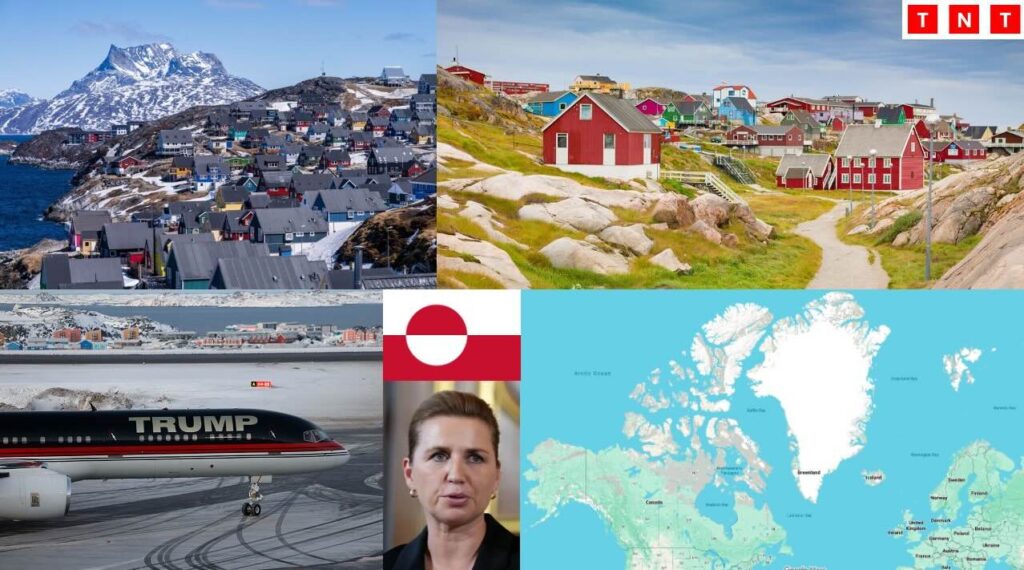
Greenland occupies a pivotal position in the Arctic, overlooking emerging polar shipping routes and hosting the U.S.-operated Pituffik Space Base (formerly Thule Air Base). The facility plays a central role in missile warning systems and space surveillance.
In addition, Greenland is believed to hold significant deposits of rare earth minerals and other critical resources, which have attracted interest from multiple global powers. Western security assessments have repeatedly highlighted China’s commercial outreach in Greenland’s mining sector and Russia’s expanding Arctic military footprint as factors reshaping the region’s strategic balance.
Historical Context of Trump’s Greenland Focus
Trump first drew international attention to Greenland in 2019, when he publicly floated the idea of purchasing the island from Denmark. The proposal was swiftly rejected, prompting a diplomatic rift and the cancellation of a planned state visit.
After returning to office, Trump again raised the issue in 2025, refusing to rule out annexation and framing Greenland as indispensable to U.S. security. While no formal policy proposal followed, the remarks unsettled European allies already grappling with heightened geopolitical uncertainty.
Assessing Trump’s Greenland Statements: Threat, Bluff, or Strategy
The renewed rhetoric has fuelled debate among diplomats and analysts over whether Trump’s statements represent an actionable threat or a pressure tactic consistent with his negotiating style.
Most security experts view outright annexation or military action as highly improbable. Greenland is part of a NATO member state, and any attempt to seize it by force would risk a severe alliance crisis, legal challenges under international law, and economic retaliation from the European Union.
At the same time, analysts acknowledge that Trump’s language is not random. It aligns with a broader pattern in which he advances extreme positions to reset negotiations, particularly on trade and security. Similar approaches were seen during tariff disputes with allies and adversaries, as well as in his dealings with North Korea and Iran.
In the Greenland context, execution is more likely to take the form of economic leverage, diplomatic pressure, or expanded U.S. access, rather than territorial acquisition. Existing defence agreements already grant Washington substantial operational freedom on the island.
Public Opinion and Alliance Constraints
Polling and surveys conducted in Greenland and Denmark over recent years have consistently shown strong oppositionto any form of U.S. takeover, alongside rising sensitivity to external pressure. Nordic partners such as Norway and Sweden have also indicated that any move undermining Danish sovereignty would face regional resistance.
These constraints, combined with NATO obligations and the economic costs of confrontation, sharply limit the range of viable options available to Washington.
Deflection or Strategic Noise?
Some observers argue that the Greenland rhetoric may also serve as a distraction or signalling device, drawing attention away from other foreign policy priorities while projecting unpredictability. Trump has previously used provocative statements to dominate media cycles, allowing parallel negotiations or domestic initiatives to proceed with less scrutiny.
Whether intentional or not, the effect has been to inject uncertainty into transatlantic relations at a moment when Arctic stability and alliance cohesion are increasingly tested.
What Comes Next
Despite the sharp language, diplomatic channels remain open, and there is no indication of imminent policy action targeting Greenland’s status. Most analysts expect the issue to subside into quieter negotiations over Arctic security cooperation, investment, and resource access.
For Denmark and Greenland, the episode has reinforced calls for clearer international backing. For the United States, it highlights the tension between strategic ambition and alliance management in an increasingly contested Arctic.