US Vice President JD Vance’s Historic Armenia Visit Reshapes Regional Strategy
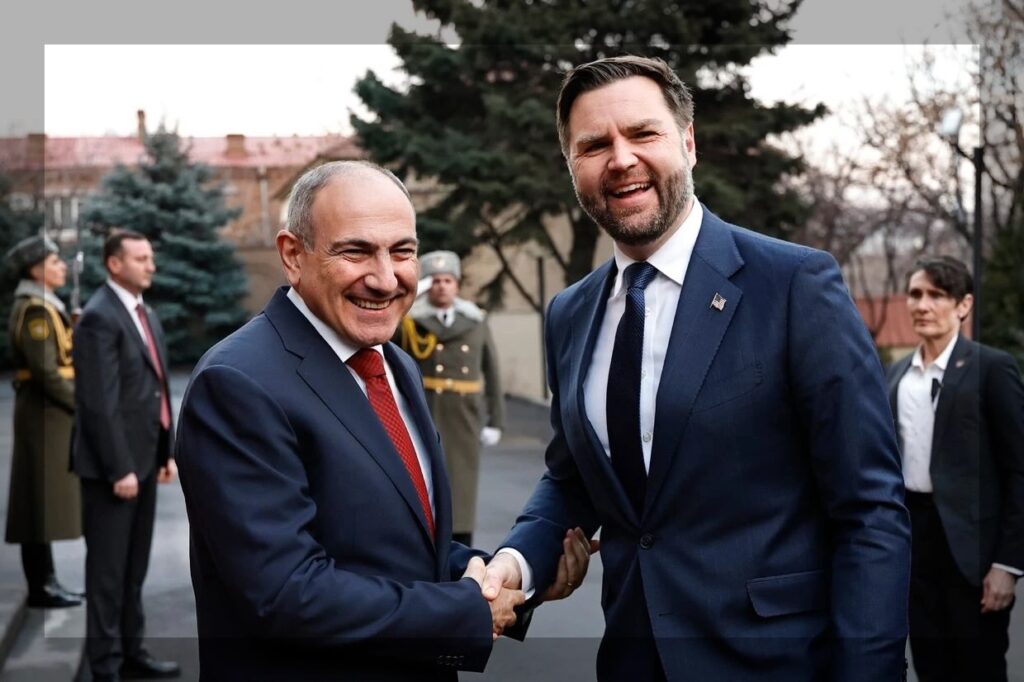
The JD Vance Armenia visit in February 2026 marks a turning point in US engagement with the South Caucasus. As the first sitting American vice president to travel to Yerevan, Vance’s presence signalled Washington’s intent to expand its strategic footprint through energy cooperation, defence ties, and direct mediation in regional connectivity and peace initiatives.
Over two days of intensive talks with Prime Minister Nikol Pashinyan, the visit produced concrete agreements that redefine Armenia’s economic and security orientation.
Symbolism and Diplomatic Signalling
Vance began his visit by laying flowers at the Tsitsernakaberd Armenian Genocide Memorial. The gesture carried deep symbolic meaning in Armenian political culture and was widely interpreted as recognition of national historical trauma.
Both leaders publicly described bilateral relations as stronger than ever. Vance characterised the meetings as highly productive, while Pashinyan framed them as evidence of Armenia’s growing international partnerships beyond traditional allies.
The symbolism reinforced the broader strategic message of the visit: Armenia is no longer confined to a single geopolitical orbit.
Section 123 Nuclear Cooperation Agreement
The centrepiece of the JD Vance Armenia visit was the conclusion of negotiations on a Section 123 Agreement for Cooperation in the Peaceful Uses of Nuclear Energy.
A joint statement formalised the framework that permits US companies to export nuclear reactors, fuel, and technical services to Armenia. According to Vance, the agreement could generate up to USD 9 billion in commercial contracts, including five billion dollars in initial exports and approximately four billion dollars in long-term service and fuel agreements.
The focus is expected to be on small modular reactors designed to replace or supplement the ageing Metsamor nuclear plant, which currently supplies nearly forty per cent of Armenia’s electricity using Russian technology and fuel.
For Yerevan, the agreement represents a pathway toward energy diversification and reduced dependence on Moscow. For Washington, it offers both economic returns and strategic leverage in a sensitive region.
A brief public controversy emerged when live translation initially referred to “investment” rather than “exports.” Official clarifications later confirmed that the figures represent projected commercial activity, not direct government funding.
Emerging Defence Cooperation Through Drone Sales
Alongside energy cooperation, the visit delivered Armenia’s first direct US defence technology acquisition. The two sides finalised an eleven million dollar sale of reconnaissance and surveillance drones.
Vance and Pashinyan jointly inspected one of the systems during the visit, underscoring the political importance attached to the deal.
Although modest in financial terms, the transaction signals a gradual shift in Armenia’s defence partnerships, traditionally dominated by Russia. Analysts view it as an opening move toward broader security cooperation with Western partners.
TRIPP Corridor and Regional Connectivity Strategy
A major focus of the talks was the Trump Route for International Peace and Prosperity, known as TRIPP. The project envisages a forty-three-kilometre multimodal corridor across southern Armenia linking Azerbaijan to its Nakhchivan exclave and onward to Turkey.
The corridor would carry road, rail, energy pipelines, and digital infrastructure. It forms part of the peace architecture outlined at the 2025 Washington Summit.
Under the arrangement, a US-backed developer holds commercial development rights, while Armenia retains full sovereignty, customs authority, taxation powers, and security control.
Vance emphasised that the project aims to deliver lasting economic benefits through transit revenue and trade integration, while reducing reliance on Russian and Iranian routes. He framed TRIPP as a mechanism for embedding peace through shared prosperity.
For Armenia, the corridor remains politically sensitive, but Washington views it as central to reshaping South Caucasus connectivity.
Momentum in Armenia–Azerbaijan Peace Talks
The JD Vance Armenia visit also served to reinforce US mediation in the Armenia–Azerbaijan peace process. Both leaders reviewed progress following recent meetings between Yerevan and Baku.
A framework treaty initialled in 2025 remains under negotiation, with unresolved issues including borders, security guarantees, and transit arrangements. Vance expressed optimism, describing the emerging agreement as viable and durable if properly supported.
Following his Yerevan meetings, Vance travelled to Baku to continue diplomatic engagement, underlining Washington’s active role on both sides of the dispute.
Strategic Cooperation Beyond Energy and Security
Beyond headline agreements, the talks explored potential collaboration in critical minerals, infrastructure development, and advanced manufacturing.
These discussions reflect US interest in securing diversified supply chains and supporting Armenia’s economic modernisation. For Yerevan, such cooperation offers access to capital, technology, and global markets.
The expanding agenda suggests that bilateral relations are evolving from symbolic partnership into structured strategic alignment.
Implications for Regional Power Balance
The JD Vance Armenia visit represents a significant recalibration of US policy in the South Caucasus. By combining nuclear cooperation, defence assistance, infrastructure investment, and peace mediation, Washington is positioning itself as a central stakeholder in regional stability.
This approach challenges Russia’s traditional dominance, limits Iranian influence, and constrains Turkey’s unilateral leverage. It also aligns Armenia more closely with Western institutions and commercial networks.
For neighbouring states, the visit signals that the United States intends to remain actively engaged in shaping post-conflict regional architecture.
Looking Ahead
The Section 123 agreement now enters legislative and regulatory review in both countries. Detailed negotiations on reactor deployment, financing, and safety standards are expected to follow.
Implementation of the TRIPP corridor will depend on continued political consensus and security guarantees. Defence cooperation is likely to expand gradually, subject to regional sensitivities.
Taken together, the February 2026 visit marks the most substantial upgrade in US–Armenian relations since independence. It reflects a deliberate strategy to integrate Armenia into a US-supported framework of energy security, regional connectivity, and conflict resolution.
As diplomatic, commercial, and security ties deepen, the JD Vance Armenia visit may come to be seen as the moment when Washington decisively embedded itself in the future of the South Caucasus.