Microsoft vs. Nayara Precedent
The Trigger: EU Sanctions, Microsoft, and the Nayara Suit
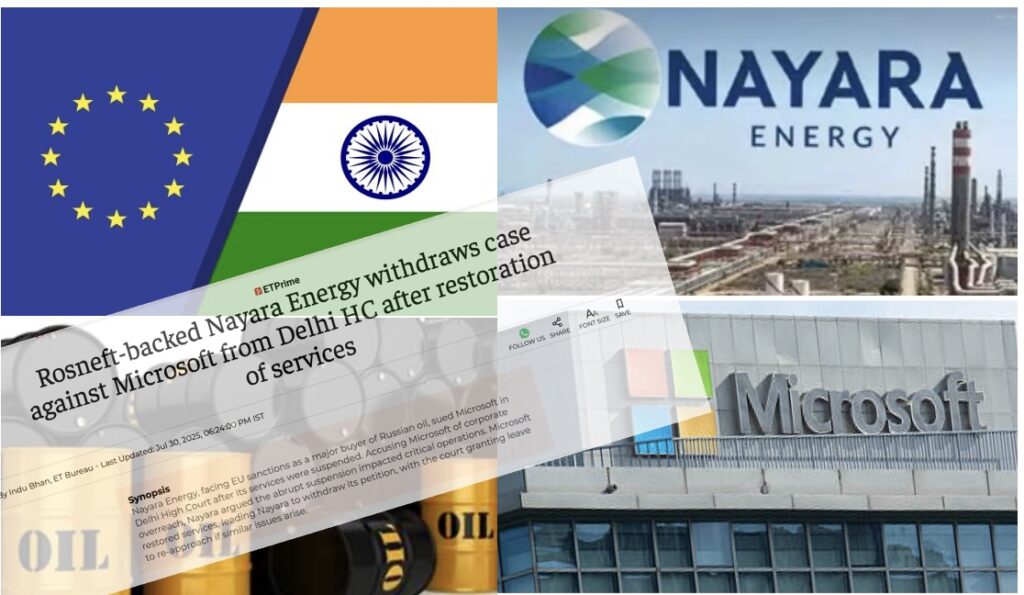
The recent episode involving Nayara Energy’s legal battle against Microsoft in the Delhi High Court encapsulates the broader legal, geopolitical, and policy anxieties facing India amid global tech compliance and cross-border sanctions. Nayara, an Indian oil refiner with Russian consortium ownership, became a target of new EU sanctions due to its ties with Rosneft. In purported compliance with these sanctions, Microsoft, a US-based global tech giant, abruptly suspended critical cloud and IT services to Nayara, disrupting its day-to-day operations.
In response, Nayara filed a suit in the Delhi High Court accusing Microsoft of “corporate overreach,” contending that neither Indian nor US law mandated such a suspension. Microsoft was charged with unilaterally cutting off access to paid-licensed products and services without prior notice, impacting Nayara’s crucial business functions in India.
TIMELINE of Microsoft Vs. Nayara Case
-
EU sanctions on Nayara announced on Jul 18, 2025
-
Microsoft suspends Nayara services on July 23, 2025
-
Nayara files a petition in Delhi High Court on July 28, 2025
-
Delhi High Court notifies Microsoft on July 29, 2025
-
Microsoft restores services to Nayara on July 30, 2025
-
Nayara withdraws its petition on July 30, 2025
-
Delhi High Court grants leave to re-approach if a hearing occurs again in future on July 30, 2025
Nayara sought an interim injunction, arguing that the suspension lacked legal basis under Indian or US law and was instead based on Microsoft’s interpretation of EU sanctions, which do not directly apply in India. The Delhi High Court intervened, leading Microsoft to restore Nayara’s access. Subsequently, the court permitted Nayara to withdraw its petition, while explicitly granting leave to re-approach if similar disruptions occur in the future
Legal Boundaries: Whose Law Prevails?
Microsoft’s decision raises urgent questions for India’s legal sovereignty:
Jurisdiction Clash: Microsoft operates in India under Indian law. EU sanctions are not binding in India; US sanctions (had they been relevant) and Indian law are the principal guidelines. Yet, global corporations like Microsoft frequently act to avoid jeopardizing their worldwide operations, risking overreach when foreign regulatory pressures conflict with local legal obligations.
Successful Local Challenge: The Delhi High Court’s intervention and Microsoft’s subsequent compliance reaffirm that within Indian borders, Indian legal jurisdiction is paramount — even for global service providers.
Corporate Signalling: Was a Veiled Threat Involved?
Some argue that Microsoft’s abrupt suspension was more than mere compliance; it also served as a corporate signal—a message not only to Nayara but also to the Indian government and industry.
Pressure Tactic: Microsoft’s suspension functioned not only as a measure of sanction compliance but also as a way to signal to Indian authorities and businesses that global sanction regimes—and the companies enforcing them—wield significant influence, even if their actions are not fully grounded in local law. Ultimately, such moves place implicit pressure on the government, warning of the broader risks associated with relying on foreign technology amid extraterritorial sanction threats.
Sovereignty and Autonomy: From India’s perspective, such corporate actions risk being seen as challenges to the country’s sovereign jurisdiction. The government may interpret this as indirect external political pressure, which can feel like a veiled threat. Sudden service cuts—especially when they impact critical sectors like energy—can come across as infringements on sovereignty, potentially influencing policy decisions related to technological self-sufficiency and strategic autonomy.
Is This a Public Interest Issue – a matter for PIL?
At the core, the original suit was a private matter, targeting harm done to Nayara. But the scale of Microsoft’s services — spanning not just industry but health, pharma, defence, and routine public infrastructure — raises serious consideration:
PIL Criteria: Indian courts entertain PILs when an issue endangers larger public welfare — the right to life, health, safety, or access to essential services.
Broader Impact: If Microsoft ever withdrew or restricted widespread services like Windows OS at scale, the resulting impact could threaten the public interest and justify PIL. Even now, the case reveals how the disruption of such foundational IT services extends beyond “business as usual,” implicating national welfare and strategic interests.
Standing and Gravity: The courts would need clear evidence that such disruptions tangibly harm the broader populace and not just commercial stakeholders. With digital services now underpinning everything from hospitals to national security, the threshold for PIL relevance is arguably met if the scope broadens beyond individual companies.
Should Microsoft Face Further Penalties?
With the petition withdrawn after Microsoft restored services, punitive action by the court is rare:
Legal Recourse: Courts generally issue penalties for ongoing or proven violations, not as retribution after voluntary restoration. Nayara’s retained right to re-approach remains an appropriate legal safeguard.
Policy Tools: The real answer may be regulatory rather than judicial. The government could require advance notice for service disruptions, mandate local data and service redundancy, or penalize abrupt, unjustified service cuts affecting core sectors.
Geopolitical and Market Implications
Microsoft’s initial action, while reversed, brought reputational attention to the vulnerabilities in India’s tech ecosystem:
Erosion of Trust and Damage to Market Position: Microsoft’s abrupt suspension has dented its image as a stable, neutral service provider in India. Microsoft, though still dominant, the incident has raised questions about its reliability given external geopolitical pressures influencing its India operations.
Government Scrutiny: This has intensified calls for the government to reduce dependence on foreign tech services for critical sectors such as defence, public health, and finance. Relying on multinational corporations vulnerable to extraterritorial sanctions or geopolitical shifts poses strategic risks.
Catalyst for Indigenous Alternatives: The incident adds momentum to the push for developing Indian technological alternatives — open-source software solutions, sovereign cloud infrastructure, and domestic operating systems. Such initiatives aim not only at strategic autonomy but also at safeguarding against unpredictable service disruptions dictated by foreign regulatory regimes.
Market Opportunity: Indian startups and established IT firms have a clear opening to innovate and provide robust, locally controlled alternatives tailored to Indian legal and security requirements.
The PIL Argument Revisited
As highlighted, a strong case exists that disruptions to widely-used digital services could be framed as a PIL, especially with implications for public health, national defence, or routine citizen welfare. Indian legal doctrine, which upholds public access to essential services as a constitutional right, supports such broad PIL scope when evidence of tangible harm exists.
Conclusion
The Nayara-Microsoft episode is a warning shot — foreign multinationals cannot take Indian legal sovereignty lightly, and the government must proactively address risks from extraterritorial regulatory spillovers. As digital infrastructure becomes as essential as roads or electricity, courts and policymakers should be vigilant — ensuring that global compliance never tramples local interests, and that recourse remains open both for companies and the public.
Microsoft’s unilateral suspension, and the resulting reputational damage, have made clear the need for India to accelerate its efforts toward digital self-reliance. Legal sovereignty, regulatory clarity, and technological innovation must combine to protect India’s critical infrastructure and strategic autonomy in an increasingly complex global tech landscape.
This case is more than a contractual dispute; it is a precedent in India’s journey to digital sovereignty and effective public interest protection in a globalized world, and it is a turning point in India’s pursuit of digital sovereignty. It underscores the urgency of building indigenous technologies and platforms that reduce dependence on foreign service providers, whose unilateral actions can jeopardize national interests. By fostering domestic innovation alongside clear regulatory safeguards, India can ensure that critical digital infrastructure remains resilient, accountable, and firmly aligned with public interest in an interconnected but uncertain global tech order.