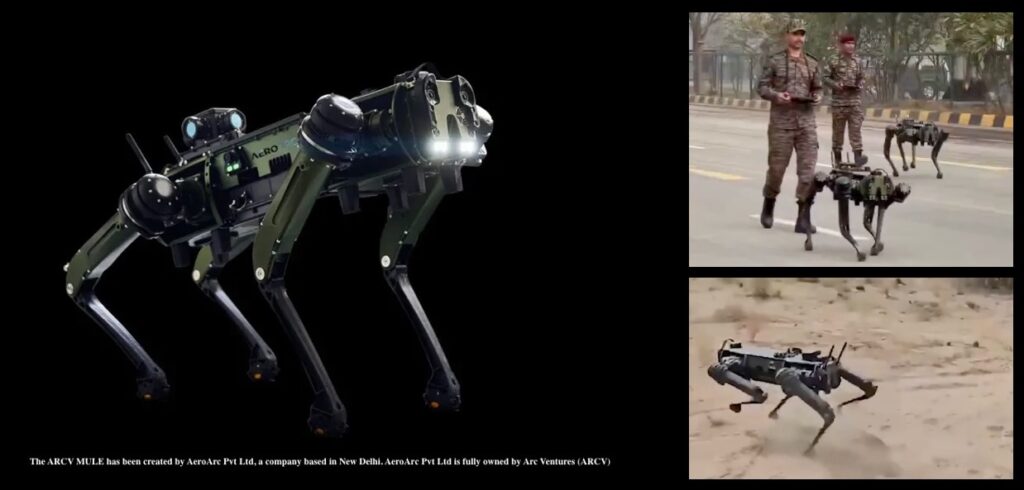
Indian Army MULE Robot and the Rise of AI Warfare on India’s Frontiers
18 February 2026, New Delhi | Against the backdrop of the ongoing Artificial Intelligence Summit in New Delhi, where emerging technologies and strategic applications of artificial intelligence were in focus, attention has increasingly shifted to how AI-driven systems are reshaping security and defence operations. The growing emphasis on autonomous surveillance, intelligent logistics, and human–machine coordination reflects a broader transition towards technology-led warfare and border management. Against this backdrop, the Indian Army’s deployment of the Indian Army MULE Robot stands out as a practical example of how artificial intelligence is already transforming military operations on the ground.
The MULE, which stands for Multi-Utility Legged Equipment, is a quadrupedal robotic platform developed to support Indian Army operations in high-risk and difficult terrains.
Over the past two years, the Army has quietly inducted these robotic quadrupeds across sensitive sectors, signalling a decisive shift towards technology-led border management.
Indian Army MULE Robot and Indigenous Development
The Indian Army MULE Robot—short for Multi-Utility Legged Equipment—has been developed under India’s defence indigenisation programme. The system reflects close cooperation between the Army and domestic technology firms.
A major supplier is AeroArc, which delivered the first batch of military-grade quadruped robots in 2023. These platforms form the foundation of current field deployments.
Another contributor is Bhairav Robotics, whose “Shvana” unmanned ground vehicle shares similar design philosophies and operational goals.
Technical integration and legacy robotics expertise have also drawn from Defence Research and Development Organisation (DRDO), particularly in explosive detection and remote operations.
Together, these efforts have produced a platform tailored for India’s mountainous, desert, and high-altitude conditions.
Deployment Along Strategic Borders
The Indian Army has deployed the Indian Army MULE Robot primarily in forward areas along the Line of Control (LoC)and the Line of Actual Control (LAC).
These regions demand constant surveillance, rapid response, and reliable logistics support. Traditional patrols and animal transport systems face limitations in such environments.
MULE units now assist troops in anti-infiltration grids, high-altitude posts, and remote observation bases. By early 2026, around 100 units had entered operational service, with further expansion under evaluation.
In addition, the robots have been tested in desert warfare exercises and mountainous field trials, demonstrating reliable performance under extreme temperatures.
Technical Specifications and Sensor Architecture
The Indian Army MULE Robot has been designed for durability, stability, and long-duration missions.
Key technical specifications include:
- Weight: Approximately 51–52 kg (including battery)
- Payload Capacity: 12–15 kg
- Maximum Speed: Up to 10 km/h
- Battery Endurance: Up to 20 hours (including standby)
- Mobility: Climbs stairs, crosses obstacles, handles 45-degree slopes, snow, and rocky terrain
One of the most important features is its advanced sensor architecture.
MULE is equipped with:
- Thermal imaging cameras
- High-resolution optical cameras
- Short-range radar systems
- LiDAR-based depth-mapping sensors
- 360-degree environmental awareness modules
These systems are integrated into a compact “head” assembly that enables real-time terrain analysis, obstacle detection, and threat identification. Radar and LiDAR together provide accurate navigation in fog, snow, darkness, and dust-heavy environments.
This sensor fusion allows MULE to operate effectively in conditions where human vision and conventional equipment face limitations.
AI-Driven Autonomy and Control Systems
Artificial intelligence forms the operational backbone of the Indian Army MULE Robot.
The platform supports dual-mode functioning.
Remote-Controlled Mode
Operators control the robot through secure Wi-Fi or LTE networks. This mode is used for precision missions such as bomb inspection, close reconnaissance, and supply delivery.
Autonomous Mode
In autonomous operations, MULE executes pre-programmed missions with minimal human input. Onboard AI processes data from cameras, radar, and LiDAR to make real-time movement decisions.
Key AI functions include:
- Dynamic path planning
- Obstacle avoidance
- Terrain adaptation
- Gait and balance optimisation
- Waypoint navigation
- “Follow-me” troop support mode
Advanced processors run machine-learning models for situational awareness and navigation. As a result, MULE can patrol assigned routes, monitor perimeters, and transport supplies independently.
However, critical decisions remain under human supervision, in line with ethical AI principles.
Operational Roles and Battlefield Applications
The Indian Army MULE Robot functions as a multi-mission platform rather than a single-purpose machine.
Surveillance and Reconnaissance: MULE provides real-time video and thermal feeds from hostile zones. It supports operations in chemical, biological, and hazardous environments.
Bomb Detection and Disposal: Equipped with detection tools, it inspects suspicious objects, tunnels, and abandoned structures before bomb disposal teams intervene.
Logistics Support: The robot carries ammunition, medical kits, food supplies, and communication equipment in difficult terrain, reducing soldier fatigue.
Combat Support: While no standard weaponised version is officially confirmed, modular design allows limited payload integration under human control.
Perimeter Security: MULE patrols sensitive installations, border outposts, and infiltration-prone routes on a continuous basis.
These roles collectively enhance operational efficiency and troop safety.
Public Showcases and Growing Visibility
The Indian Army MULE Robot gained national attention after appearing in Republic Day and Army Day parades in recent years.
Demonstrations in Kolkata, Gangtok, Pune and New Delhi generated widespread interest on social media platforms.
A unit informally named “Sanjay” became particularly popular, symbolising the Army’s technological modernisation.
While public reactions have been largely positive, some observers have expressed nostalgia for traditional pack animals. Military officials, however, maintain that robotic systems are designed to complement human capabilities, not replace them.
Strategic Significance and Future Outlook
From a strategic perspective, the Indian Army MULE Robot delivers three major advantages.
First, it reduces casualties by taking over high-risk reconnaissance and inspection tasks.
Second, it acts as a force multiplier, allowing fewer soldiers to cover wider operational areas.
Third, it integrates seamlessly with drones, surveillance networks, and command systems.
Looking ahead, the Army is evaluating upgrades such as improved batteries, swarm coordination, satellite connectivity, and deeper AI integration. Future variants may operate alongside aerial drones as part of coordinated human-machine teams.
This approach aligns India with global trends in autonomous defence systems.
A Quiet Transformation on the Frontlines
The induction of the Indian Army MULE Robot represents more than a technological experiment. It reflects a fundamental change in how the Army approaches mobility, surveillance, and risk management.
By combining indigenous manufacturing, radar-LiDAR sensor fusion, and AI-driven autonomy, MULE has moved from concept to operational reality. As border challenges continue to evolve, this four-legged machine is likely to become a permanent feature of India’s defence architecture.