DRDO’s SFDR Success Puts India in Elite Ramjet Missile Club
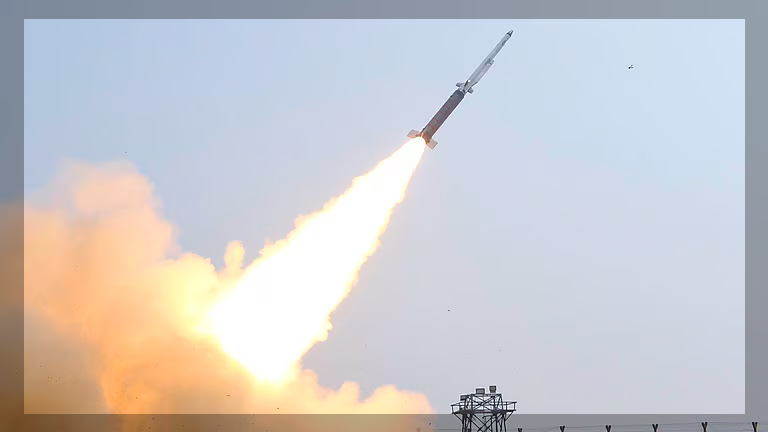
India has taken a major leap in defence technology with the successful demonstration of DRDO SFDR missile technology on February 3, 2026. The test was conducted from the Integrated Test Range at Chandipur, Odisha, at around 10:45 AM. This achievement places India among a select group of nations possessing advanced solid fuel ducted ramjet propulsion systems for long-range air-to-air missiles.
The development has been confirmed in an official statements from DRDO and ANI. The successful trial marks a critical milestone in India’s quest for sustained air superiority and advanced missile capabilities.
Successful Demonstration at Chandipur Test Range
The flight test was carried out from the Integrated Test Range located off the Odisha coast. The missile system demonstrated stable ignition, sustained combustion, and controlled flight throughout the mission profile.
According to defence officials, all mission objectives were met successfully. The system validated the operational reliability of the propulsion module under real flight conditions.
In addition, telemetry and radar tracking confirmed accurate performance across all phases of the test. This strengthens confidence in the system’s readiness for further weaponisation.
Understanding Solid Fuel Ducted Ramjet Technology
Solid Fuel Ducted Ramjet, or SFDR, is an advanced air-breathing propulsion system. It combines the reliability of solid fuel with the efficiency of ramjet combustion.
Unlike conventional rocket motors, SFDR systems do not carry oxidisers. Instead, they use atmospheric oxygen for combustion. This allows sustained thrust over long distances.
As a result, missiles equipped with SFDR technology can maintain high supersonic speeds for extended periods. This improves range, energy retention, and terminal manoeuvrability.
Why the 2026 Test Is Being Called a Breakthrough
Although DRDO successfully conducted an SFDR technology demonstration in December 2024, that earlier test primarily validated critical subsystems and basic in-flight combustion. It confirmed that the solid fuel ducted ramjet concept could function under controlled flight conditions. However, it did not establish full operational reliability.
The February 2026 trial went significantly further. It demonstrated the complete propulsion cycle, including stable ignition, sustained supersonic cruise, fuel regulation, and terminal shutdown under realistic mission profiles. More importantly, it validated the system’s performance across all flight phases, a prerequisite for combat integration.
In practical terms, the 2024 test proved feasibility, while the 2026 demonstration proved maturity. The latest trial indicates that the technology is now ready for weaponisation and platform integration, making it a genuine operational breakthrough rather than a mere experimental success.
Enabling Long-Range Air-to-Air Missiles
The successful SFDR demonstration directly supports the development of next-generation Indian air-to-air missiles. The technology will power the Astra Mk-3, also known as Gandiva.
This missile is expected to have a range exceeding 300 kilometres. It will offer sustained supersonic cruise and an expanded no-escape zone.
Consequently, Indian fighter aircraft will be able to engage hostile targets much earlier and with greater probability of success.
This capability significantly enhances the Indian Air Force’s beyond-visual-range combat effectiveness.
India Joins an Exclusive Global Technology Club
With this achievement, India has joined a very small group of nations mastering advanced ramjet missile propulsion.
Europe and the Meteor Programme
The European consortium led by MBDA operates the Meteor missile. It has been in service since 2016–17 and equips aircraft such as Rafale, Typhoon, and Gripen.
Meteor remains the only widely deployed operational ramjet BVR missile system.
China’s Ramjet and Dual-Pulse Developments
China fields the PL-15 missile and is developing the PL-21. These systems provide extended-range engagement capability for platforms such as the J-20.
Chinese programmes are considered near-operational in advanced propulsion technology.
India’s SFDR Programme
India’s SFDR programme now places it firmly in this elite category. The indigenous system enables future weapons like Astra Mk-3 with sustained supersonic performance.
Notably, India is among the few countries to publicly demonstrate a mature solid-fuel ducted ramjet system for air combat.
Turkey’s Emerging Capabilities
Turkey is developing Gökhan and Gökbora ramjet missiles for future fighter platforms. These projects remain in advanced research and testing phases.
Strategic Impact on Regional Air Superiority
The success of DRDO SFDR missile technology has major strategic implications. It strengthens India’s deterrence posture in the Indo-Pacific region.
Against adversaries such as China and Pakistan, long-range ramjet-powered missiles provide decisive tactical advantages. They reduce reaction time for enemy aircraft and restrict operational freedom.
Furthermore, these systems enhance survivability of Indian fighters by enabling stand-off engagements.
As a result, India’s air combat doctrine receives a substantial technological boost.
Strengthening Indigenous Defence Ecosystem
The SFDR success also highlights the growing maturity of India’s defence research ecosystem.
DRDO laboratories, public sector units, and private industry partners contributed to propulsion, materials, guidance, and testing systems.
This collaboration aligns with the government’s Atmanirbhar Bharat initiative. It reduces dependence on foreign suppliers for critical combat technologies.
In addition, indigenous mastery of ramjet propulsion opens new opportunities for exports and international partnerships.
Road Ahead: From Demonstration to Deployment
Following this successful test, DRDO will focus on weaponisation and platform integration. Further trials will refine guidance, seeker integration, and combat readiness.
The Astra Mk-3 programme is expected to benefit directly from this propulsion breakthrough. Operational deployment may follow after comprehensive user evaluations.
Meanwhile, the defence establishment is likely to accelerate parallel developments in sensors, networking, and electronic warfare support.
India’s Growing Position in Advanced Missile Technology
India’s SFDR breakthrough represents more than a technical milestone. It reflects long-term investment in scientific capability and strategic autonomy.
While only a few nations have achieved similar mastery, India has now demonstrated its ability to compete at the highest technological level.
As defence modernisation continues, such achievements will play a central role in safeguarding national security and maintaining regional stability.