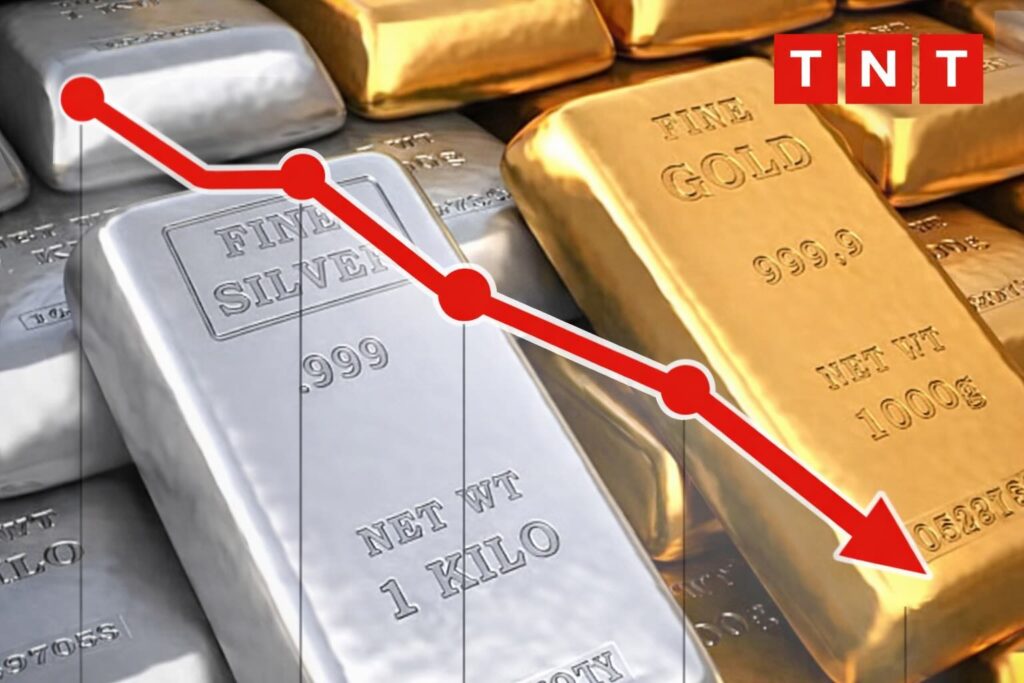
The Volatile Journey of Gold and Silver: From Historic Peaks to Sharp Declines in 2025–2026
Year 2025 marked a period of unprecedented Gold Silver Price Volatility, driven by geopolitical tensions, economic policies, and shifting global demand. Prices surged to historic highs in early 2026 amid fears of trade wars, inflation, and a weakening US dollar. However, markets soon witnessed a sharp correction in February as stability returned and investors booked profits.
This article examines international prices in USD per ounce and local rates in INR per gram for 24-karat gold in Delhi. In addition, it presents parallel insights for silver. Using recent market data, it analyses the rise, peak, fall, and continuing downward trend, while offering a forward-looking perspective.
Gold’s Rollercoaster Ride: Surge, Summit, and Slump
Gold, widely regarded as the ultimate safe-haven asset, recorded explosive growth in 2025. This surge culminated in record highs in January 2026. However, the rally reversed rapidly as global conditions improved.
Investors viewed gold as protection against uncertainty. As a result, demand increased sharply. Nevertheless, easing geopolitical tensions and changing monetary policies triggered a decline.
The Sudden Rise to Historical Highs
Throughout 2025, international gold prices rose by more than 65%. This growth resulted from US tariff uncertainties under the Trump administration, persistent inflation, and aggressive central bank purchases.
In addition, geopolitical risks such as US–China trade frictions and regional instability intensified demand. Meanwhile, the US dollar weakened by nearly 10% against major currencies. Consequently, gold became more attractive as a hedge against currency debasement.
By early 2026, these pressures intensified further. Central banks in emerging markets increased reserves amid de-dollarisation efforts. At the same time, exchange-traded funds received strong inflows. Therefore, gold prices reached unprecedented levels.
Peak Prices
At the international level, gold reached an all-time high of USD 5,608.35 per ounce in January 2026. Other reports confirmed prices between USD 5,598 and USD 5,602 on January 28 and 29. This represented a year-on-year increase of nearly 67%.
In Delhi, 24-karat gold reflected this global rally. Prices touched ₹18,305 per gram (₹1,83,050 per 10 grams) on January 29, 2026. Rupee depreciation and strong festive demand contributed significantly to this rise.
Dramatic Fall and Continued Decline
The upward momentum proved short-lived. By mid-February 2026, prices corrected sharply. Gold declined by nearly 12 to 15% from peak levels.
This fall occurred due to profit-taking, reduced holiday trading volumes, and signals of policy stabilisation in the United States. Furthermore, the nomination of Kevin Warsh as Federal Reserve Chair strengthened expectations of higher interest rates. As a result, the US dollar strengthened, raising the opportunity cost of holding gold.
In addition, resolved tariff reviews on critical minerals reduced market uncertainty. Consequently, investors accelerated sell-offs.
As of February 17, 2026, international gold traded between USD 4,906 and USD 4,918 per ounce, reflecting a daily decline of around 1.7 to 1.8%. In Delhi, prices ranged between ₹15,506 and ₹15,802 per gram, indicating a decline of ₹153 to ₹1,530 per gram or per 10 grams from recent highs.
During 2025, average international prices stood at USD 4,336.64 per ounce, while Delhi prices ranged approximately between ₹10,500 and ₹13,000 per gram.
Key Factors Behind the Movements
The rise in gold prices resulted mainly from geopolitical risks, Middle East tensions, and US tariff policies. Central bank purchases exceeding 1,000 tonnes annually also supported prices. In addition, a weakening dollar and inflation fears reinforced demand.
Conversely, the fall followed overbought market conditions. A stronger dollar, changing Federal Reserve policies, and reduced uncertainty after tariff resolutions further accelerated the decline.
Silver’s Even Wilder Trajectory: Industrial Boom Meets Market Correction
Silver experienced even greater volatility than gold. During 2025, prices surged by more than 160%. However, this rally ended in a sharper correction.
Silver’s dual role as a precious and industrial metal amplified market fluctuations. While industrial demand supported growth, supply constraints and speculation increased risk.
The Sudden Rise to Historical Highs
Silver’s rally in 2025 was driven by structural supply deficits. Global supply declined to nearly 1.03 billion ounces. Meanwhile, demand surged due to solar panels, electric vehicles, AI data centres, and electronics.
The market recorded its fifth consecutive year of deficit, with a shortfall of 118 million ounces in 2025. In addition, China’s export restrictions in early 2026 intensified supply shortages.
Therefore, silver prices rose rapidly, supported by both industrial and safe-haven demand.
Peak Prices
International silver prices reached USD 121.64 to USD 121.67 per ounce in January 2026, reflecting a year-on-year rise exceeding 126%.
In Delhi, silver touched ₹345.29 per gram (₹3,45,290 per kg) on January 29, 2026. In some regional markets, prices reportedly reached between ₹400 and ₹410 per gram.
Dramatic Fall and Continued Decline
Silver prices declined more sharply than gold. Over the following month, prices dropped by nearly 21%.
This fall resulted from margin calls, technology stock corrections, and easing fears over industrial demand. Furthermore, thin trading volumes and resolved US tariff policies on critical minerals contributed to the correction.
Although retail demand in Asia provided limited support, overall momentum weakened.
As of February 17, 2026, international silver traded between USD 74.47 and USD 76.54 per ounce, reflecting a daily decline of around 1.27%. In Delhi, prices ranged between ₹260 and ₹285 per gram, equivalent to ₹2,60,000 to ₹2,84,900 per kg.
During 2025, average international prices stood at USD 76.25 per ounce, while Delhi prices averaged approximately ₹262 per gram.
Key Factors Behind the Movements
Silver’s rise was driven by strong industrial demand from solar, electric vehicles, and AI sectors. Persistent supply deficits, China’s export curbs, and safe-haven flows also supported prices.
However, overbought conditions, technology market corrections, a stronger dollar, and partial tariff resolutions reduced urgency. Consequently, prices declined.
Outlook: Stabilisation or Further Volatility?
Market analysts project moderate gains for gold, with forecasts around USD 5,094 by the end of Q1 and USD 5,460 over 12 months. Silver is expected to average nearly USD 81 in 2026. However, industrial slowdowns remain a significant risk.
Persistent supply deficits may support price floors. Nevertheless, rising interest rates or stronger economic recovery could extend declines.
In India, local factors such as import duties of 15% and rupee movements will continue to influence Delhi prices.
Investors are advised to maintain diversified portfolios and accumulate precious metals during price corrections. Gold and silver remain important hedges against global uncertainties. However, historical trends indicate that sharp crashes remain possible if confidence in fiat currencies improves. Therefore, consulting financial advisors for personalised strategies remains essential.