EU Refuses to Recognise Delcy Rodríguez as Interim President as Venezuela Crisis Deepens
The European Commission has stated that it does not recognise the legitimacy
of Venezuela’s new interim president, Delcy Rodríguez, extending its
long-standing refusal to recognise Nicolás Maduro, even as it keeps channels open for what it terms
“targeted engagement” with Caracas. The position underscores a widening
international divide following the dramatic U.S. capture of Maduro,
which has reshaped Venezuela’s political landscape overnight.
Rodríguez’s sudden elevation has intensified disagreement between Washington, European
capitals, United Nations officials, and regional actors. While the United States signals conditional cooperation,
the European Union and others continue to anchor their response in international law, democratic
legitimacy, and human rights standards.
EU Position: No Recognition, Limited Engagement
European Commission spokesperson Anitta Hipper told reporters in Brussels that the EU does not recognise Rodríguez’s interim presidency.
She said Venezuela’s leadership derives its authority from electoral processes that failed to respect the
will of the people for democratic change. This reasoning mirrors the bloc’s
earlier refusal to recognise Maduro.
At the same time, the EU has opted to maintain “targeted engagement” with Venezuelan authorities. This formulation allows technical and diplomatic contact to
protect European interests without conferring political legitimacy. Officials have described it as a pragmatic
approach amid uncertainty on the ground.
How Delcy Rodríguez Assumed Power
Delcy Rodríguez, a 56-year-old lawyer and long-time Chavista insider, served as vice
president and oil minister under Maduro. Since 2018, she oversaw key areas of Venezuela’s crisis-hit economy and
intelligence apparatus, making her one of the most powerful figures within the ruling elite.
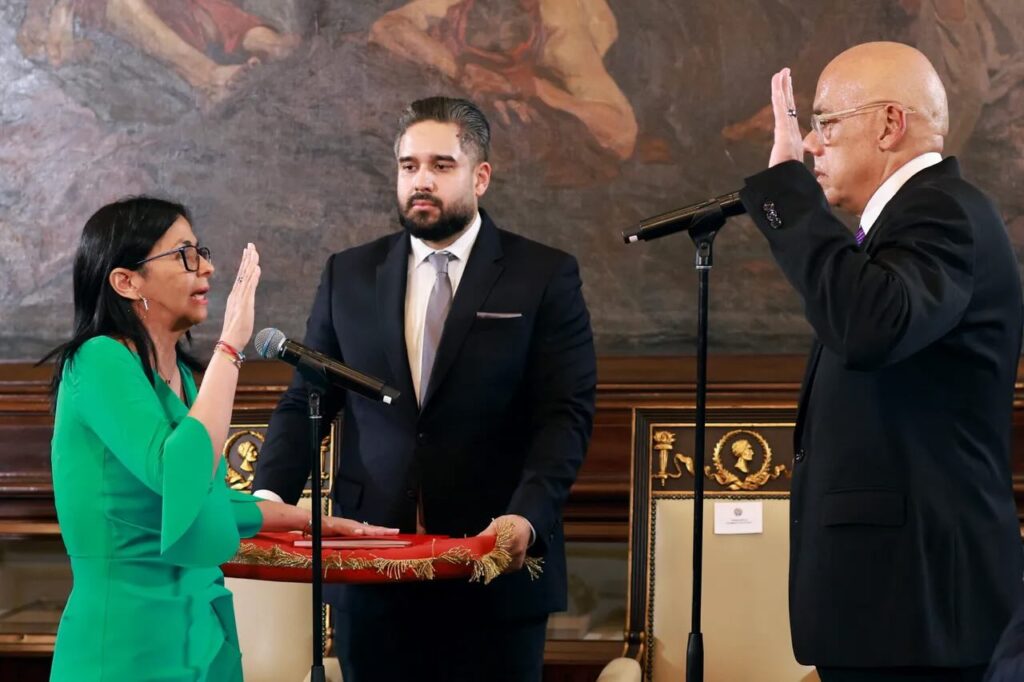
She was sworn in as interim president on January 5, 2026, during a session of the National Assembly led by her brother, Jorge
Rodríguez. The move came just two days after a U.S. special operation
captured Maduro and his wife, Cilia Flores, in Caracas. Both were transferred to
New York to face drug-trafficking charges.
Washington Signals Conditional Cooperation
U.S. President Donald Trump has publicly
indicated a willingness to “work with” Rodríguez as a transitional figure. However, he has also warned that her tenure could be
brief. His remarks implied that continued U.S. engagement depends on alignment with Washington’s expectations for a
“safe and proper” transition.
This conditional stance contrasts sharply with the EU’s refusal to recognise Rodríguez
at all. It has added to confusion over whether the interim presidency represents continuity, transition, or a
tactical pause in Venezuela’s power struggle.
UN Focuses on Legality and Sovereignty
At the United Nations, Secretary-General António Guterres and several Security Council members have avoided endorsing any individual leader.
Instead, they have focused on the legality of the U.S. operation and
the importance of Venezuelan sovereignty.
UN officials have repeatedly stressed the need for the “power of law” to prevail over the “law of power.” They
have urged restraint, warning that unilateral actions risk eroding international norms and destabilising the region
further.
Elections at the Centre of the Legitimacy Debate
The EU’s position is rooted in its assessment of Venezuela’s recent elections.
Particular emphasis has fallen on the disputed 2024 presidential vote,
in which Maduro claimed a third term. Independent observers reported severe irregularities and the absence of
credible official results.
Opposition tallies suggested that challenger Edmundo González actually won the election. These concerns revive memories of the 2018
election, after which parts of the West briefly recognised opposition leader
Juan Guaidó. Human rights groups have since documented mass arrests and lethal force used against protesters
alleging electoral fraud.
What Rodríguez Represents Politically
Analysts describe Rodríguez as both a loyalist and a hardliner. She has been sanctioned
by the EU, United States, and other Western governments for
undermining democracy and the rule of law. Her rise is widely seen as preserving the existing power structure around
the Chavista elite rather than signalling genuine reform.
Think-tank experts argue that her interim presidency could follow one of two paths. It
may entrench Maduro-era authoritarianism with backing from Russia, China, Iran, and Cuba. Alternatively, it could become a pressured bridge to negotiations if domestic unrest and
external leverage converge on a roadmap towards credible elections.
Machado Rejects Rodríguez and Demands Elections
Venezuela’s opposition leader María Corina Machado has categorically rejected Rodríguez’s authority. Speaking from hiding, she vowed to
return home “as soon as possible” and demanded free and fair elections,
claiming the opposition won the 2024 vote by a landslide.
Machado, who won the Nobel Peace Prize in 2025, praised Trump’s action against Maduro while accusing Rodríguez of being a
corrupt architect of persecution. She said Venezuelans are ready to
enforce their electoral mandate and restore constitutional order.
Opposition Push and Military Appeals
Machado’s movement claims its candidate, Edmundo González, defeated Maduro by a wide
margin based on tallies from over 80% of voting machines. Those
results were rejected by Venezuela’s court-aligned electoral council.
From exile, González echoed calls for the military to uphold the election
outcome, release political prisoners, and respect the people’s will. Meanwhile,
Venezuelan authorities have launched fresh arrests amid street protests, reinforcing opposition claims that
repression is continuing under Rodríguez.
Global Stakes and Uncertain Trajectory
Reports of CIA involvement in supporting Maduro’s capture have added another layer of
controversy. While Washington has stopped short of publicly calling for regime change, the operation has already
altered diplomatic calculations across Europe and Latin America.
As the EU withholds recognition, the US signals conditional engagement, and the
opposition mobilises for elections, Venezuela stands at a critical crossroads. The struggle over legitimacy now
extends far beyond Caracas, raising fundamental questions about sovereignty, intervention, and the future of
democratic norms in a rapidly polarising global order.