U.S. Military Operation in Venezuela Captures President Nicolás Maduro
In the early hours of January 3, 2026,
Venezuela was jolted awake by a series of explosions across Caracas and surrounding regions, as the United
States launched a sudden, large-scale military
operation that resulted in the reported capture of President Nicolás
Maduro and First Lady Cilia Flores. The rapid escalation, executed in under an
hour, has triggered global diplomatic fallout and renewed debate over sovereignty, international law, and regime
change by force.
Residents reported being awakened around 2:30 a.m. local time by loud blasts, low-flying aircraft, and helicopter
fire. With no immediate official
information, Venezuelans began sharing videos through messaging platforms and social media, which quickly went
viral. The footage showed explosions, fires, and helicopters manoeuvring over urban areas, creating what observers
described as a real-time, citizen-driven account of the unfolding operation.
Explosions Hit Strategic Military and Government Sites
Explosions were reported at several high-value locations, including La Carlota
air base, the Fuerte Tiuna military complex, the Federal Legislative Palace, and the
port of La Guaira. Additional activity was reported in Miranda
and Aragua states, including near Maracay, one of the country’s most significant military centres.
Smoke and fires were visible from multiple neighbourhoods, while CNN footage later
showed deserted streets around La Carlota following the strikes. Eyewitnesses reported helicopters flying at low
altitude and deploying munitions, while gunfire echoed intermittently in parts of the capital.
Despite the intensity of the initial assault, there were no verified reports of
widespread damage to civilian infrastructure, power grids, or oil facilities during the operation.
Rapid, Precision Strike and Absence of Venezuelan Defence Response
Multiple military analysts and eyewitness accounts indicate that the U.S. operation was
highly selective, tightly sequenced, and time-bound, focusing on strategic
command, aviation, and leadership-linked locations rather than broad civilian or economic targets.
Strikes were concentrated on La Carlota, Fuerte Tiuna, and La Guaira
port, all critical nodes within Venezuela’s command-and-control and rapid
response architecture. There were no confirmed reports of sustained bombardment beyond these sites, reinforcing
assessments that the action resembled a precision decapitation operation rather than a prolonged military
campaign.
More striking was the near-total absence of a layered Venezuelan defence
response. Despite repeated official claims over the years of possessing advanced
air defence systems, there were no confirmed interceptions by Sukhoi fighter aircraft, no visible activation of
Russian-supplied missile batteries, and no deployment of Iranian-origin drones. Anti-aircraft fire appeared limited
to sporadic heavy machine-gun fire at La Guaira port, with no evidence of coordinated national air defence
engagement.
The locals were completely unaware of the situation. President Nicolás Maduro did not
address the nation during or immediately after the strikes, breaking with precedent during previous crises. This
silence, combined with the lack of air and missile defence activation, immediately raised questions among observers
about command continuity within the Venezuelan armed forces.
The absence of resistance has prompted speculation over multiple possible explanations,
including internal compromise, command paralysis, pre-emptive neutralisation of key defence nodes, or
prior arrangements within sections of the security establishment. Some
commentators have also questioned whether elements within the system were incentivised, coerced, or
persuaded to stand down, though no independent confirmation has emerged.
According to multiple converging reports, the entire operation — from the first
explosions to the reported capture and extraction of Maduro and his wife — was completed within
approximately 30 minutes, underscoring both the speed of execution and the
apparent collapse of an organised defensive response.
Maduro Absent as Government Acknowledges Uncertainty
While Defence Minister Vladimir Padrino López issued a brief statement condemning the strikes as “criminal
military aggression” and
vowing resistance, Maduro himself did not appear. Several hours later, Vice President Delcy Rodríguez
addressed the nation on state television, admitting that authorities did not know
the whereabouts of the president or first lady.
“We demand immediate proof of life,” Rodríguez said, accusing Washington of violating
Venezuelan sovereignty and international law.
The acknowledgement effectively confirmed that the government had lost physical custody
of its head of state.
Trump Confirms Capture, Praises Operation
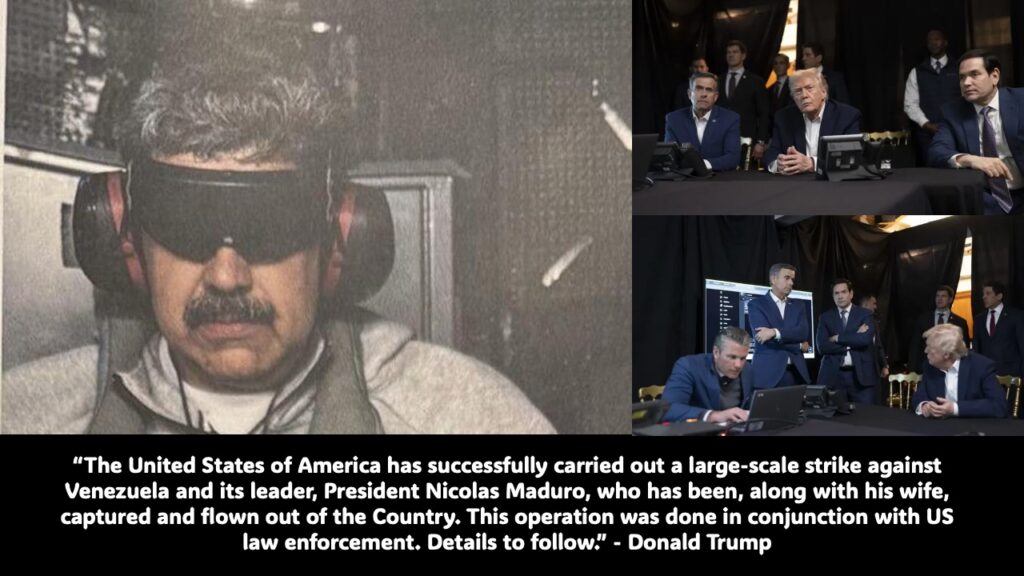
At approximately 12:30 p.m. IST, former
U.S. President Donald Trump announced on his social media platform
that the United States had successfully carried out a “large-scale strike against Venezuela” and that
Nicolás Maduro and Cilia Flores had been captured and flown out of the country.
Later, speaking at Mar-a-Lago, Trump
described the operation as an “extraordinary military action” using “overwhelming power, air, land and sea”. He
stated that Maduro was being transported to New York to face
prosecution and dismissed international criticism as “irrelevant”.
Trump also signalled that the United States would be “very strongly involved” in
Venezuela’s future oil sector and political transition.
U.S. Justice Department Unseals Narco-Terrorism Charges
Shortly after Trump’s announcement, the U.S. Department of Justice unsealed a superseding indictment charging
Maduro, Flores, and senior associates with
narco-terrorism conspiracy, cocaine trafficking, and weapons
offences.
Attorney General Pamela Bondi stated that
Maduro had led a criminal enterprise that used narcotics as a weapon against the United States. Officials confirmed
that a long-standing $50 million reward for information leading to
Maduro’s capture had been active.
U.S. authorities framed the operation as a law-enforcement-linked action rather than a
formal declaration of war.
Opposition Celebrations and Calls for Transition
Venezuelan opposition leader
María Corina
Machado, winner of the 2025 Nobel Peace Prize, hailed the development as
a turning point. In a statement posted on X, she said that Maduro would now face international justice and called on
opposition-backed leader Edmundo González Urrutia to assume authority
and release political prisoners.
Celebrations were reported in parts of Caracas and among Venezuelan expatriate
communities in Miami, Madrid, and other cities, although security
conditions inside Venezuela remained tense.
Global Condemnation and Diplomatic Fallout
International reaction to the U.S. military action in Venezuela was swift and sharply
divided.
Mexico, Brazil, Colombia,
China, Russia, Iran, and Cuba condemned the strikes as violations
of sovereignty and the UN Charter, with Colombia deploying forces
along its border amid refugee concerns. France, Chile, and the European Union stressed that political crises must
not be resolved through force.
By contrast, Argentina’s President Javier Milei openly praised the operation as advancing freedom, while the
United
Kingdom stated it was not involved and called for restraint.
The United Nations Secretary-General
expressed deep alarm, warning that the action set a dangerous precedent in international relations.
Uncertain Hours Ahead for Venezuela
As of the evening of January 3, U.S.
forces were reported to have withdrawn from Venezuelan territory. Constitutionally, executive authority would pass
to Vice President Rodríguez, even as opposition leaders push for a rapid transition.
Casualty figures remain unconfirmed, and the possibility of resistance from loyalist
military factions has not been ruled out. The operation has already affected global oil markets and intensified
debate over intervention, legality, and the future balance of power in Latin America.
For Venezuela, the coming hours may determine whether the country enters a managed transition — or a new phase of
instability.