India Procures Javelin Missiles and Excalibur Projectiles in $93 Million US Arms Approval
Nearly six weeks after Washington formally cleared the sale, the India Javelin missile deal has returned to the centre of strategic debate. Its operational, regional, and doctrinal implications are now coming into sharper focus when compared with indigenous ATGMs.
On November 19, 2025, the United States Defence Security Cooperation Agency approved two Foreign Military Sales packages for India, together valued at approximately USD 93 million. One covers 100 FGM-148 Javelin anti-tank guided missiles along with launch units, training, and lifecycle support. The other clears 216 M982A1 Excalibur precision-guided artillery projectiles with associated fire-control systems and technical assistance.
While both approvals were announced simultaneously, they address very different operational domains. Accordingly, TNT will examine the Excalibur artillery system—its range, accuracy, and battlefield impact—in a separate dedicated analysis. This article focuses on the strategic and technical significance of the India Javelin missile deal and what it reveals about the evolving balance of ground warfare in South Asia.
Why the Javelin Deal Is Being Discussed Now
The renewed attention to the India Javelin missile deal is driven by three converging developments rather than the timing of the original announcement.
First, delivery expectations are now being actively assessed within defence planning circles. Under the US Foreign Military Sales framework, approval does not imply immediate delivery. Comparable cases suggest that Javelin systems are likely to be delivered in tranches, with operator training and system familiarisation preceding full operational deployment. Current assessments indicate that initial induction could occur by late 2026, aligning with India’s ongoing transition away from older second-generation anti-tank systems.
Second, the deal is now being evaluated alongside indigenous capability milestones. Over the past month, production clearance for the Nag Mk-2 and fresh trial updates on the Man-Portable Anti-Tank Guided Missile have reframed the discussion. The question is no longer whether India should import advanced systems, but how imported capabilities interact with domestic programmes during a critical transition phase.
Third, regional signalling has intensified. Pakistan’s visible induction of Turkish OMTAS missiles, fields Russian Kornet systems, and China’s continued armour build-up in Tibet have collectively shifted attention from procurement headlines to operational balance. In this context, the Javelin deal is being reassessed as a tactical and doctrinal insertion rather than a symbolic purchase.
Status of Delivery and Operational Induction
As of now, no Javelin missiles have been delivered to India. The November approval constitutes legal and administrative clearance only. Delivery schedules under FMS typically extend over 12–24 months, depending on production slots, training pipelines, and logistical sequencing.
India is expected to induct Javelin systems selectively rather than at scale. Initial deployment is likely within infantry and mountain formations, where portability, rapid engagement, and shoot-and-scoot survivability outweigh sheer range. The system is therefore best understood as a capability bridge, filling an operational gap rather than replacing existing inventories wholesale.
Why Javelin Matters Operationally
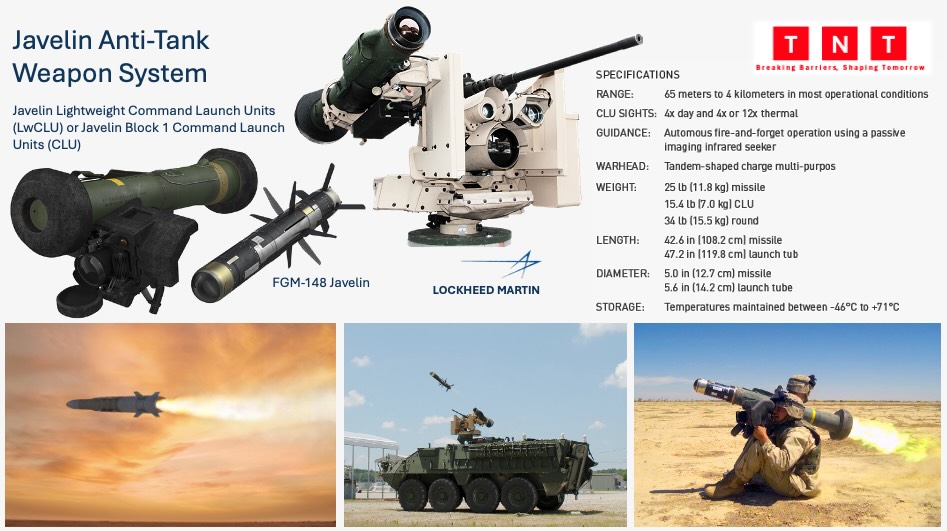
The FGM-148 Javelin is a third-generation, shoulder-fired anti-tank guided missile with an effective range of approximately 2.5 – 4 kilometres, depending on firing mode. Its defining feature is true fire-and-forget infrared homing, which allows the operator to disengage immediately after launch. Combat experience has demonstrated very high hit probability, even under battlefield stress, because the missile does not require continuous operator guidance once locked.
Equally important is its top-attack profile, which targets the weakest armour on modern tanks. In terrain such as Kashmir or eastern Ladakh, where exposure time can be fatal, this combination of accuracy and survivability is operationally decisive.
For the Indian Army, the Javelin addresses a long-standing requirement for man-portable, autonomous anti-tank capability, particularly for infantry units operating without heavy armour support.
Javelin and Nag Mk-2: Similar Generation, Different Roles
India’s indigenous Nag Mk-2 belongs to the same third-generation class as the Javelin but follows a different operational philosophy.
Nag Mk-2 offers a longer engagement range of up to 4 kilometres and carries a heavier tandem warhead capable of defeating modern explosive reactive armour. Its imaging infrared seeker enables top-attack capability comparable to Javelin. However, Nag is primarily vehicle-mounted, deployed via the NAMICA platform, making it less suitable for light infantry but highly effective in prepared kill zones.
Ease of firing marks a key distinction. Javelin is self-contained and shoulder-fired, optimised for rapid infantry ambushes. Nag requires vehicle integration and coordinated crew operation, trading portability for protection, endurance, and firepower.
In practical terms, Javelin provides tactical agility, while Nag delivers theatre-level lethality. The two systems are complementary rather than redundant.
Pakistan’s Anti-Tank Arsenal: Range and Volume Over Autonomy
Pakistan’s anti-tank doctrine contrasts sharply with India’s emerging emphasis on survivability and autonomy.
The most widely deployed system, the Baktar-Shikan, a locally produced variant of China’s HJ-8, offers a 5–5.5 kilometre range. However, it relies on wire-guided or semi-automatic command guidance, requiring the operator to track the target until impact. This significantly increases battlefield exposure and reduces effectiveness under counter-fire or electronic disruption.
Pakistan’s most potent missile, the Russian Kornet-E, extends engagement range up to 8 kilometres and boasts exceptional penetration capability. Yet it remains a laser beam-riding system, not fire-and-forget. While deadly in static or prepared positions, it is less suited to manoeuvre warfare where survivability and rapid relocation are critical. Notably, Pakistan had acquired Kornet-E ATGM launchers (52 reported) and an unspecified number of missiles around 2017–18.
Turkey’s OMTAS introduces infrared homing and top-attack capability with a 4 kilometre range, but Pakistan’s inducted numbers remain limited. Integration across varied terrain is still evolving.
Overall, Pakistan fields longer-range missiles in greater numbers, but most demand continuous operator guidance, making quantity a substitute for survivability rather than a replacement.
Accuracy and Survivability Versus Bulk Volume
The contrast between India and Pakistan is not simply about missile specifications, but about operational philosophy.
India’s trajectory increasingly prioritises accuracy, autonomy, and networked warfare. Systems such as Javelin, Nag, and Spike reduce operator exposure and integrate effectively with UAV-based surveillance and target acquisition. Precision, rather than saturation, underpins deterrence.
Pakistan’s approach relies on volume and layered deployment. This can be effective in static defence, but it carries inherent vulnerabilities against an adversary capable of drone-enabled detection, precision strikes, and rapid counter-battery response.
The emerging balance is therefore system-to-system, not missile-to-missile.
What India Still Needs to Improve
Despite the advantages introduced by the India Javelin missile deal, critical gaps remain.
India must accelerate mass production of indigenous man-portable ATGMs. Without scale, imports will continue to fill gaps rather than merely bridge them.
Second, India needs a unified infantry anti-tank doctrine. The current mix of Konkurs, Milan, Spike, and future Javelin systems complicates training, logistics, and sustainment.
Third, India must move faster on drone-integrated anti-armour warfare. Pakistan’s UAV-launched Barq munitions underscore the urgency of integrating loitering munitions and drone-launched ATGMs at the brigade and battalion level.
Technological superiority, if not institutionalised, risks remaining selective rather than systemic.
A Calculated Step, Not a Strategic Breakthrough
The India Javelin missile deal does not represent a dramatic shift in doctrine or alignment. It is a measured insertion of proven capability at a time when India is transitioning from legacy systems to indigenous solutions.
Its real value will be determined not by numbers inducted, but by how effectively India absorbs operational lessons, accelerates domestic production, and integrates precision systems into a coherent battlefield architecture.
In that sense, the Javelin approval marks neither dependency nor departure. It marks a pragmatic pause-point in India’s long march towards credible, indigenous, precision-centric ground warfare.