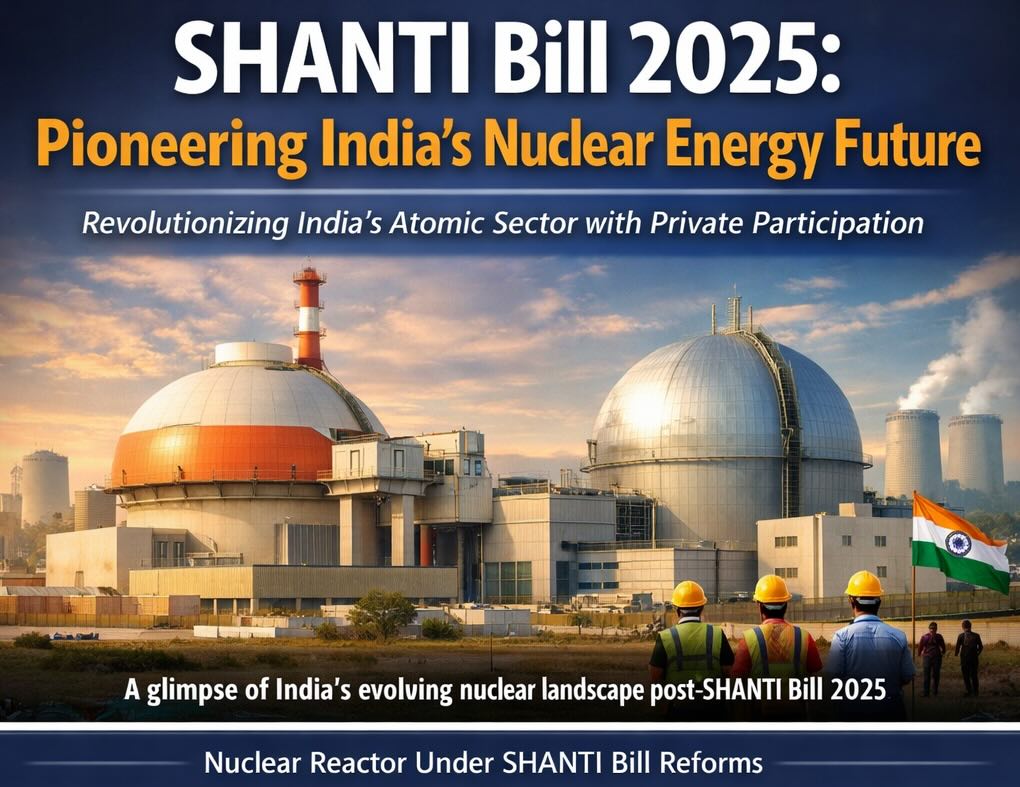
SHANTI Bill 2025: Pioneering India’s Nuclear Energy Future
India’s nuclear sector has entered a decisive phase with the passage of the SHANTI Bill 2025, a legislation that fundamentally redefines how atomic energy is governed, financed, and expanded. For the first time since independence, private participation in nuclear power generation is formally enabled, ending a six-decade state monopoly.
The SHANTI Bill 2025 arrives at a moment when India faces three converging pressures. First, electricity demand is rising sharply. Second, climate commitments require low-carbon base-load power. Third, fiscal constraints limit public-sector expansion. Nuclear energy, long constrained by outdated legal frameworks, is now positioned as a strategic solution rather than a political taboo.
Unlike previous amendments that merely tweaked administrative control, this bill restructures liability, regulation, and commercial participation in one integrated framework. It seeks to modernise atomic energy governance without relinquishing sovereign control over sensitive nuclear domains.
Core Provisions Shaping the SHANTI Bill 2025
At the heart of the SHANTI Bill 2025 lies a deliberate separation between policy, regulation, and operation, a principle long advocated by global nuclear regulators.
The bill grants full statutory independence to the Atomic Energy Regulatory Board (AERB), severing its earlier administrative linkage with the Atomic Energy Commission. This separation is intended to strengthen safety oversight and reduce institutional conflict of interest.
Private entities are now legally permitted to:
Build and operate nuclear power plants
Manufacture nuclear components
Undertake fuel fabrication and on-site storage
However, the State retains exclusive control over uranium enrichment, spent fuel reprocessing, and strategic materials. This balance ensures national security is not compromised while commercial efficiency is introduced.
A key reform lies in the graded nuclear liability framework. Operator liability is capped based on reactor capacity, ranging from ₹100 crore for small modular units to ₹3,000 crore for large reactors. Any damage beyond this threshold is assumed by the sovereign, aligning India with international liability conventions.
The SHANTI Bill 2025 also explicitly promotes Small Modular Reactors (SMRs), recognising their suitability for distributed grids, industrial clusters, and remote regions.
SHANTI Bill 2025 and India’s Nuclear Energy Reform Trajectory
India’s nuclear energy reform under the SHANTI Bill 2025 marks a clear departure from the Atomic Energy Act, 1962, which confined all nuclear activities to the public sector. That framework reflected Cold War anxieties rather than contemporary energy realities.
Equally significant is the repeal of the Civil Liability for Nuclear Damage Act, 2010, which imposed unlimited supplier liability. That law effectively stalled foreign collaboration after the Indo-US nuclear agreement and discouraged domestic investment.
The new regime introduces predictable risk allocation, enabling project financing and insurance pooling. Licensing timelines are streamlined through a four-tier dispute resolution mechanism, ending the procedural paralysis that plagued earlier projects.
Environmental governance remains anchored to the Environment Protection Act, but the bill allows limited procedural exemptions for low-risk projects. While this accelerates approvals, it has triggered debate among environmental jurists and civil society groups.
Private Nuclear Participation: Opportunities and Economic Logic
Private nuclear participation is the most transformative element of the SHANTI Bill 2025. Indian conglomerates such as L&T, Tata Power, and Adani Power are already assessing joint ventures and EPC-linked reactor projects.
From an economic standpoint, the reform addresses three chronic bottlenecks:
Capital scarcity in public-sector nuclear expansion
Delays in reactor construction and commissioning
Limited technological diversification
Private capital improves project bankability, while competition incentivises efficiency. The government estimates that nearly 46 GW of nuclear capacity could originate from private or hybrid models by 2047, significantly strengthening India’s clean energy base.
Foreign firms may participate only through Indian-controlled joint ventures, preserving compliance with Nuclear Suppliers Group safeguards. This approach reflects a calibrated opening rather than wholesale liberalisation.
For broader context, TNT readers may also examine India’s evolving clean energy strategy in our analysis on renewable transitions:
Risks, Criticism, and Governance Challenges
Despite its promise, the SHANTI Bill 2025 has not escaped criticism. Safety experts warn that rapid expansion without institutional depth could strain regulatory capacity. India’s mixed record on project delays raises legitimate concern about execution discipline.
Environmental groups object to diluted impact assessment norms, especially for thorium mining and long-term waste disposal. The absence of a dedicated decommissioning fund remains a structural weakness.
Liability caps have also drawn scrutiny. Major nuclear accidents, such as Fukushima, exceeded $200 billion in damages. Critics argue that statutory caps socialise catastrophic risk while privatising profits.
Legal scholars further highlight restricted judicial access, as civil courts are excluded from most nuclear disputes. This raises constitutional questions under Article 21 relating to victims’ rights and access to remedy.
The International Atomic Energy Agency has repeatedly stressed that robust regulatory enforcement, not merely legislative reform, determines nuclear safety outcomes.
SHANTI Bill 2025 in Global Nuclear Perspective
Globally, India’s approach now mirrors key elements of mature nuclear economies. The US operates under the Price-Anderson Act, which caps liability at approximately $16 billion through an industry-pooled insurance model. India’s graded liability system moves in the same direction, albeit with stronger sovereign backstopping.
France’s nuclear regime remains state-centric under EDF, but mandates comprehensive waste funding and lifecycle accountability. The UK allows private operators but enforces rigorous environmental scrutiny.
India’s SHANTI Bill 2025 blends these models selectively. It opens commercial participation while retaining sovereign oversight of strategic fuel cycles. What remains uncertain is whether regulatory independence will translate into regulatory strength.
India’s nuclear future now depends less on legislation and more on implementation. The SHANTI Bill 2025 provides the legal architecture for atomic energy modernisation, but institutions, transparency, and public trust will determine its success. Whether this reform becomes a cornerstone of energy security or a contested experiment will be revealed in the decade ahead.