How the Real Breakdown Began — A Chain of Escalating Incidents
The Azerbaijan Airlines Tragedy
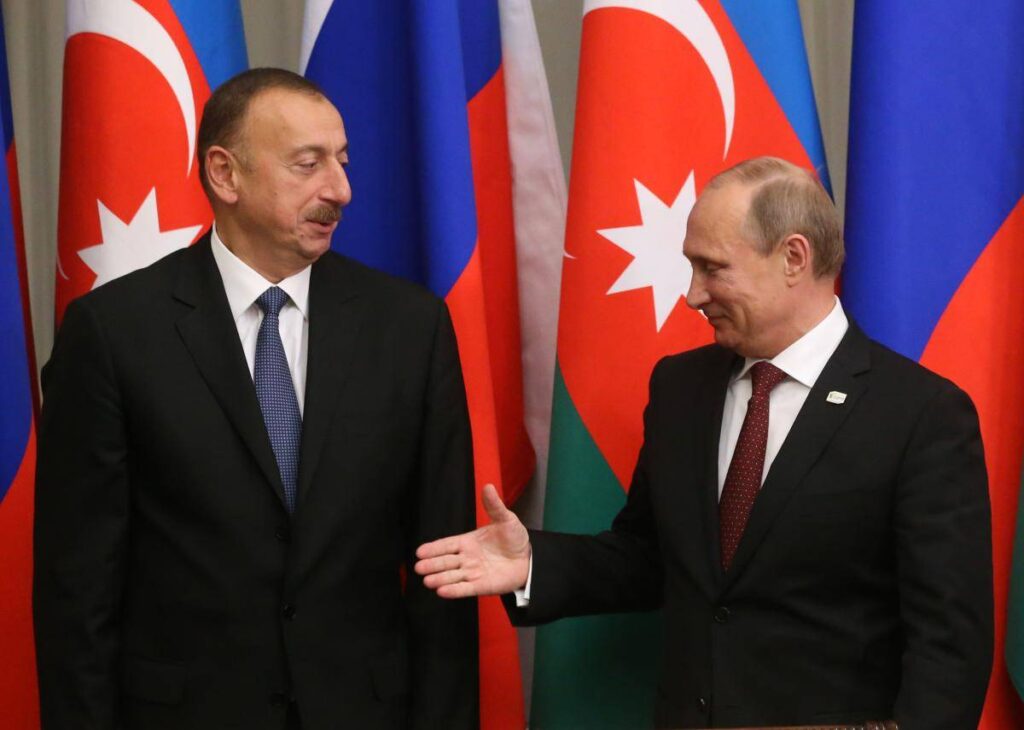
The recent crisis began on 25 December 2024. Two Russian air-defence missiles, fired while intercepting a Ukrainian drone, detonated near an Azerbaijan Airlines Embraer 190 flying from Baku to Grozny. The aircraft crash-landed in Kazakhstan, killing 38 people. President Vladimir Putin issued a public apology in December 2024, yet only in October 2025 did he explicitly acknowledge that Russian air defence was responsible. That ten-month delay inflamed public anger across Azerbaijan. In response, Baku grounded Russian flights and suspended key bilateral trade agreements. This marked the moment when the diplomatic façade between the two states began to crumble.
Two Azerbaijani Brothers Die in Russian Custody – Public Anger Spills Into the Political Arena
Tensions intensified sharply in June 2025, when two Azerbaijani brothers died in Russian police custody in Yekaterinburg. Moscow’s vague explanations enraged the Azerbaijani public and political class.
Baku responded by targeting Russian interests within its borders. Actions included:
- Arresting prominent Russian media figures
- Closing the Sputnik news agency’s Baku bureau
- Shutting multiple Russian cultural centres
The Sputnik office, widely believed to operate as a Russian intelligence node, became a focal point of confrontation.
Baku’s Shadow Support for Ukraine
A central factor behind the rising Azerbaijan Russia tensions is Baku’s discreet assistance to Ukraine. Although unconfirmed reports suggest Azerbaijan may have helped transfer Soviet-era Su-22 fighter jets to Kyiv through a multi-country route involving Türkiye, Sudan and Germany, these claims remain unverified. However, supply of Azerbaijan-origin aerial bombs, including QFAB-250 LG precision-guided munitions is verified.
These weapons reached Ukraine in 2022 via Sudan and later European transit points. They improved Ukraine’s ability to deploy precision munitions from its Soviet-era aircraft fleet. This assistance, even if limited, was enough to irritate Moscow at a sensitive moment.
Operation Spiderweb — A Shadow War?
Pro-Kremlin sources later accused Azerbaijani diaspora networks of aiding Ukrainian sabotage missions, including the alleged “Operation Spiderweb” — a 117-drone FPV strike by Ukraine’s SBU into deep Russian territory on 1 June 2025. Baku denied involvement. Nevertheless, the narrative shows how Azerbaijan is using Russia’s overstretched security posture to its advantage without engaging in overt confrontation.
Energy as a Strategic Weapon
Energy politics opened a new front in the growing discord. In July 2025, Azerbaijan began supplying natural gas to Ukraine through the Trans-Balkan pipeline, giving Kyiv its first consistent non-Russian gas source since 2014. This development also supported Europe’s long-term diversification strategy.
Tensions escalated further when Russia struck SOCAR-linked facilities in Odesa in August 2025. Baku responded with strong diplomatic protests. Moreover, Azerbaijan intensified its legal action against Russia, especially concerning the December 2024 aircraft incident. The arrest of several Russian nationals and draft evaders in 2025 further signalled that Baku was ready to apply pressure through legal and diplomatic channels.
Diplomatic Snubs, Missile Incidents and Rising Hostility
Cold Gestures and Unmistakable Messages
Diplomatic signalling intensified throughout 2025, as Azerbaijan began openly distancing itself from Moscow’s geopolitical orbit. Its refusal to attend Russia’s Victory Day Parade was widely interpreted as a symbolic rejection of Moscow’s historic narrative and regional dominance.
Azerbaijan also sent humanitarian aid to Ukraine, an unmistakable diplomatic gesture that signalled its desire to distance itself from Russia’s wartime narrative.
Tensions escalated even further on 14 November 2025, when an Iskander missile struck Azerbaijan’s embassy in Kyiv, damaging the compound and sparking immediate outrage in Baku. Russia claimed the impact was caused by Ukrainian air-defence interception, yet Azerbaijan rejected this explanation and lodged a formal diplomatic protest. The Azerbaijani foreign ministry summoned the Russian ambassador and demanded accountability for what it described as either gross negligence or a reckless disregard for diplomatic safety.
A Campaign to Reframe Russia as a Security Threat
The embassy incident did not occur in isolation. Earlier strikes near the Azerbaijani diplomatic compound in Kyiv had already alarmed officials in Baku. Throughout 2025, Azerbaijan used international forums to portray Russia as an emerging security threat, arguing that Moscow’s actions — intentional or otherwise — placed Azerbaijani citizens and interests at risk. This sustained messaging campaign shifted global perceptions and exposed the deepening distrust at the heart of Azerbaijan Russia tensions.
Alliances With Turkey and Israel Reshape the Caucasus
Growing Defence Partnerships Challenge Moscow
Azerbaijan’s deepening defence partnerships with Turkey and Israel are altering regional power dynamics. These ties, initially focused on defence hardware and energy cooperation, have evolved into a sophisticated network involving joint manufacturing, intelligence coordination and military training.
Turkey, a NATO member, provides combat drones, training programmes and advisers. Israel supplies drones, missiles and advanced surveillance systems. Intelligence-sharing, particularly concerning Iran’s activities, has expanded at a fast pace.
Moscow’s Strategic Frustration
For the Kremlin, these alliances are deeply troubling. Both Turkey and Israel maintain adversarial or competitive relationships with Iran, Russia’s closest regional partner. As Azerbaijan strengthens ties with these states, Moscow finds itself navigating a far more complicated Caucasus landscape at a moment when it cannot afford new complications.
Russia’s Influence Erodes as the Ukraine War Drags On
A Weakening Regional Power
Russia’s prolonged war in Ukraine has drained its military, diplomatic and economic resources. Its inability to win decisively has weakened its influence not only in the Caucasus but across the Middle East.
Armenia Also Begins to Drift Away
Feeling abandoned by Moscow, Armenia has quietly distanced itself from the CSTO. It has expanded defence ties with India, France and Greece and has begun pushing for normalisation with both Azerbaijan and Turkey.
Baku’s Bid to Bypass Moscow — The Zangezur Corridor
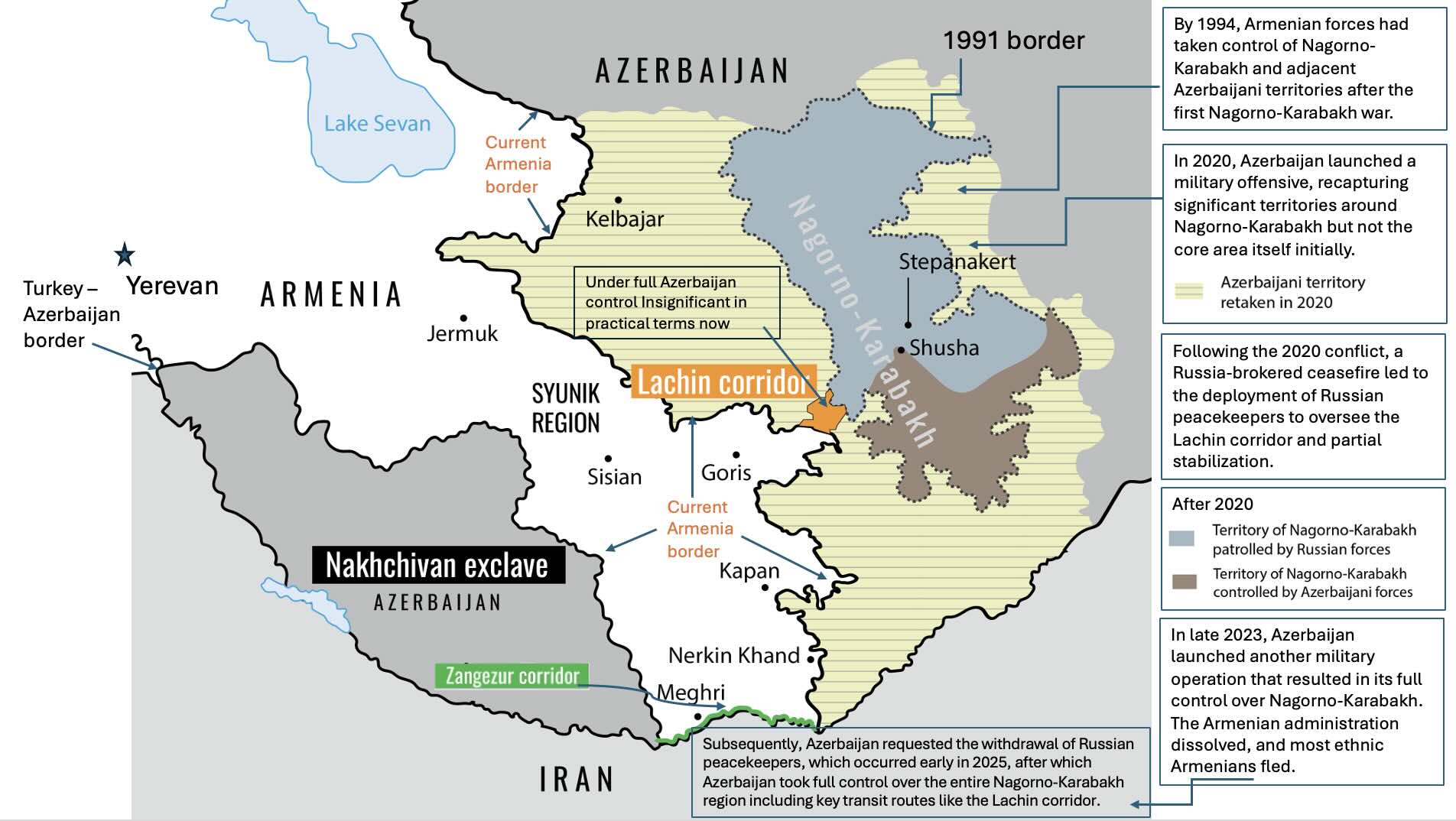
The Zangezur Corridor, conceptualised after the 2020 Nagorno-Karabakh conflict, has become pivotal in Azerbaijan’s attempt to reduce Russian transit dominance. Its planned land link between Azerbaijan and Turkey through Armenia’s Syunik province advanced significantly in 2025. Türkiye accelerated construction on its side of the project, weakening the relevance of Russian-controlled routes across the Caucasus.
New Geopolitical Alignments in the Caucasus
Azerbaijan Becomes Europe’s New Energy Lifeline
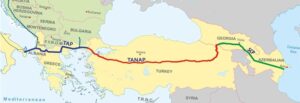
Azerbaijan has emerged as a crucial supplier of natural gas to Europe. Pipelines such as TANAP (Trans-Anatolian Natural Gas Pipeline – commissioned in June 2018) have made Baku a cornerstone of Europe’s diversification efforts. Countries like Germany have expanded energy cooperation with Azerbaijan to reduce dependence on Russian gas
The Iran Factor — A Dangerous New Dimension
Iran accuses Azerbaijan of enabling Israeli aircraft to enter Iranian airspace during Israel’s Operation Rising Lion. Tehran filed a formal protest in July 2025, alleging that Israeli jets accessed Iranian territory via the Caspian corridor with Azerbaijani support — something Baku denies. These claims reveal Iran’s increasing anxiety about its northern border.
The Push for Regional Normalisation
Turkey–Armenia–Azerbaijan: A New Diplomatic Triangle
As Russian and Iranian influence wanes, Türkiye has emerged as a central mediator. Armenia, having lost all control over Nagorno-Karabakh, now sees merit in normalisation. The Shusha Declaration of 2021 is gradually becoming the framework for peace talks.
The Zangezur Corridor Debate — A New Flashpoint
The proposed Zangezur Corridor remains contentious. Armenia insists on full sovereignty over customs and security. Azerbaijan demands internationally guaranteed arrangements. Türkiye supports Baku’s stance. The European Union is positioning itself as a possible guarantor. In a symbolic moment, Armenian Prime Minister Nikol Pashinyan visited Istanbul in June 2025 — the first official Armenian visit to Türkiye.
Risks of Russian Retaliation and the Uncertain Road Ahead
Moscow May Seek to Reassert Control
Despite Azerbaijan’s gains, its assertiveness carries risks. If the Ukraine conflict stabilises, Russia may attempt to reassert dominance in the South Caucasus. Analysts warn that Moscow could resort to hybrid warfare, including cyberattacks on Azerbaijan’s energy infrastructure. Russia may also empower Armenian nationalist groups to destabilise the region or stage limited incursions along disputed borders.
Lessons From Georgia and Ukraine
Russia’s operations in Georgia in 2008 and Ukraine serve as reminders of its willingness to use force against neighbours perceived as defiant. If Moscow acts in concert with Iran, Azerbaijan may face significant pressure. Any miscalculation could harm Baku’s hard-earned progress.
A Fragile Balance in a Region Defined by Quiet Conflict
Azerbaijan’s subtle yet assertive policies have reshaped its relationship with Russia, contributing to a period of escalating Azerbaijan Russia tensions. These moves strengthen Baku’s independence and regional influence, yet they also expose it to new risks. The future trajectory of this strained relationship will depend on the course of the Ukraine war, shifting alliances and Moscow’s capacity to respond. For now, a strategic shadow war is underway — shaping Eurasia in ways that are quiet, complex and profoundly consequential.