By Arav Kumar Chand
Winning the 2026 World Cup Might Be Cristiano Ronaldo’s Toughest Battle
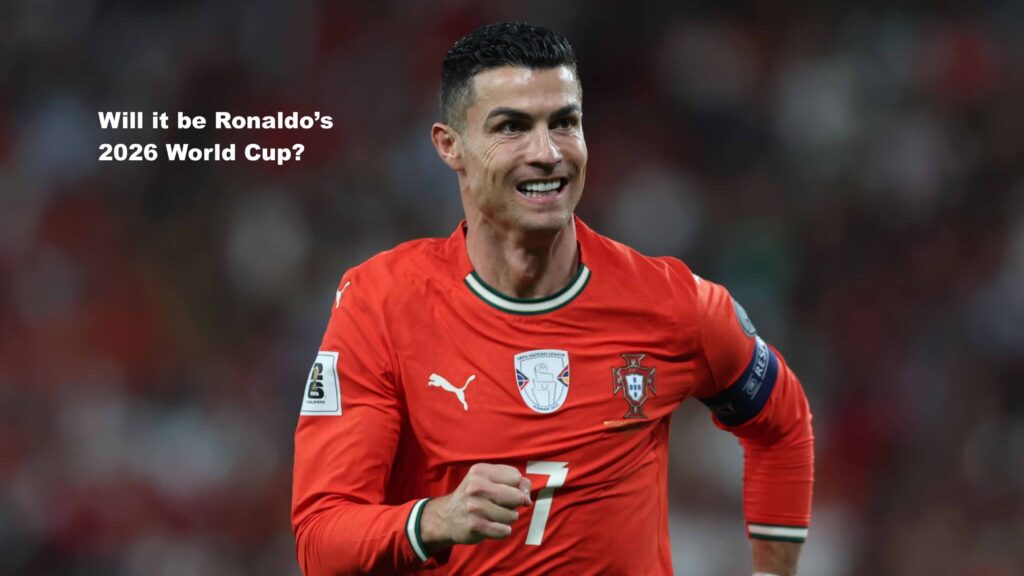
The Ronaldo 2026 World Cup campaign is shaping up to be one of the most emotionally charged chapters in football history. Cristiano Ronaldo, a player who has rewritten record books across two decades, is widely expected to make his final appearance on the world’s biggest stage when the tournament kicks off. Yet, despite a career overflowing with silverware, individual honours, and defining moments, the FIFA World Cup remains the one prize he has never lifted.
For Portugal, and for Ronaldo himself, the journey ahead looks anything but straightforward.
A Final Opportunity Without Football’s Ultimate Prize
Cristiano Ronaldo has conquered almost every major competition available at club level. In addition, he carried Portugal to their greatest international success by winning Euro 2016 and later the UEFA Nations League. However, the World Cup has consistently remained out of reach.
By 2026, Ronaldo will be 41 years old. Age, naturally, becomes an unavoidable factor at this level of competition. While his professionalism and physical conditioning remain exceptional, the intensity of a World Cup demands perfection over several high-stakes matches. Therefore, the Ronaldo 2026 World Cup is not merely another tournament. It represents a final, all-or-nothing pursuit of football immortality.
Portugal’s Complicated World Cup Record
Portugal’s history at the World Cup has been defined more by promise than fulfilment. Their finest campaign came in 1966, when Eusébio inspired the nation to a remarkable third-place finish. Since then, expectations have often exceeded outcomes.
In recent editions, Portugal have repeatedly entered tournaments as dark horses or contenders. Yet, progress has been inconsistent. Their quarter-final exit in 2022 reinforced a familiar pattern, where talent did not fully translate into a deep tournament run. As a result, the pressure on the current generation, led by Ronaldo, remains immense.
A Group Stage With Little Margin for Error
The group stage at the 2026 World Cup offers no guarantees. Although Portugal may appear strong on paper, the competition includes opponents capable of disrupting any tactical plan. Early momentum will be crucial, as dropped points could complicate the knockout pathway significantly.
Consistency, discipline, and composure from the opening match will define Portugal’s campaign. Any lapse could prove costly in a tournament where recovery time is limited.
Colombia: The First Serious Test
Among Portugal’s group-stage opponents, Colombia stand out as the most dangerous challenge. Their blend of physicality, technical ability, and midfield control makes them a difficult side to neutralise.
A potential Colombian XI could include Vargas in goal, supported by Cuadrado, Mina, Sánchez, and Mojica in defence. The midfield, anchored by Lerma and Uribe, provides balance, while the attacking unit of Luis Díaz, James Rodríguez, Arias, and Rafael Borré offers both creativity and threat.
Breaking down such a disciplined yet expressive side will demand tactical intelligence from Portugal. For Ronaldo, space may be limited, and efficiency will be vital.
Knockout Football and Instant Elimination Pressure
Progressing beyond the group stage shifts the tournament into a completely different psychological space. Knockout football allows no margin for error. One defensive lapse or missed opportunity can instantly end a campaign built over four years.
For the Ronaldo 2026 World Cup dream, this reality carries added weight. Every match becomes potentially his last on the world stage.
England or Croatia: A Ruthless Round of 16
Portugal could face either England or Croatia in the Round of 16, both presenting unique challenges.
England’s squad boasts pace, technical quality, and attacking depth. With players such as Bellingham, Foden, Saka, and Kane, they possess the ability to dominate possession and punish defensive mistakes.
Croatia, meanwhile, offer experience and composure. A midfield featuring Modrić, Brozović, and Kovačić remains one of the most intelligent units in international football. An encounter with Croatia would also carry emotional significance, as it could mark Luka Modrić’s final World Cup appearance.
Quarter-Finals: Where Giants Collide
Reaching the quarter-finals would likely bring Portugal face-to-face with either Argentina or France. At this stage, the margin between success and elimination becomes razor-thin.
A potential clash with Argentina would revive the sport’s greatest rivalry. A World Cup meeting between Ronaldo and Messi would captivate fans globally, serving as a symbolic final chapter in an era-defining duel.
France, however, present a different challenge altogether. With Mbappé’s pace, Griezmann’s intelligence, and an athletic midfield, they combine physical dominance with tactical maturity. Overcoming either side would require a near-perfect performance.
Semi-Finals: Brazil or Spain Await
If Portugal progress further, the semi-final hurdle could involve Brazil or Spain, both footballing powerhouses.
Brazil’s flair, depth, and attacking talent remain unmatched. This tournament could also represent Neymar’s final World Cup, adding emotional intensity to any encounter.
Spain, on the other hand, offer technical precision and tactical discipline. Their midfield control, driven by players like Rodri and Pedri, can suffocate opponents and dictate match tempo relentlessly.
The Final and the Weight of History
Reaching the final itself would already stand among Portugal’s greatest footballing achievements. However, lifting the trophy would require navigating an unforgiving sequence of elite opponents.
For Ronaldo, the achievement would redefine his legacy at international level. It would also elevate him alongside, or even beyond, Eusébio, Portugal’s most iconic World Cup figure from 1966.
The Ronaldo 2026 World Cup campaign is not simply about winning matches. It is about time, legacy, and the unforgiving reality of elite sport. The dream remains alive, but the path is arguably the most demanding of his entire career. Winning it is possible. Doing so, however, will demand perfection against football’s very best.
FIFA World Cup 2026
The next FIFA Men’s World Cup – 2026 is scheduled to take place from June 11 to July 19, 2026. It will be co-hosted by Canada, Mexico, and the United States, featuring an expanded format with 48 teams and 104 matches total. The tournament opens on June 11 in Mexico City, and the final is on July 19 at MetLife Stadium in East Rutherford, New Jersey.