India BrahMos vs ASBMs: Why New Delhi Rejects Ballistic Options
India’s BrahMos Doctrine and the ASBM Debate
Pakistan’s recent test of its ship-launched SMASH anti-ship ballistic missile (ASBM) has generated considerable attention across South Asia. By publicly demonstrating a ballistic missile fired from a naval platform and intended for maritime targets, Pakistan has become the first country in the region to showcase such a capability. India, despite its far more advanced missile programmes, has never carried out a similar test. The contrast has revived an important question: if anti-ship ballistic missiles offer long-range striking power, why has India never developed, displayed, or sought one?
The answer lies not in technological limitations but in a deliberate doctrinal choice. India has focused on a different set of priorities at sea, and its existing missile systems already meet those aims.
Pakistan’s SMASH Test and Its Regional Significance
Pakistan’s Navy conducted the SMASH test to signal an expanding sea-denial posture in the Arabian Sea. The system adapts a small ballistic missile to target large surface vessels, especially high-value units.
The test is strategically important for Islamabad because it strengthens its capacity to raise operational costs for larger navies in the region. It aligns with Pakistan’s traditional coastal-defence approach. For India, however, the development does not change core strategic assessments. India possesses the scientific and industrial ability to produce an ASBM if it chooses, but its naval doctrine does not consider such a system central to its needs. The Indian Navy operates across wider maritime spaces with an emphasis on sea control rather than sea denial.
For Pakistan, SMASH is both a technological statement and a deterrence tool aimed at constraining hostile naval movements within its exclusive economic zone.
India’s Missile Inventory and the Centrality of BrahMos
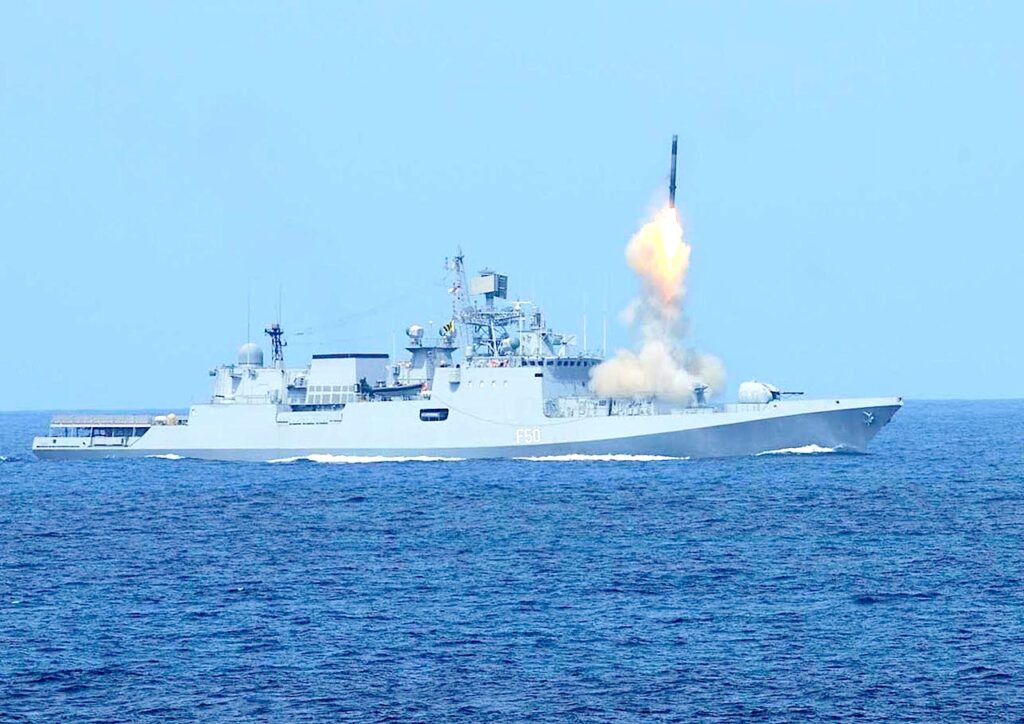
India’s missile inventory highlights this doctrinal divergence. The Navy already fields the BrahMos—one of the world’s most lethal anti-ship missiles—in ship-launched, submarine-launched, air-launched, and coastal-battery variants. This multi-platform deployment, combined with high precision and lightning speed, gives India a level of strike flexibility that ship-launched ASBMs cannot match.
Inducted into the Navy in 2005, BrahMos—with a 450–600 km range—remains among the fastest, sustained supersonic and most accurate anti-ship missiles globally. Its low-altitude, sea-skimming terminal profile provides survivability and manoeuvrability that ballistic missiles simply cannot offer. The BrahMos-II, currently under development, will be a sustained hypersonic cruise missile with an estimated range of 800 km, further extending India’s lead in this category.
In contrast, ASBMs come with inherent limitations: their large radar signatures make them easy to detect during the boost phase; their trajectories—predictable even when quasi-ballistic—expose them to high interception risks against advanced navies like India’s; and they cannot perform sea-skimming or pop-up evasive manoeuvres.
India Already Possesses Countermeasures Against ASBMs
India’s layered ballistic missile defence architecture provides Barak-8/LR-SAM, MRSAM, and the PGLRSAM hypersonic interceptors (Mach 7+), supported by Swordfish LRTR and space-based sensors. Given that ASBMs follow high, detectable trajectories, India can potentially intercept and destroy them like Fatah-II was destroyed during Operation Sindoor.
This is why the Indian Navy prioritises countering supersonic and hypersonic cruise threats rather than ballistic arcs.
Why ASBMs Are Less Practical for India’s Way of War
Anti-ship ballistic missiles depend on a complex ecosystem. Their effectiveness relies on real-time ocean surveillance networks, satellite constellations, airborne sensors, and continuous target updates. Tracking a moving warship across hundreds of kilometres requires a dense and expensive web of sensors. China’s DF-21D works because Beijing has spent years building such an observation system. India’s maritime surveillance capabilities are robust and expanding, but they are optimised for broader naval tasks rather than the narrow demands of a ballistic anti-ship strike.
Sea Control vs Sea Denial: The Doctrinal Divide
The role of the weapon also differs. ASBMs are most effective in denying access to specific sea zones or chokepoints. They threaten carriers and large vessels entering a defined area. This is useful for countries with limited blue-water reach and a need to deter more powerful navies near home waters. Pakistan fits this profile. India does not. India’s Navy escorts carrier groups, protects shipping lanes, undertakes long-range patrols, and increasingly operates across the wider Indo-Pacific. A weapon that flies high on a predictable arc and cannot adjust its course substantially during flight simply does not match India’s operational style.
Redundancy and the Hypersonic Future
There is also the question of redundancy. India already possesses strategic submarine-launched ballistic missiles, which serve an entirely different purpose related to nuclear deterrence. It also has long-range cruise missiles and ongoing hypersonic programmes that promise far greater manoeuvrability than any traditional ballistic anti-ship design. With these developments in view, Indian planners see little benefit in pursuing a technology that may soon be overtaken by more agile hypersonic systems.
Pakistan’s Needs Are Not India’s Needs
Pakistan’s choice reflects its own needs. It seeks to complicate India’s naval planning in the Arabian Sea and enhance deterrence near its coast. For Islamabad, even a limited ASBM can serve that purpose. For New Delhi, the calculus is broader, the navy’s responsibilities are wider, and the emphasis is on versatility and reach. The BrahMos family fits that requirement, and its forthcoming hypersonic successors are expected to push the envelope further.
A Capability India Can Build, But Does Not Require
India has refrained from developing an ASBM not due to any technological limitation, but because it does not need one. BrahMos already provides a powerful and proven anti-ship capability beyond ASBM across all major naval platforms. Therefore, developing/deploying a ballistic anti-ship system may stress the system without meaningful operational value, and would divert resources from technologies better suited to India’s long-term maritime strategy.
India’s short-range ballistic missile Prithvi was first tested in 1988 and inducted into service in 1994. The Prithvi-II—an extended-range version developed for the Air Force and later the Army—was first tested in 1996 and inducted into the Strategic Forces Command in 2003. The naval variant Dhanush (Prithvi-III class) was first tested in 2000 and achieved full operational capability in 2004. All three variants carry a 1,000 kg payload with a range of approximately 350 km.
Similarly, India’s intermediate-range ballistic missile Agni was first tested in 1989 and entered service in 2007. The current variant, Agni-V—an 8,000 km-range, hypersonic, MIRV-capable system—has been operational since 2018.
In addition, India’s K-15 and K-4 submarine-launched ballistic missiles (SLBMs) are already in service with the Navy. The K-15 is deployed on INS Arihant and the more advanced K-4 on INS Arighaat. The K-15 has a range of 750 km, while the K-4 reaches 3,500 km.
Although these systems—including the SLBMs—are strategic nuclear weapons rather than anti-ship ballistic missiles, the technologies, platforms, and engineering foundations are firmly in place. If required, developing and deploying an ASBM would not present a significant challenge for India.
A Tale of Two Doctrines
Pakistan’s SMASH test marks a notable regional milestone, but it does not alter India’s fundamental approach. New Delhi remains committed to a doctrine built on precision, manoeuvrability, and multi-platform integration, rather than on high-altitude ballistic trajectories. In India’s view, the future lies in faster, smarter, and more flexible missiles — not in ballistic arcs over the sea.