
When Completion Certificates Fail: How Loopholes Created Ghost Colonies in Several Sectors of Greater Noida
In several sectors of Greater Noida, an unsettling sight confronts visitors: rows of empty, crumbling houses hidden behind rusted gates line wide, well-lit roads. These ghost colonies, despite being surrounded by world-class infrastructure, present an eerie contrast of planned urban development and visible neglect. The core issue: Greater Noida’s Completion Certificate (CC) system, designed to verify construction compliance and habitability, has become a loophole exploited by speculators and overlooked by authorities. This exploitation has led to the proliferation of uninhabited, deteriorating structures, undermining the very policy intent of vibrant, integrated communities.
This isn’t the story of a failed township in some forgotten corner of India. This is Greater Noida. And yet, despite its world-class infrastructure, some of its most prominent large-plotted residential sectors resemble ghost towns.
The reason? A well-intentioned but deeply flawed system of completion certification — exploited by speculators, overlooked by authorities, and ignored in spirit by those it was designed to regulate.
The Backstory of Greater Noida
Greater Noida was conceived in the early 1990s to relieve pressure from Delhi and Noida by providing a modern, planned urban space. Developed under the Greater Noida Industrial Development Authority (GNIDA), it featured wide arterial roads, distinct residential and industrial zones, green belts, and cutting-edge infrastructure. Projects like Jewar International Airport and Film City promise further advancement along with several Universities and Sports City on the horizon. Yet, in many large-pitched residential sectors—particularly with larger plot sizes—the vision remains unfulfilled.
GNIDA’s Policy on Plot Development and Neighbourhood Vibrancy
GNIDA, like other authorities in Gautam Buddha Nagar such as NOIDA and YEIDA, has established clear regulations governing the development of allotted plots. These regulations require that allottees complete construction within a specified timeframe—typically between three to five years from the date of allotment. Failure to meet these deadlines results in progressively increasing penalties that escalate over time. Additionally, continued non-compliance may lead to cancellation of the allotment and legal action, as stipulated in the lease deed’s forfeiture clauses.
The primary objectives of this policy framework are:
Discouraging speculative land hoarding
Ensuring vibrant, inhabited neighbourhoods as part of fully planned urban development
Promoting optimal utilization of existing infrastructure
Sustaining economic activity through ongoing construction and occupancy
Maintaining legal compliance and preserving the integrity of the master plan
Despite this well-articulated framework, enforcement remains inconsistent and compliance patchy, especially in sectors with larger residential plots (typically 350 square meters and above).
The Chi-Phi Extension: A Case Study in Ghost Colonies
The Chi and Phi sectors, allotted post-2004, vividly illustrate these failures. Over 1,050 plots ranging from 350 to 1,000 square meters were distributed across Chi-III, Chi-IV, Phi-III, and Phi-IV with estate names like Cassia Nodosa and Ebony Estate. Despite GNIDA’s infrastructure upkeep, physical surveys and verification with satellite imaginary reveal distressing patterns.
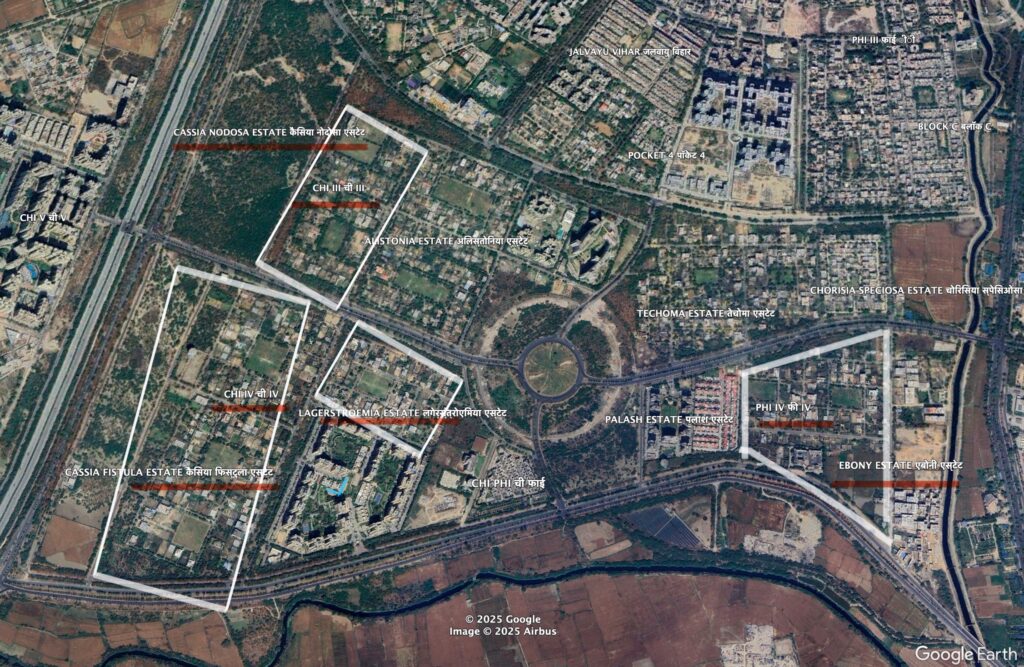
In Ebony Estate (Phi-IV), only 7-8% of plots host properly built, occupied homes. Another 7-8% are abandoned, lacking completion certificates and facing heavy penalties. Astonishingly, nearly 85% have obtained CCs but are abandoned or falling into ruins. These structures are low-quality “shells” built merely to secure certificates, often lacking essential amenities like functioning kitchens or toilets. Several vacated plots have illegal occupants—caretakers or economically weaker groups—living in dilapidated conditions.
Chi-III and Chi-IV reflect similar patterns, with larger plots far more prone to superficial construction and neglect compared to the smaller 350 Sq. M. plots in Phi-III.
The Completion Certificate Loophole’s Role
The GNIDA Completion Certificate is meant to certify that construction complies with approved plans and building codes, ensuring safety, habitability, and basic amenities. However, this system has become a regulatory loophole:
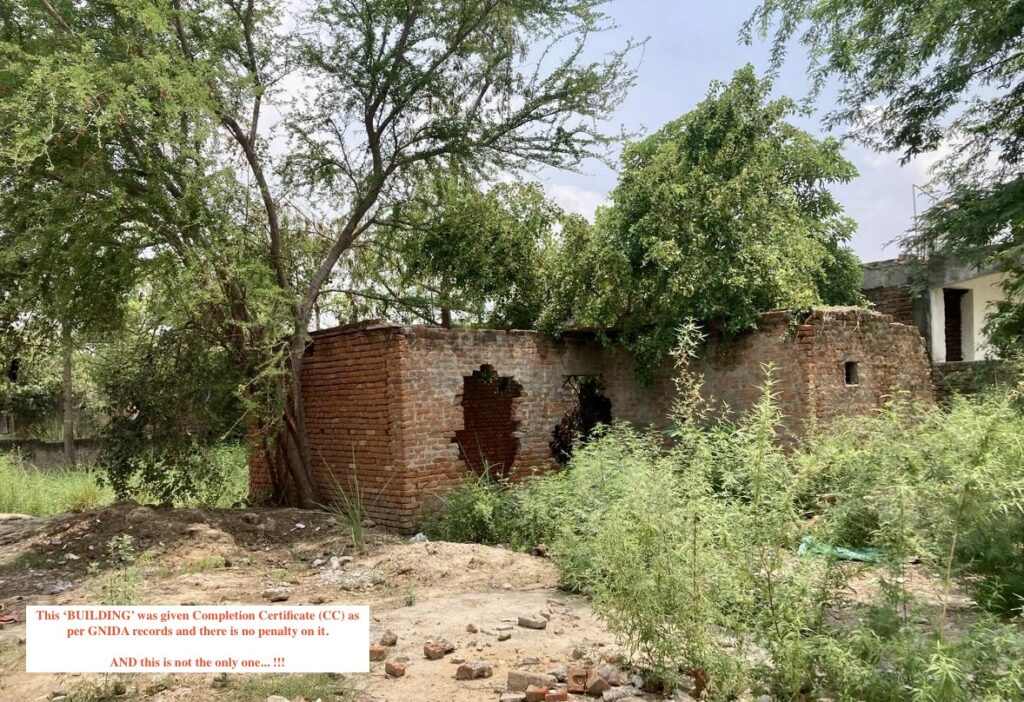
Over 90% of large-plotted allottees build minimally—cheap, rudimentary structures designed solely to meet CC criteria.
Many buildings lack basic necessities such as functional toilets, kitchens, or proper sewer connections yet still receive certifications.
After obtaining CCs, owners abandon these properties to speculate on land value appreciation.
The CC regime, intended as a tool for quality control, inadvertently rewards superficial compliance rather than genuine habitation and upkeep.
Accountability: Who Is Responsible?
Responsibility is twofold:
Allottees: Those who build low-quality, non-habitable structures betray the spirit of the acquisition, destroying community prospects.
GNIDA: The authority’s inspections have been either too superficial or inadequately enforced. Allowing uninhabitable constructions to pass inspection points to regulatory weakness or possible collusion.
Furthermore, GNIDA’s rules do not mandate post-certification occupancy checks or penalties for abandonment or decay. Once a CC is issued, oversight effectively ends, allowing deterioration without repercussions.
Questioning the Validity of Past Completion Certificates
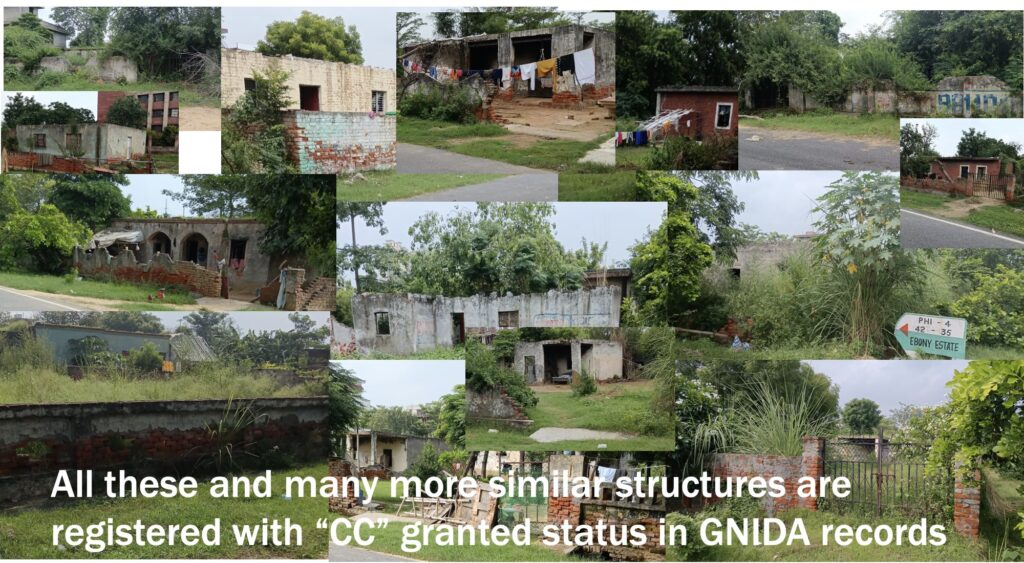
The rapid decay of many certified houses—some falling into ruins within a decade—raises grave doubts about inspection standards. Completion Certificates issued between 2005 and 2010 should guarantee much more than four walls and a roof; they are supposed to ensure structural integrity, safety, and habitability.
While no direct evidence of corruption has emerged publicly, the widespread pattern of low-quality certified structures and the resulting urban decay strongly suggest systemic failure in adherence to regulatory standards.
The Unequal Burden of Penalties
The penalty structure is starkly unfair:
Those without Completion Certificates face heavy penalties (i.e., up to 200% of their original premium calculated until July 2025) or cancellation threats.
Those obtaining CCs through superficial construction escape further sanctions, despite contributing heavily to neighbourhood deterioration.
This disparity discourages sincere developers and incentivizes minimal efforts to merely secure certificates, perpetuating ghost colonies.
Recommendations for Reform
To reclaim Greater Noida’s promise, reform is crucial:
Revised Completion Standards: Require minimum quality, evidence of habitability, and occupancy proof, not just structural presence.
Post-Certification Monitoring: Conduct periodic inspections; penalize abandonment, dilapidation, and illegal occupancy.
Transparency and Accountability: Pair online certification with transparent physical inspections and public disclosure of compliance status.
Retrospective Audits: Audit existing certificates in ghost sectors; hold both officials and allottees accountable for negligence or malpractice.
Conclusion
Greater Noida’s ghost colonies vividly illustrate how urban development goals can be undermined by regulatory loopholes, lax enforcement, and weak accountability. Good governance requires robust inspection, enforcement, and continuous oversight to ensure that planned developments translate into real, thriving communities. Without serious reform, the contradiction of world-class infrastructure hosting ghost towns will persist—undermining public trust and wasting resources.
The story of Greater Noida is a call to action for policymakers, administrators, and stakeholders to ensure that the vision of integrated, vibrant townships becomes reality, grounded in accountability and respect for public policy.
This detailed insight underscores the urgent need for a shift in policy and governance culture, balancing regulation with genuine community development to unlock the full potential of Greater Noida and similar emerging urban centers.