Part One – Explainer/Background
UK Grooming Gangs: A Look at the Ongoing Scandal in Britain
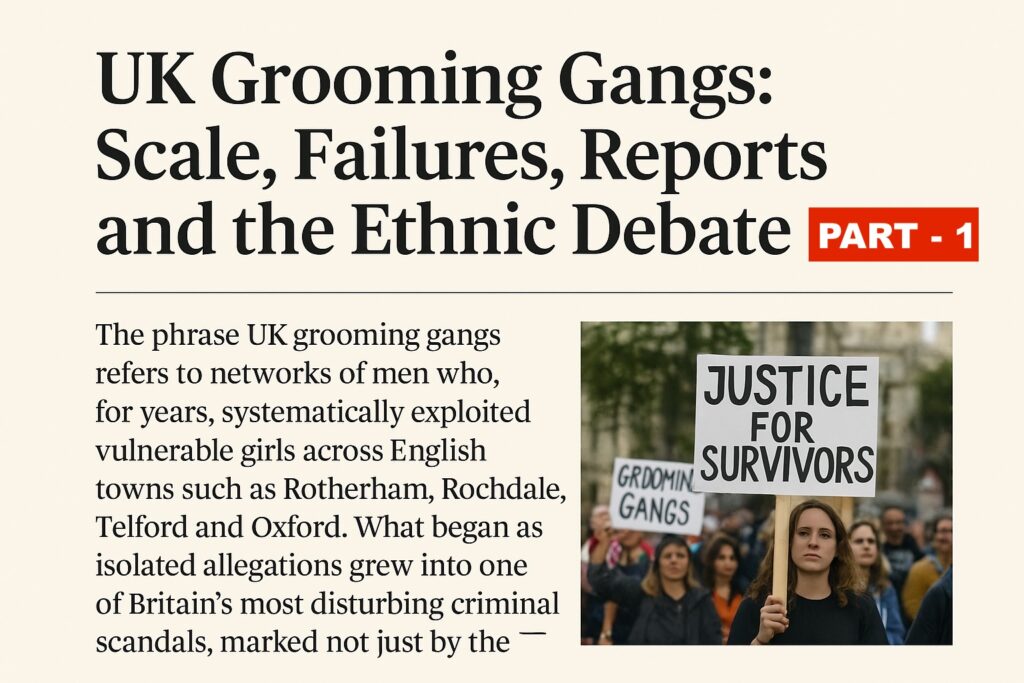
The term “UK grooming gangs” refers to groups of males who have been taking advantage of weak girls in English areas including Rotherham, Rochdale, Telford, and Oxford for years. What started as a few separate accusations became into one of the most shocking criminal scandals in Britain, not only because of the abuse itself but also because institutions failed to stop it.
What Happened and Where
Groups of males went after girls as young as 12 from the late 1990s to the 2010s. A lot of the victims came from poor homes. They had problems at home, were kicked out of school, or were living in a group home. People who did bad things utilized drugs, drink, and promises of love to get them to come. Once they were caught, victims were scared, assaulted, and in many cases handed around to different abusers.
Some of the most important hotspots were:
- According to Alexis Jay’s 2014 investigation, more than 1,400 children were exploited in Rotherham between 1997 to 2013.
- Nine males were found guilty of grooming and trafficking in Rochdale from 2004 to 2008.
- Oxford and Telford (2000s–2010s): Dozens of girls were abused for years, and significant trials were still going on in 2018.
How It Works
The abuse happened in a set way:
- Finding girls that are at risk.
- Grooming by giving them gifts, attention, or drugs to get them ready.
- Using violence and intimidation to keep everything under control.
- haring victims between networks, even moving them across towns for sex.
This pattern was seen in several areas, which suggests that institutional blindness was just as important as the offenders’ methods.
Facts and Numbers
- The exact (or even a closely estimated) number of victims is unknown.
- There were more than 1,400 victims in Rotherham alone (until 2013).
- Dozens of people have been found guilty in several locations, and their penalties range from 10 years to life.
- Thousands of cases don’t go to court because evidence is lost or victims don’t want to testify.
- The Casey Report – 2025 talked about a “culture of ignorance” that let crimes go on.
Failures in Institutions
Several investigations found that police, authorities, and social agencies ignored warning flags over and over again. Some of the things that mattered were:
- Fear of being called racist, considering many of the people who did it were Pakistani Muslims.
- Bureaucratic inertia, which means that records are not kept well and agencies don’t work together.
- Blaming the victim: Authorities typically saw victims as criminals instead of children in danger.
Ethnicity and Debate
Ethnicity emerged as a particularly sensitive dimension. A lot of the people who were found guilty in high-profile instances were Muslims from Pakistani descent. Leaders in the community agreed that there was a problem, but they warned against making generalisations about whole communities. Experts stressed that most sexual abuse in the UK is done by white men, and that focusing only on race could hide bigger problems with protecting people.
Justice and Unfinished Business
Many of the people who did the crime are already in jail, but hundreds of others who were implicated in investigations have never been charged. Survivors say that justice is still not complete since holding institutions accountable has been sluggish and uneven.
The grooming gang scandals are, in the end, both a crime and a story of how the system failed. They still have an effect on discussions about justice, community relations, and how Britain keeps its kids safe.