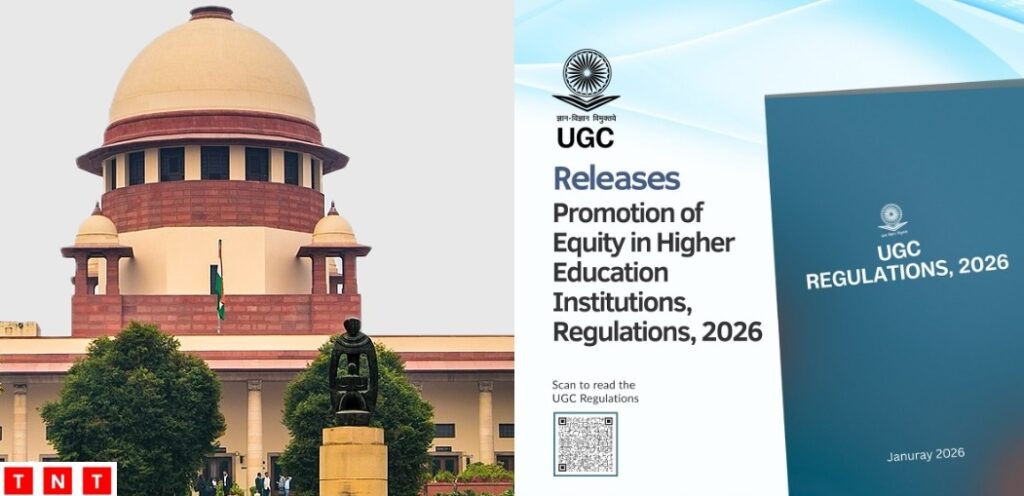
UGC Equity Rules 2026 Under Govt Review Amid SC Challenge
UGC Equity Regulations 2026 Trigger Review Panel as Supreme Court Challenge Intensifies Debate
New Delhi — The UGC Promotion of Equity in Higher Education Institutions Regulations, 2026 have entered a decisive phase, with the Union government on Monday announcing the formation of a high-level review committee amid protests, legal scrutiny, and growing political debate.
The decision follows widespread objections to the newly notified regulations, which aim to combat caste-based discrimination in universities through mandatory equity mechanisms. The move also coincides with a fresh petition before the Supreme Court challenging key provisions of the rules on constitutional grounds.
What the UGC Regulations Mandate
The regulations, notified by the University Grants Commission earlier this month, seek to institutionalise safeguards against discrimination across higher education institutions. They mandate the creation of Equity Committees, Anti-Discrimination Cells, and grievance redressal frameworks in all colleges and universities.
The rules explicitly extend protections to Scheduled Castes, Scheduled Tribes, Other Backward Classes, persons with disabilities, and other vulnerable groups. Institutional heads are made accountable for implementation, while penalties for non-compliance include funding curbs and derecognition.
UGC officials have described the framework as a long-overdue correction to earlier guidelines, which critics said lacked enforcement teeth.
Government Forms High-Level Review Committee
Amid protests from student groups and concerns raised by university administrators, the Modi government has now decided to constitute a high-level committee comprising education experts, senior officials, and UGC representatives.
According to officials familiar with the development, the committee will examine implementation challenges, stakeholder concerns, and the legal sustainability of the regulations. The UGC is also expected to issue a formal clarification on contentious provisions in the coming days.
Government sources stress that the review does not amount to a rollback but reflects the need for wider consultation given the sensitivity of the issue.
Supreme Court Petition Challenges Definition Clause
The controversy has intensified following a petition filed in the Supreme Court by advocate Vineet Jindal. The plea challenges Regulation 3(c) of the UGC Equity Regulations 2026, which defines caste-based discrimination as acts directed against members of SC, ST, and OBC communities.
The petitioner argues that the definition excludes students and staff from general categories who may face caste-linked harassment, thereby denying them access to grievance redressal mechanisms. The plea seeks an interim stay on the provision and calls for a caste-neutral definition.
Jindal contends that the current wording violates Articles 14, 15(1), and 21 of the Constitution by creating an impermissible classification.
Roots in Campus Tragedies
The regulations trace their origin to a 2019 public interest litigation filed by the mothers of Rohith Vemula and Payal Tadvi, whose deaths by suicide were linked to alleged caste-based harassment on campus.
The case exposed systemic gaps in the UGC’s 2012 equity guidelines, prompting repeated Supreme Court interventions. In 2025, the court directed the Centre to notify strengthened regulations after stakeholder consultations, leading to the January 2026 notification.
Supporters argue that the new framework finally responds to long-standing demands for enforceable safeguards.
Divergent Reactions Across Campuses
Reactions to the regulations remain sharply divided. Dalit rights organisations and student unions have welcomed the rules as a necessary intervention to curb entrenched discrimination. They warn that dilution would weaken protections for historically marginalised groups.
Opposition voices, including some faculty associations and general-category student groups, argue that the framework risks misuse and administrative overreach. They also question whether grievance systems should operate on category-specific definitions.
Universities, meanwhile, have flagged implementation burdens and called for clearer operational guidelines.
What Lies Ahead
The Supreme Court is yet to list the petition for hearing, though legal observers expect early consideration given the nationwide implications. The court’s approach could shape how equity and equality are balanced within higher education governance.
With over a thousand universities affected, the outcome will influence not only campus grievance systems but also the broader discourse on affirmative action and institutional accountability.
For now, the formation of the review committee signals the government’s attempt to manage a volatile intersection of law, social justice, and education policy — one that is unlikely to settle quickly.
Also Read