UAE–Pakistan Closeness: Should India Be Alarmed or Is It Business as Usual?
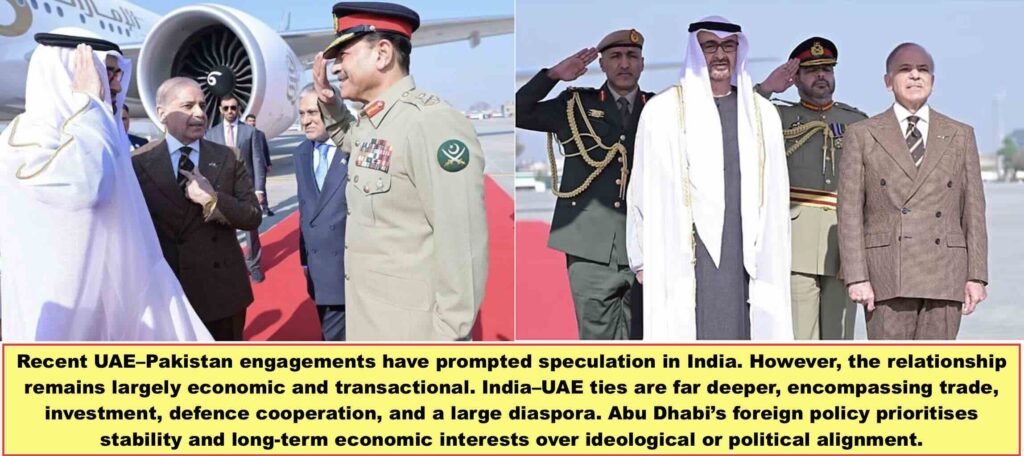
The recent visit of UAE President Sheikh Mohamed bin Zayed Al Nahyan to Pakistan on December 26, 2025—his second visit within the same year—has reignited debate in Indian strategic circles. The symbolism was unmistakable. A public holiday declared in Pakistan, ceremonial warmth, and the Emirati leader landing at the refurbished Nur Khan airbase all conveyed closeness. For some commentators’ remarks gained traction on social media, the optics raised an unsettling question: is the UAE drifting towards Pakistan in ways that could undermine India’s security interests?
Such anxieties, however, warrant careful scrutiny rather than instinctive alarm. A closer examination of UAE–Pakistan relations, placed against the much broader canvas of India–UAE ties and Gulf geopolitics, suggests that what is being interpreted as strategic realignment is better understood as geopolitical routine driven by economics, not ideology.
UAE–Pakistan Relations: Old Ties, Limited Strategic Depth
Pakistan and the UAE share a relationship that predates many of the Gulf’s contemporary alliances. Islamabad was the first country to formally recognise the UAE after its formation in 1971. In the early decades, Pakistani military personnel played a visible role in building Emirati security institutions, particularly the air force. Cultural affinity, religious commonality, and labour migration further reinforced ties.
Economically, the relationship remains important for Pakistan, though modest by Gulf standards. Bilateral trade reached roughly USD 10 billion in FY 2024–25, making the UAE Pakistan’s third-largest trading partner. Remittances from nearly 1.8 million Pakistanis working in the UAE remain a critical foreign exchange source, estimated at over USD 6.5 billion annually. Emirati investments, particularly in energy, ports, and infrastructure, have provided Pakistan breathing space during repeated balance-of-payments crises.
Yet, beneath this continuity lies caution. The UAE has grown increasingly wary of Pakistan’s political volatility, security challenges, and economic fragility. Tighter scrutiny of Pakistani travellers, episodic visa restrictions, and investor hesitancy point to a relationship that is transactional rather than strategic. Abu Dhabi has consistently avoided deep entanglement in Pakistan’s internal or regional disputes, including Kashmir, preferring humanitarian assistance over political alignment.
India–UAE Ties: A Relationship of a Different Order
Any assessment of UAE–Pakistan closeness becomes incomplete without comparison to India–UAE relations, which operate on an entirely different scale.
Bilateral trade between India and the UAE crossed USD 100 billion in FY 2024–25, nearly ten times the UAE–Pakistan volume. The Comprehensive Economic Partnership Agreement has accelerated non-oil trade, while Emirati investments in India now exceed USD 22 billion. Indian companies, in turn, have become major players in the UAE’s technology, logistics, real estate, and renewable energy sectors.
The human dimension is even more decisive. Over 4.3 million Indians live and work in the UAE, forming the largest expatriate community and a core pillar of its economy. Unlike Pakistan’s labour-centric footprint, the Indian presence spans finance, healthcare, education, construction, and technology.
Strategically, cooperation has expanded into defence exercises, counter-terrorism coordination, fintech integration, space collaboration, and energy security. The rupee–dirham settlement mechanism, digital payments linkage, and joint investment platforms reflect institutional trust rather than symbolic warmth.
Signals That Clearly Favoured India
On politically sensitive issues, the UAE has repeatedly adopted positions that quietly but unmistakably align with Indian interests. Following India’s abrogation of Article 370 in 2019, Abu Dhabi categorised the move as an internal matter, refusing to echo Pakistan’s protests. The award of the Order of Zayed to Prime Minister Narendra Modi shortly thereafter carried diplomatic weight far beyond ceremony.
More recently, Emirati real estate investments in Indian-administered Jammu and Kashmir reinforced a de facto acceptance of India’s sovereign control. Pakistan’s repeated appeals for UAE mediation on Kashmir have been met with studied neutrality, underscoring Abu Dhabi’s unwillingness to jeopardise its strategic partnership with New Delhi.
These choices have been particularly unsettling for Islamabad because they reflect a broader erosion of Pakistan’s influence within the Muslim world.
The Ummah Argument and Its Limits
Much of the anxiety surrounding UAE–Pakistan closeness rests on the assumption of pan-Islamic solidarity overriding national interest. This assumption no longer holds.
Under Sheikh Mohamed bin Zayed, the UAE has consciously distanced itself from ideological constructs of the Ummah in favour of economic diversification and political stability. The designation of the Muslim Brotherhood as a terrorist organisation, the suppression of Islamist networks, and the Abraham Accords with Israel collectively signal a foreign policy rooted in state interest, not religious alignment.
Pakistan’s periodic engagement with Islamist actors, even when tactical, sits uneasily with Emirati priorities. In contrast, India’s emphasis on counter-terrorism, financial transparency, and economic scale aligns more closely with Abu Dhabi’s long-term vision.
Gulf Rivalries and Strategic Balancing
The broader Gulf landscape further explains UAE behaviour. Rivalries with Qatar, ideological competition with Turkey, and managed hostility with Iran shape Emirati decision-making. Pakistan’s warming defence ties with Turkey and outreach to Iran place it on a different axis from UAE–Saudi strategic thinking.
In this environment, the UAE balances relationships without committing exclusively to any. Engagement with Pakistan provides labour, markets, and limited strategic leverage. Partnership with India delivers scale, stability, and global connectivity. The hierarchy is clear.
So, Should India Be Alarmed?
The answer, grounded in evidence rather than optics, is no.
UAE–Pakistan closeness is neither new nor transformational. It reflects economic pragmatism and historical familiarity, not strategic convergence. India, meanwhile, occupies a far more consequential position in Abu Dhabi’s worldview—economically, demographically, and geopolitically.
For the UAE, risking a USD 100-billion-plus partnership with India to indulge ideological or tactical alignment with Pakistan would be strategically irrational. Gulf diplomacy today rewards predictability, scale, and stability, all of which India provides in abundance.
India’s task, therefore, is not to react nervously to symbolic gestures but to continue consolidating substance. In the Gulf’s calculus, economics consistently outweigh ideology, and by that measure, India’s position remains secure.