Trust Shortfall: Understanding Indian Wariness Toward the United States
Why India Still Hesitates to Trust America
India and the United States today describe themselves as “strategic partners.” Their cooperation spans defense, technology, education, and global diplomacy. Yet beneath these handshakes and joint statements lies a recurring undercurrent of mistrust.
For many Indians, memories of American duplicity, pressure tactics, and double standards linger. These impressions are rooted not only in Cold War alignments but also in repeated episodes across diplomacy, security, trade, and even corporate accountability. Each of these episodes rekindles the central doubt: Can America ever truly be trusted as a partner?
Key Issues Shaping Indian Distrust of America
A series of historic events and diplomatic episodes have contributed to this wariness. Among them, 3 – 4 major issues stand out, symbolizing for many Indians America’s capacity to act contrary to Indian interests:
The 1971 War and the 7th Fleet
Perhaps the sharpest blow to Indian trust came during the 1971 Bangladesh Liberation War. As Indian forces intervened to end a genocide by Pakistan’s army in East Pakistan, U.S. President Richard Nixon and his adviser Henry Kissinger chose to back Islamabad.
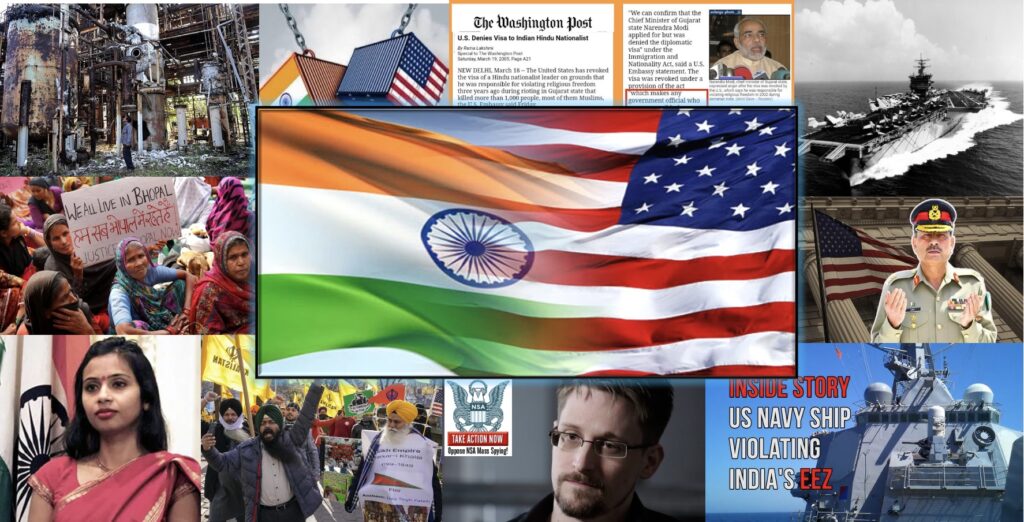
When Washington deployed the Seventh Fleet’s nuclear-powered USS Enterprise to the Bay of Bengal—an overt show of force meant to intimidate India—the message was clear: America was willing to brandish military power against New Delhi in defense of Pakistan. Only a Soviet counter‑deployment prevented escalation.
For India, this episode crystallized the view that Washington would sacrifice Indian interests at will to suit its geopolitical agenda.
Safe Havens for Separatists
Another persistent irritant has been the perceived U.S. tolerance toward Khalistani separatists. Leaders advocating violence and secession have found political and organizational space in America under the cover of “free expression.” For Indians, this looks less like liberal democracy and more like interference in domestic sovereignty.
Washington’s Oscillating Tilt Toward Pakistan
Despite improving ties with India in recent decades, Washington’s periodic swings back to Islamabad trigger renewed suspicion. The U.S. has often justified closeness with Pakistan in the name of counterterrorism or “regional balance.” However, New Delhi reads these moves as signs that America still prefers its traditional playbook of hedging India against Pakistan rather than treating India as a standalone ally.
Trade, Tariffs, and Pressure Tactics
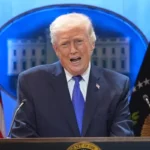
Economic wrangles have further strained trust. Under Donald Trump’s administration, India faced sharp tariff hikes—steel, aluminum, and later, a punitive 25% duty tied to India’s continued purchases of Russian crude oil. Trump’s trade advisers openly branded India the “maharaja of tariffs” and accused it of being a “laundromat for the Kremlin.”
India’s External Affairs Minister S. Jaishankar responded unambiguously. He argued that India’s energy and trade choices are driven by national interest and “red lines” shaped by the needs of farmers and small producers. He also accused Washington of inconsistencies—singling out India while sparing larger importers like China and Europe.
This back-and-forth once again revived the narrative that America uses coercion, not partnership, when interests diverge.
Diplomatic Flashpoints that Cut Deep
Several incidents reinforced mistrust at the people-to-people and official levels:
2005 Visa Ban on Narendra Modi, before he became Prime Minister, was perceived as a diplomatic insult.
2013 Devyani Khobragade case, where an Indian diplomat was arrested and strip-searched, sparked nationwide outrage.
NSA surveillance revelations of Indian leaders and missions in 2013–14 embittered diplomatic trust.
USS John Paul Jones’ passage through India’s Exclusive Economic Zone in 2021, without prior consent, raised sharp sovereignty concerns.
Each incident may seem isolated—together they built a running theme: America talks “equal partnership” but often acts otherwise.
The Bhopal Legacy: A Wound That Festers
Perhaps no corporate episode has left as lasting a scar on India’s memory of America as the 1984 Bhopal Gas Tragedy. On the night of December 2–3, toxic methyl isocyanate gas leaked from the Union Carbide India Limited pesticide plant in Bhopal, then a subsidiary of U.S.-based Union Carbide Corporation. The result was catastrophic: an estimated 3,000 people died within the first few days, while Indian government figures put the **official death toll at over 5,000. Independent organizations and health groups, however, estimate that 15,000–20,000 people have died prematurely over the following decades due to prolonged exposure.
More than 500,000 residents were directly exposed to the toxic fumes. Even today, tens of thousands continue to suffer chronic respiratory illnesses, cancers, vision loss, birth defects, and groundwater contamination. The abandoned factory site remains polluted, serving as a grim reminder that industrial poison still seeps into the lives of survivors four decades later.
What deepened the wound was not only the disaster itself but its aftermath. Union Carbide’s CEO, Warren Anderson, fled India soon after his brief arrest—widely believed to have been facilitated by U.S. political pressure. Despite repeated extradition requests, Anderson never faced trial in India and died in 2014 in the United States, beyond the reach of justice.
In 1989, Union Carbide agreed to a $470 million settlement with the Indian government, an amount widely criticized as paltry compared with the scale of deaths and long‑term suffering. Dow Chemical, which later acquired Union Carbide, has consistently denied responsibility for cleanup or further compensation.
For many Indians, Bhopal remains a living wound—an illustration that when American corporations are involved, accountability is often evaded, and powerful U.S. institutions shield their own. It is not just remembered as a tragedy, but as a betrayal.
The “Deep State” and Perceptions of Meddling
Suspicion is also reinforced by the belief that parts of the American establishment—the so‑called “deep state”—take hostile positions against India. From backing NGOs critical of India’s human rights record, to giving space to separatists, to funding journalism that questions the government, these patterns feed the narrative that America’s institutions prefer to meddle rather than respect sovereignty.
Why Mistrust Persists
Every time India feels pressured by discussions on human rights, trade, or foreign policy choices, it reawakens this collective memory of betrayal: the 1971 war, the 2005 visa ban, Khalistan, Bhopal, and countless smaller cuts.
The United States insists its positions are pragmatic and issue-based. But Indians often see a different picture—a nation quick to preach, slower to respect, and unreliable when accountability is tested.
Thus, the India‑U.S. relationship remains a paradox—partnership on the rise, but trust running thin. Dialogue and cooperation will continue, but for many Indians, America is still a partner to be treated with caution rather than certainty.