Trump’s 10% Tariffs Take Effect as White House Prepares for 15% Move
Trump Global Tariffs Reshape US Trade Policy
President Donald Trump’s sweeping Trump global tariffs regime formally came into force at 12:01 a.m. ET on Tuesday, February 24, 2026. The new policy imposes a 10% baseline tariff on nearly all imports entering the United States.
This marks the first major overhaul of American trade policy since the Supreme Court of the United States invalidated key parts of the previous tariff framework last week. The ruling restricted the administration’s ability to impose wide-ranging country-specific duties.
As a result, the White House moved swiftly to introduce a new system under Section 122 of the 1974 Trade Act. This provision permits temporary surcharges of up to 15% for 150 days to address balance-of-payments challenges.
However, the current order includes exemptions for critical minerals, pharmaceuticals, energy products, vehicles, aerospace components, and selected agricultural goods. Officials estimate that the average effective tariff rate now stands at around 10.2%.
Legal Background and Policy Shift After Supreme Court Ruling
The Supreme Court’s 6–3 decision on February 20 struck down the administration’s earlier reliance on the International Emergency Economic Powers Act. The judgment limited the executive branch’s authority to impose blanket tariffs without congressional oversight.
Within hours of the ruling, President Trump signed a new proclamation late on Friday night. On Saturday, he announced on Truth Social that he intended to raise tariffs to the legal maximum of 15%.
Nevertheless, as of Tuesday morning, only the 10% rate has taken effect. According to Bloomberg, officials are preparing a separate executive order to activate the higher levy.
This uncertainty has unsettled importers and exporters. Many firms remain unsure whether to renegotiate contracts or absorb higher costs in the coming weeks.
Trump’s Trade Strategy and Political Messaging
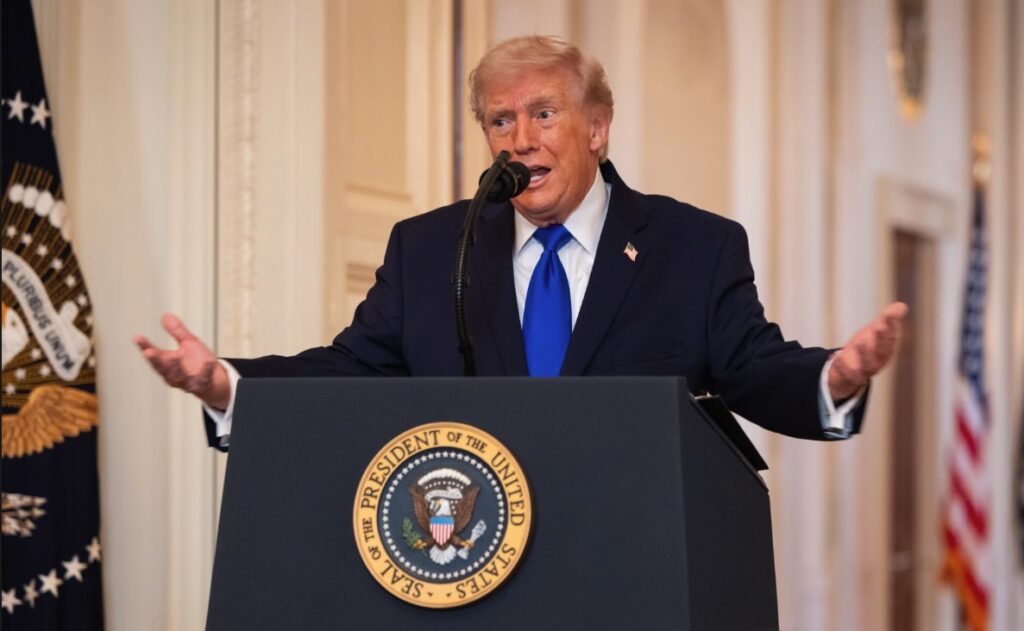
President Trump has consistently portrayed tariffs as a core economic weapon. In recent speeches, he described them as a powerful tool to defend American workers and revive domestic manufacturing.
He has argued that decades of trade deficits weakened US industry. Therefore, he views aggressive tariffs as necessary corrective measures. Supporters claim this approach strengthens bargaining power. Critics, however, warn of higher consumer prices and disrupted supply chains.
On February 23, Trump issued a sharp warning to trading partners. He stated that countries attempting to “play games” with agreements would face “much higher tariffs” and adverse commercial consequences.
This rhetoric reinforces his broader “America First” doctrine, which prioritises domestic industry over multilateral trade norms.
European Union Pauses Trade Agreement Ratification
EU Freezes Parliamentary Approval
The European Union has suspended ratification of its July 2025 trade agreement with Washington. The deal had capped most European exports at 15% while removing duties on many US products.
Bernd Lange, Chair of the European Parliament’s Trade Committee, announced that the vote has been postponed indefinitely. Officials seek “full clarity” on the new tariff regime.
According to Reuters, EU representatives fear that additional levies could breach existing commitments, particularly for chemicals, plastics, textiles, and dairy products.
A senior official stated, “A deal is a deal,” highlighting growing frustration in Brussels.
United Kingdom Adopts Cautious Diplomatic Stance
London Seeks to Avoid Escalation
The United Kingdom has responded with restraint. A spokesperson for Prime Minister Keir Starmer confirmed that London does not want a trade war.
The UK had previously negotiated a 10% preferential rate. However, the new global baseline threatens to undermine this arrangement. Therefore, British officials are monitoring developments closely.
At present, no retaliatory measures have been announced. Nevertheless, Downing Street has indicated that “nothing is off the table” if conditions deteriorate.
China Signals Possible Retaliation
Beijing Balances Restraint and Warning
China has reacted cautiously but firmly. A Commerce Ministry official said that Beijing would decide on countermeasures “in due course.”
China benefits from the flat-rate system introduced after the court ruling. Its effective tariff burden has declined under the new structure. Consequently, Chinese authorities have urged Washington to abandon unilateral measures.
They have called for dialogue instead of confrontation. However, analysts believe retaliation remains a strong possibility if tariffs rise to 15%.
India Halts Trade Talks Amid Rising Uncertainty
New Delhi Reassesses Interim Agreement
India has temporarily suspended plans to send a high-level delegation to Washington. The talks were intended to finalise an interim trade agreement concluded earlier this month.
Under that framework, US tariffs on Indian garments, pharmaceuticals, and gems were to fall to 18%. The new global levy complicates this arrangement.
Indian officials stated that more time is needed to assess legal and economic implications. Opposition parties, including Congress, have demanded a full renegotiation.
This pause adds pressure to India-US relations, which had recently shown signs of improvement.
Markets React as Investors Weigh Risks
Global financial markets opened cautiously on Tuesday. US stock futures declined marginally. The dollar remained stable. Gold prices edged higher.
Investors are balancing short-term relief for exporters against the risk of further escalation. China, India, and Brazil stand to gain temporarily. However, a 15% hike could reverse these benefits rapidly.
Supply chain managers are also reassessing logistics strategies. Many firms are accelerating diversification to reduce dependence on US markets.
Upcoming US–China Talks and Diplomatic Outlook
The White House has confirmed that President Trump will visit China from March 31 to April 2. He is scheduled to meet President Xi Jinping.
This will be the first bilateral summit of Trump’s second term. Trade policy, tariffs, and strategic rivalry will dominate discussions.
Diplomats hope the meeting can prevent further escalation. However, expectations remain modest given recent rhetoric.
Global Trade Landscape Remains Volatile
The introduction of Trump global tariffs marks a decisive shift in international trade relations. While the administration presents the move as economic self-defence, partners view it as destabilising.
Uncertainty persists over the timing and scope of the proposed 15% hike. Businesses, investors, and governments continue to prepare for multiple scenarios.
Tattvam News Today will monitor policy developments, market responses, and diplomatic negotiations. Readers can expect continuous updates on how this evolving tariff regime affects Indian exporters, global supply chains, and consumer prices worldwide.
The global tariff chessboard has been reset. However, the final outcome remains uncertain.