US Supreme Court Strikes Down Trump’s Sweeping Global Tariffs: A Deep Dive into the Verdict, Its Finality, Next Steps, and Implications for India-US Trade Deal
February 20, 2026 | Washington / New Delhi
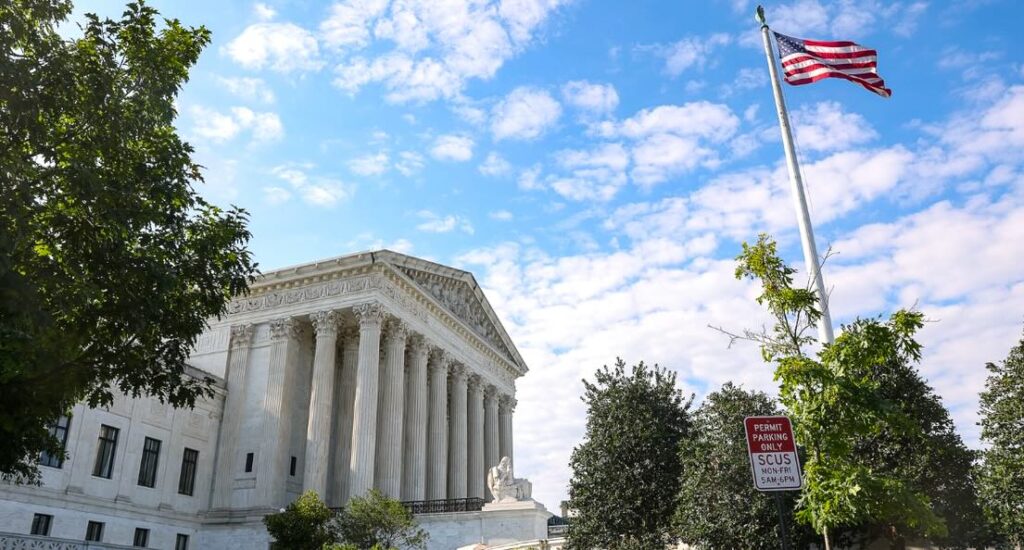
The Trump global tariffs ruling delivered by the Supreme Court of the United States on February 20, 2026, has marked a turning point in American trade policy. The court struck down sweeping import duties imposed by former President Donald Trump, stating that ‘executive authority’ cannot be stretched to justify unilateral trade wars.
The judgment has triggered strong reactions across global markets. It has also raised important questions about tariff refunds, future US trade strategy, and the fate of recent bilateral arrangements, including the interim framework with India.
As governments and businesses respond, the ruling is being seen as a decisive reassertion of constitutional limits on presidential power.
Key Details of the US Supreme Court Tariffs Verdict
In a 6–3 decision in Learning Resources, Inc. v. Trump, the Supreme Court ruled that President Trump exceeded his authority under the International Emergency Economic Powers Act (IEEPA) of 1977. The Act allows emergency controls on commerce. However, it does not authorise blanket tariffs aimed at correcting trade deficits.
Chief Justice John Roberts wrote the majority opinion. He was joined by Justices Amy Coney Barrett, Neil Gorsuch, and the court’s three liberal judges.
The dissenting view was expressed by Clarence Thomas, Samuel Alito, and Brett Kavanaugh, who argued for wider executive discretion in trade matters.
The invalidated “Liberation Day” tariffs imposed a baseline 10% duty on imports worldwide. Higher rates applied to major partners, including 25% on China, Canada, and Mexico, with later increases for select countries.
The court reaffirmed that tariff authority primarily lies with Congress under the US Constitution. It rejected the use of IEEPA as a “blank cheque” for unilateral trade actions.
Importantly, tariffs imposed under other laws, such as Section 232 or anti-dumping provisions, remain unaffected.
Finality of the Ruling and Its Constitutional Significance
The US Supreme Court tariffs verdict is final and binding. As the country’s highest judicial authority, the court’s interpretations of federal law and constitutional provisions cannot be appealed.
Reversal would require either a future Supreme Court decision overturning the precedent or a constitutional amendment. Both options are highly improbable in the current political climate.
The judgment has therefore immediately halted the collection of all IEEPA-based tariffs. It also represents a rare instance in which a conservative-leaning bench has curtailed expansive presidential authority.
Legal experts view the ruling as a reinforcement of institutional checks and balances within the US governance system.
What Happens Next: Tariff Removal, Refunds, and Policy Direction
The ruling has initiated a complex administrative and economic adjustment process.
Tariff Withdrawal
US Customs and Border Protection has begun suspending the collection of invalidated duties. Import costs are expected to decline. As a result, inflationary pressures on consumers may ease.
Pre-ruling studies had warned of a potential $3 trillion economic impact over a decade. The verdict may therefore mitigate long-term economic risks.
Refund Mechanism
The federal government now faces refund claims estimated at $175–200 billion. Importers who paid the duties will file claims through CBP procedures or the US Court of International Trade.
Large corporations such as Costco and Revlon are expected to seek substantial recoveries.
However, the process is likely to be lengthy. It may take several years to resolve all claims. Consumers, who indirectly bore the cost through higher prices, are unlikely to receive direct compensation.
Policy Realignment
The White House may now pursue fresh legislation through Congress. Alternatively, it may rely on trade laws such as Section 301. These moves could revive trade tensions but will operate within clearer legal boundaries.
Allies may also revisit agreements concluded under tariff pressure.
Impact on the India-US Trade Deal Framework
The ruling has significant implications for the interim India-US trade framework announced on February 6, 2026. The agreement followed talks between President Trump and Prime Minister Narendra Modi.
Under the framework, US tariffs on Indian goods were reduced from 50% to 18%. In return, Washington claimed that India would restrict Russian oil imports and commit to large-scale purchases of US goods. However, New Delhi has not formally confirmed these as binding commitments, stating that the understandings were not final commitments but preliminary still under discussion.
Since the 18% duty was imposed using IEEPA authority, it now stands invalidated. Indian exports to the US revert to Most Favoured Nation rates of around 3%.
This change benefits key sectors, including:
- Textiles and garments
- Pharmaceuticals
- Gems and jewellery
These sectors together account for nearly 55% of India’s exports to the US, valued at over $80 billion annually.
However, Section 232 tariffs on steel and aluminium continue to apply. These affect roughly 10% of Indian exports.
With tariff leverage weakened, India may reassess commitments on energy imports and large procurement targets. Domestic critics have already questioned the framework’s economic and strategic costs.
Renegotiations are therefore likely. They may delay the proposed comprehensive Bilateral Trade Agreement.
Strategic Implications for Global Trade and India-US Relations
The Trump tariffs struck down verdict reshapes US trade diplomacy. It signals that emergency powers cannot replace legislative consensus in economic policymaking.
For India, the ruling strengthens negotiating leverage. It aligns with New Delhi’s recent trade engagements with the European Union and Gulf Cooperation Council countries.
Defence, technology, and semiconductor cooperation between India and the US remains robust. However, trade talks are likely to become more rules-based and less personality-driven.
The decision also encourages other nations to challenge unilateral economic measures through legal channels.
In the evolving geopolitical environment, this judgment reinforces the importance of predictable, law-based trade systems. It also underscores India’s growing role as a confident economic partner in a multipolar world.