By Samir Gupta, IIT Delhi alumnus | Tattvam News | October 2025
India’s Middle Class: A Hidden Downfall
The Quiet Strain Beneath India’s Growth Story
India’s middle class — once the country’s engine of aspiration and progress — is under silent siege. Behind the dazzling GDP numbers and record stock indices lies a quieter truth: families are working harder, saving less, and worrying more.
They are not poor enough to seek government aid, nor wealthy enough to shield themselves from inflation and rising living costs. Yet, the strain on this vast section of India’s population could reshape the nation’s economic and social balance more profoundly than any political change.
From Aspiration to Anxiety: The Slow Squeeze
A decade ago, the average Indian household saved nearly one-fourth of its income. Today, that figure has dropped below one-fifth — a decline economists describe as deeply worrying.
This fall isn’t about careless spending. It’s about survival amid relentless inflation. Education, rent, groceries, and fuel now consume a larger share of income than ever. Even those earning more than before find their additional pay swallowed by basic expenses.
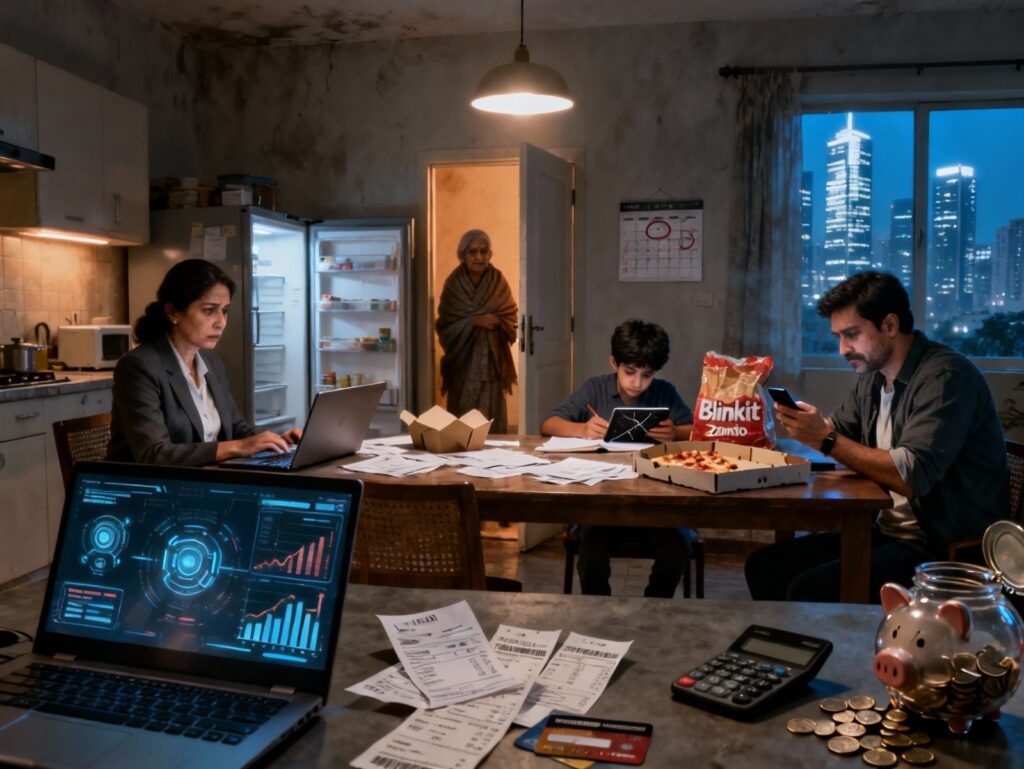
Middle-class comfort, once symbolised by thrift and security, is now defined by tight budgets and credit card EMIs.
Ambition at a Cost: The Education Trap
Ironically, the same ambition that fuelled India’s rise is now draining its middle class. Parents routinely fund foreign education for their children — often by exhausting savings or taking loans.
Every year, billions of dollars flow out of India in tuition payments, mostly from middle-class families chasing global degrees. But when these students return, the jobs rarely match the investment.
The result? A cycle of wealth outflow and confidence erosion. Families that once planned for a stable future now live month to month, trapped between debt and hope.
Automation: The New Middle-Class Threat
Adding to the stress is the rapid transformation of employment. Automation and artificial intelligence have begun replacing roles once handled by junior executives and analysts.
Stable, long-term jobs — the traditional middle-class cushion — are thinning out. Professionals today must learn to coexist with algorithms rather than command them.
The shift has bred a new form of uncertainty. It’s no longer about losing jobs, but about losing relevance. For a generation raised on the promise of progress through education, that’s a frightening reversal.
The Mirage of Comfort
From the outside, the middle class still appears secure — smartphones, modest cars, annual holidays. But beneath this image lies shrinking financial security.
The middle class now juggles rising EMIs, unpredictable jobs, and stagnant savings. Beneath the surface of prosperity lies a reality of living on borrowed credit and borrowed time.
Why the Middle Class Matters
The Indian middle class isn’t just an income bracket. It is the conscience, stabiliser, and tax backbone of the nation.
It sustains consumer demand, pays most of the taxes, and bridges the emotional distance between privilege and poverty. When it thrives, India feels anchored. When it struggles, everything above and below starts to wobble.
That’s why economists — from the Reserve Bank to the World Bank — warn that GDP growth alone cannot define progress. India’s stability depends on secure household incomes, predictable jobs, and renewed trust in effort.
Erosion of the Centre: A National Risk
If money continues to flow abroad for foreign education and jobs vanish to automation, India’s progress risks eating itself from within. A society can tolerate inequality, but not the hollowing of its middle.
When the centre weakens, both extremes — the rich and the poor — lose equilibrium. The poor protest; the rich move their wealth to safety. But the middle class remains silent, and that silence becomes India’s loudest warning.
The Psychological Collapse
This crisis isn’t only economic — it’s emotional. When ordinary citizens lose faith in progress, they stop saving. When they stop saving, they stop investing — not only money, but belief.
A nation begins to slow from within when its people no longer see effort as rewarding.
Restoring Faith and Stability
India still has time. It can rebuild trust, revive stability, and restore the dignity of effort — but only with bold policy choices.
The middle class needs protection not through subsidies, but through safeguards and modern frameworks.
-
Regulate automation to amplify human potential, not replace it.
-
Discourage unjustified layoffs in the name of technology.
-
Introduce incentives that keep domestic education competitive to reduce outflow of funds.
Families sending money abroad for education should be encouraged to reinvest a share back into India’s innovation and learning ecosystem.
A Call for Policy Courage
If India’s middle class is to survive, it needs protection from erosion — the slow, silent kind that begins with ambition and ends in exhaustion.
Without decisive action, this decade may not be remembered for India’s rise, but for the moment when its strongest pillar quietly gave way beneath the noise of its own success.
Conclusion
The story of India’s middle class crisis is not about collapse — it’s about neglect. Behind every statistic lies a household doing its best to hold on. To preserve India’s growth story, the middle class must not just endure; it must be empowered once again to dream, save, and believe.