The ‘Narco-Terror’ Pretext and the Push for Regime Change in Venezuela
Venezuela on the Brink: U.S. Military Pressure Intensifies
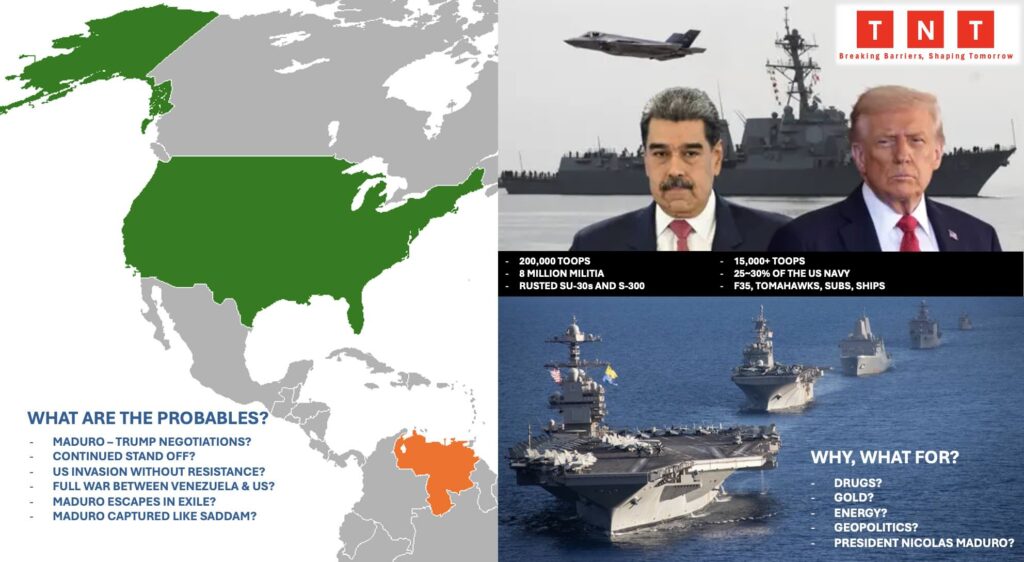
The U.S. Venezuela standoff has pushed the region into its most volatile moment in decades as key developments escalate dramatically between the United States and Venezuela. Since September, U.S. airstrikes on suspected drug boats have killed at least 83 people, pushing the region into a grey zone between covert operations and open conflict. President Nicolás Maduro now faces narcoterrorism indictments, and Washington has placed a $50 million bounty on his capture. Venezuela has reacted by mobilising 200,000 troops in sweeping drills and accusing the U.S. of manufacturing pretexts to justify a potential invasion.
Inside the United States, public sentiment remains mixed. A CBS News poll shows that more than two-thirds of Americans oppose a direct military conflict, yet the majority still supports aggressive anti-drug operations. Regionally, allies such as Colombia and Brazil are offering logistical support to the United States, though many governments fear spillover instability and wider conflict as a result of U.S. Venezuela standoff.
A Massive Deployment Unfolds Across the Caribbean
Reports confirm that as of mid-November 2025 a significant U.S. deployment is now active throughout the Caribbean. The operation includes over 15,000 personnel, drawing Marines, sailors, and support staff from U.S. Southern Command. Rapid-response Marine units have been forward-positioned on bases in Puerto Rico and nearby islands, placing them merely seven miles from Venezuela’s coast.
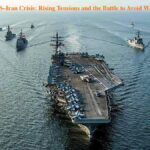
Perhaps the most striking detail is that 25–30% of all U.S. Navy warships currently deployed worldwide are concentrated in the Caribbean, led by the arrival of the USS Gerald R. Ford Carrier Strike Group on 16 November. As the largest aircraft carrier on Earth, the Ford brings more than 75 aircraft, supported by destroyers, submarines, and advanced aviation assets capable of precision strikes. Analysts describe this as a “generational” show of force and the most extensive American presence in the region since the 1989 invasion of Panama.
This overwhelming deployment aligns neatly with President Trump’s revived America First foreign policy posture, which emphasises unilateral decisive action and a restored Monroe Doctrine-style approach to the Western Hemisphere.
The Drug Narrative: A Convenient Cover?
Washington argues that the campaign is driven by narcotics concerns. Yet, critics point out that this narrative does not withstand basic scrutiny. Nearly 80–90% of all cocaine consumed in the U.S. comes from Colombia, and roughly 80% of maritime seizures of U.S.-bound narcotics also occur on Colombian routes. If Colombia remains the primary source of cocaine, the question naturally arises: why are Venezuelan vessels the ones facing airstrikes in the Caribbean?
The answer, according to analysts, lies in the construction of a domestic and international narrative. By aggressively targeting Venezuelan boats, the U.S. can shape public opinion, justify expanded operations, and prepare the legal ground for declaring not only the Cartel de los Soles but potentially the entire Venezuelan state apparatus as a terrorist organisation — a move that would dramatically simplify the path to intervention and regime change.
The Constitutional Shortcut
Under Article I of the U.S. Constitution, the president requires congressional authorisation before attacking a sovereign country. However, by designating the Cartel de los Soles as a Foreign Terrorist Organisation (FTO) on 24 November 2025, the administration has effectively bypassed Congress. This move expands executive authority, enabling unilateral strikes, asset seizures, and targeted operations without the need for a formal war declaration. It mirrors earlier U.S. practices where terrorism or national-security classifications were used to sidestep legislative oversight.
Patterns from History: When Pretexts Mask Deeper Ambitions
The U.S. Venezuela standoff scenario fits a long-standing pattern in U.S. foreign policy. Historically, interventions have often relied on convenient justifications that do not hold up under scrutiny, from Iraq’s “weapons of mass destruction” to anti-communist pretexts during the Cold War. The 2003 Iraq invasion, for example, was ultimately exposed as having no WMD foundation; yet the conflict facilitated enormous resource extraction and lucrative contracts.
Iraqi oil theft alone amounted to an estimated $150 billion in lost revenue through smuggling, black-market sales, pipeline siphoning, and systemic corruption. U.S. companies gained billions through reconstruction contracts, while oil flowed illegally across borders into Syria, Jordan, Turkey, and Iran. Such precedents shape how many observers interpret current U.S. intentions in Venezuela.
If history rhymes, the “excuse” holds until the real game starts.
Strategic Prize: Oil, Gold, and Geopolitical Control
With almost 300 billion barrels of oil reserves, Venezuela controls the world’s largest proven oil wealth. This is supplemented by significant gold deposits that the Maduro government has used as a sanctions workaround, often exchanging gold for Iranian and Russian arms support. Critics argue that the massive U.S. military buildup is about more than narcotics or terrorism. It serves a multifaceted strategic purpose: forcing regime change, securing access to Venezuela’s energy and mineral wealth, and reducing the influence of geopolitical rivals — particularly Russia, China, and Iran — in the Western Hemisphere.
Leaked documents point to potential multi-year U.S. troop rotations in the Caribbean, suggesting a long-term plan for maritime and aerial dominance in the region. CIA “battlefield-shaping” operations have reportedly been authorised, raising tensions further after at least 19 airstrikes since September. Sanctions have already frozen more than $2 billion in Venezuelan gold and oil assets, and major companies like Chevron are positioned to regain influence in the energy sector should a political transition occur.
A Renewed Monroe Doctrine: Rivals Pushed Out
The U.S. Venezuela standoff crisis deepens what analysts are calling a twenty-first century Monroe Doctrine revival. Russia is severely constrained by its war in Ukraine. China, despite its strategic partnerships with Venezuela, avoids large-scale military deployments abroad. Iran faces its own domestic and regional pressures. None are capable of providing Venezuela with substantial reinforcement, leaving Maduro diplomatically isolated.
The U.S. deployment, including 13 vessels, an attack submarine, and F-35 assets in Puerto Rico, has effectively boxed Venezuela in from both the Caribbean and the Atlantic. Venezuela’s “Independence Plan 200” mass mobilisation of 200,000 troops and 8 million militia members is widely regarded as theatrical rather than operationally viable, with obsolete F16, Su-30 fighters, unreliable S-300 systems, and sanctions-damaged maintenance infrastructure.
Signs Maduro May Be Preparing to Flee
As tension due to U.S. Venezuela standoff climb, discreet signals suggest Maduro may be preparing for exile. The Russian embassy in Caracas reportedly reduced staff to a minimal skeleton crew last week, a typical pre-exfiltration move in crisis zones. It is reported that two Russian Rossiya Il-96 aircraft are currently positioned in locations historically used for emergency extraction routes into Latin America. Maduro’s public schedule abruptly went blank after 22 November, fuelling speculation that preparations for a sudden departure may already be underway.
If events escalate, the world may soon witness headlines announcing Maduro’s arrival in Moscow “for discussions with President Putin,” followed swiftly by the formation of a transitional government and U.S. oil companies securing Venezuela’s critical infrastructure. Exile in Moscow is seen as one of the few viable options left for Maduro, with regional governments quietly acknowledging this possibility.
U.S. Venezuela standoff: A Region Waiting for the Spark
Despite the enormous U.S. mobilisation, officials insist that an invasion is not imminent. Yet the presence of the USS Gerald R. Ford and a large fraction of the American naval fleet in such proximity sends a clear message that “all options remain on the table.” Any escalation could trigger a humanitarian catastrophe, with millions more potentially fleeing Venezuela, global oil prices surging by 20–30%, and geopolitical shockwaves hitting the entire hemisphere.
Still, for now, the Caribbean remains on edge — a theatre where military build-up, strategic signalling, covert operations, and political brinkmanship are converging in real time. As history suggests, the declared justifications may not reveal the whole story. With the region watching closely and tensions already strained to breaking point, the question is no longer whether pressure will continue but how close the crisis is to erupting into the next major geopolitical conflict.