The Hidden Contest for Venezuela’s Oil & Gold: America’s Shift from Drug War to Resource War
As warships gather in the southern Caribbean and stealth fighters circle Puerto Rico, the confrontation between the United States and Venezuela has quietly morphed. What began in the public eye as a “drug-war” operation has edged into something far broader—an unfolding struggle for control of vast hydrocarbon wealth, gold reserves and regional influence. At the center: the regime of Nicolás Maduro in Caracas, and the increasingly forward-posture of the Donald Trump administration in Washington.
Why Venezuela’s Reservoirs Matter
For decades, Venezuela has held an outsized claim to global energy influence. According to the U.S. Energy Information Administration, in 2023 Venezuela had roughly 303 billion barrels of proven crude-oil reserves—about 17 % of the global total, and more than any other country.
Yet this immense potential has been poorly exploited: the EIA reports that despite the size of the reserves, Venezuela produced only about 0.8 % of global crude output in 2023.
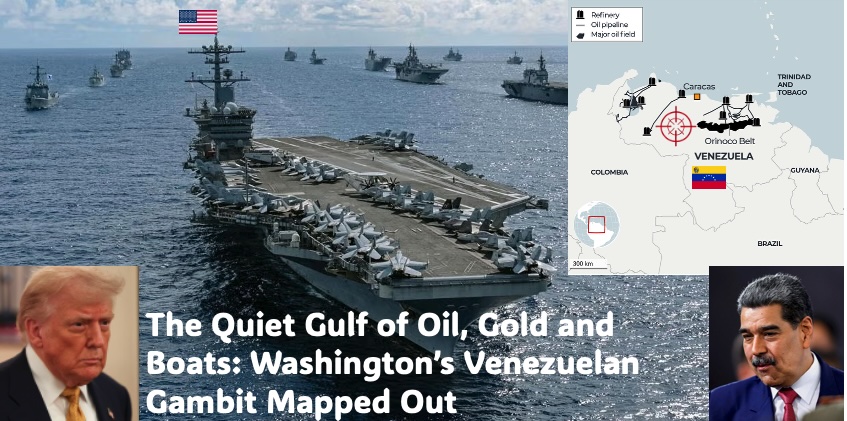
Much of the oil lies in the extra-heavy crude fields of the Orinoco belt—high cost, high complexity, politically and technically difficult to develop.
On the gold front, while data is more opaque, recent estimates place Venezuela’s official gold reserves at 161.2 tonnes in early 2024. However, more troublingly, the central bank reported a 13 % drop in gold holdings in 2024, ending the year at 53 tonnes, valued at ~$4.24 billion.
These figures point to both the latent value in Venezuela’s resources and the fragility of Caracas’s hold on them.
The U.S. Posture: More than Counternarcotics
Publicly, the U.S. framework around Venezuela remains framed in terms of counternarcotics and migration. The Trump administration claims its deployments are aimed at stopping drug-trafficking vessels and securing U.S. borders. Still, the nature and scale of the deployments tell a deeper story.
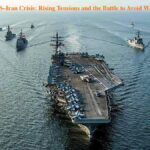
A recent press report states that the U.S. Navy deployed eight warships in Caribbean and Pacific waters near Latin America—including destroyers, an amphibious assault ship and a cruiser.
Meanwhile, normal budget-level counternarcotics forces have been supplemented by F-35 stealth fighters, MQ-9 Reaper drones, attack submarines and amphibious ready groups operating from forward bases such as the reopened Naval Station Roosevelt Roads in Puerto Rico.
Washington publicly authorised the Central Intelligence Agency to conduct covert operations inside Venezuela—breaking with traditional reticence—and signalled possible land-based strikes.
On the Venezuelan side, Caracas has responded in kind: president Maduro announced that some 25,000 troops would be deployed to coastal and border states in response to U.S. military escalation.
Collectively, this posturing forms a ring around Venezuela’s coastlines, air-space and maritime approaches, one that goes well beyond a standard counternarcotics mission. The deployment is calibrated to give swift options: surveillance, interdiction, raids, strikes, and even regime pressure or change.
What Trump Likely Wants
While official statements emphasize the drug threat, the broader choreography suggests three intertwined objectives:
Destabilise the Maduro regime — not simply as a law-enforcement target but as a political and economic entity. The intensity of the buildup, the public CIA authorisation and the naval cordon all indicate Washington is keeping regime change entirely on the table.
Choke off revenue streams and create leverage — by hitting Venezuela’s ability to export oil, move gold, or finance its security-state. The resource base is massive, but Caracas remains financially strained. A US pressure campaign can exploit that vulnerability.
Assert U.S. regional dominance and deny adversaries — whether through direct American access to resources or via third-party contracts favourable to U.S. allies. At the very least, prevent rival powers (Russia, China, Iran, Cuba) from entrenching influence in Venezuela’s resource sector.
Resource Leverage: The Real Prize
Consider the numbers: Venezuela’s oil reserves rank first globally, yet production is depressed. According to Reuters, in 2024 Venezuela’s state-oil company Petróleos de Venezuela (PDVSA) reported $17.52 billion in foreign oil sales and averaged ~805,500 barrels per day in exports, with production around 952,000 bpd.
In other words: enormous reserves, low production; huge potential, limited extraction. This gap is exactly what gives external actors leverage.
Similarly, the gold story is telling. A drop of 13 % in reserves in 2024 (ending at 53 tonnes) signals financial stress, asset erosion and opportunity for someone else to step in.
For Washington, steering or controlling upstream contracts, export licences, shipping insurance, and downstream refinery agreements becomes as important as boots in the field. The heavy assets deployed aren’t merely for interdiction—they are a means of creating an environment where resource flows can be disrupted, redirected or renegotiated.
Legal, Political and Operational Constraints
However compelling the ambition, the hurdles remain high:
International law: Using military force for counternarcotics in international waters, or even inside a sovereign state via covert operations, invokes complex issues—especially when the target is a sitting government.
Domestic U.S. governance: The U.S. Constitution allocates war powers to Congress. Extended military operations against Venezuela could run up against legal and budgetary barriers.
Regional blow-back: Latin America bears deep scars of U.S. interventions. Heavy-handed action may alienate key partners and drive regional blocs to resist.
Operational complexity: Seizing or operating oil fields and extracting value from gold deposits isn’t just about control on land. It requires technicians, supply chains, security, stable governance. Venezuela’s infrastructure has been degraded for years. Even if assets are captured, making them productive is non-trivial.
Global economic consequences: Any disruption in Venezuelan oil exports can ripple through global markets—insurance, shipping, commodity prices, refiner contracts. The U.S. cannot isolate the theatre entirely.
Near-Term Likely Pathway
Based on all the above, the most probable sequence of events is:
Increased maritime and air patrols, interdiction operations targeting drug-trafficking vessels near Venezuelan waters—framed publicly as counternarcotics but tactically serving broader pressure.
Expanded covert action inside Venezuela: intelligence gathering, sabotage of regime-revenue infrastructure, influence operations inside the security apparatus.
A squeeze on Venezuela’s export revenues via sanctions, export licences and shipping/insurance constraints — even without full occupation of oil fields.
A conditional offer to Caracas (or to elements within it) that access to foreign oil/gold investment requires a change of terms — whether political, contractual or technical.
Only under extraordinary circumstances (regime collapse or major internal shift) would the U.S. move to more direct control of extraction assets. Such a scenario remains least likely because of cost and risk.
Risk Map and What to Watch
Escalation via maritime incident: A U.S. strike on a suspected vessel or shipboard clash could rapidly shift from interdiction to broader conflict. E.g., strike that killed 11 people was reported.
Revocation or granting of export/operating licences for Venezuelan oil — especially involving U.S. firms like Chevron Corporation — signals who will benefit.
Gold reserve movements: continued drop in holdings, off-shore transfers, asset seizures abroad.
Regional alignments: how Venezuela’s allies (Russia, China, Iran, Cuba) respond. Are they prepared to counter-balance U.S. pressure?
Domestic U.S. congressional responses: bills restricting military authority, oversight hearings, funding constraints.
Infrastructure capture or partner deals: A third-party firm bids for Venezuelan oil assets under a new license — this may signal U.S. leverage shifting toward extraction.
Conclusion
What is unfolding around Venezuela is less a classic drug-war campaign and more a resource war under the guise of counternarcotics. The U.S. is deploying significant military-intelligence assets—naval task forces, stealth fighters, drones, covert operatives—while pointing to the flow of drugs and migrants. All the while, the latent prize remains oil, gold and a major strategic foothold in Latin America.
For Washington, the objective is not merely interceptions at sea but control over the pipeline of Venezuelan wealth—who sells the next barrel, who bags the next bar of gold, who signs the next contract. For Caracas, the question is whether its regime can defend its sovereignty and revenue flows or whether it becomes increasingly squeezed into dependence—or displacement.
The Caribbean is no longer a tranquil margin of U.S. influence. It has become a front line. And Venezuela, with its vast reserves and embattled regime, is the fulcrum. The next few months may well determine whether this contest remains a maritime and covert chess match—or evolves into something far more overt and costly.