
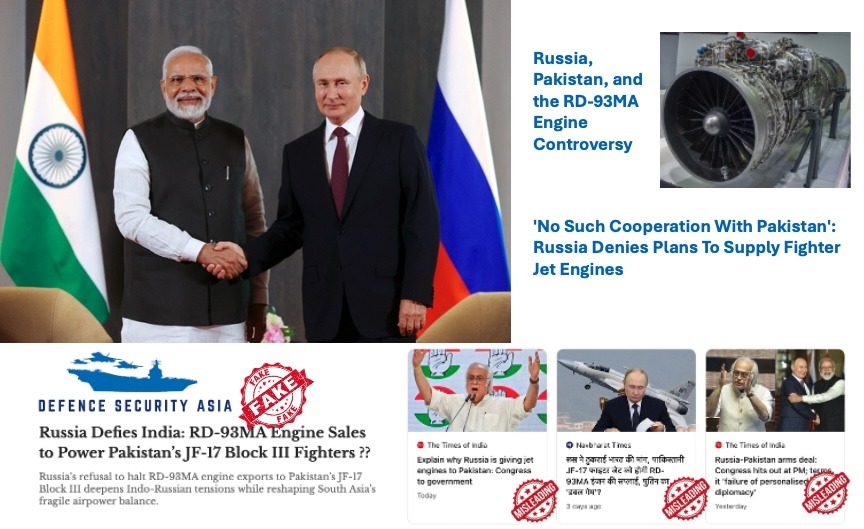
The Great Jet Engine Controversy: Unravelling the Russia–Pakistan–India Media Misinformation Game
In late September and early October 2025, a swirling controversy erupted over reports that Russia was supplying RD-93MA fighter jet engines to Pakistan for its JF-17 Thunder Block III fighters. The story spread rapidly across Indian media and political circles, sparking concerns about Russia’s strategic motives and the future of India–Russia defence relations.
However, a deeper examination of official Russian clarifications, credible media sources, and political reactions reveals a far more nuanced reality—one built on misinformation, irresponsible media sensationalism, and political opportunism.
The Russian Clarification: Firm Denial and Transparency
Russia’s Ministry of Foreign Affairs issued an unequivocal statement (on October 4, 2025, 3:00 PM IST) denying any sale or shipment of RD-93MA engines to Pakistan, stating:
“Russia has not exported and does not plan to export RD-93MA engines to Pakistan. All military exports are conducted strictly within existing international agreements and policies.”
The Russian aerospace manufacturer UEC-Klimov also dismissed the reports as “misleading misinformation” aimed at damaging Russia’s strategic partnership with India.
This clarification marks a decisive turning point, confirming that allegations of Russian arms support to Pakistan are baseless. Moscow reaffirmed its adherence to international norms and its commitment to transparency and responsible export controls.
(See coverage: “Russia Denies Reports of Supplying Newer Engine variant” via IDRW / AFI and “Big setback for Pakistan: Russia … denies supplying” in DNA India.
Indian Media’s Reaction: The Hotbed of Speculation
Even after Russia’s denial, many Indian outlets continued (some are still continuing) to frame the narrative with distrust. Headlines such as “Russia’s Supplying Jet Engines to Pakistan: Clarification or Cover-up?” and “Why Russia is Supporting Pakistan’s Military Rise Amid India’s Concerns” reinforced public alarm.
For example:
Times of India ran “Explain why Russia is giving jet engines to Pakistan: Congress to government” (Update Oct 05, 2025, 06:38 IST)
Navbharat Times published in Hindi: “रूस ने ठुकराई भारत की मांग, पाकिस्तानी JF-17 … होगा RD-93MA इंजन” (Oct 02, 2025 – now page missing)
Mathrubhumi ran “Is Russia supplying RD-93MA engines to Pakistan for JF-17 fighter jets?” in its English edition (Oct 05, 2025, 02:41 PM IST)
Politicians, such as Jairam Ramesh, used such reportage to press the government for answers—even when primary sources had denied the claims. This amplifies how unverified reports can persist as fact in public discourse.
The Politics of Misinformation: Jairam Ramesh vs. BJP
Opposition leader Jairam Ramesh publicly demanded explanations, asserting Russia was “supporting Pakistan militarily,” citing multiple reports. His post on X (formerly Twitter) read:
“The Modi government must explain why Russia — once India’s most reliable strategic ally — has chosen to ignore New Delhi’s appeals and proceed with supplying advanced RD-93MA engines to Pakistan.” (Oct 4, 2025, 4:09 PM)
Other coverage:
Telegraph India ran “Modi government must explain Russia’s delivery of advanced JF-17 engines to Pakistan: Congress” (Oct 04, 2025, 7:23 PM).
Scroll.in published “Explain why Russia ‘ignored’ India’s calls …” reflecting Ramesh’s position (Oct 05, 2025, 12:16 PM).
New Indian Express ran “Congress says Modi’s diplomacy failed as Russia supplies engines for Pakistan’s JF-17 jets.”(Oct 04, 2025, 6:25 PM).
In counter, BJP leaders struck back, calling such claims “baseless” and accusing the opposition of reckless information warfare. For instance, BJP’s Amit Malviya posted:
“No official confirmation. No credible source. Just another round of reckless information warfare.”
Thus, political actors escalated the issue, often bypassing verification in favour of media traction.
Chronology of Events: Tracking the Source of Confusion
The misinformation trail around the alleged Russia–Pakistan jet engine deal unfolded rapidly over just a few days.
It was found during our research that the misinformation was first planted by the Malaysian defence and security news website, Defence Security Asia, on 30 September 2025. The portal published a detailed report claiming that Russia was proceeding with RD-93MA engine shipments to Pakistan, despite India’s objections. The report was clearly speculative, offering no reference or attribution to any credible source. yet it became the starting point of the entire controversy.
By 1 October 2025, DNA India followed up with a short social-media update suggesting that India had made diplomatic appeals to Moscow to halt the shipment — though the post cited no confirmation from Russian or Indian officials.
On 2 October 2025, Hindi media outlets Navbharat Times and ABP News echoed similar claims, asserting that Russia was supporting Pakistan’s JF-17 Thunder programme with advanced engines. These accounts gained traction across online and television platforms.
Between 3 and 4 October 2025, the narrative spread rapidly on social media and discussion forums such as Reddit, where users quoted these reports without verification. Although Russian denials began surfacing around this time, they attracted far less attention than the speculative content being circulated.
On 4 October 2025, the Russian Ministry of Foreign Affairs issued a formal denial, declaring the allegations entirely false and describing them as part of a broader misinformation campaign. This statement was widely reported by IDRW and other Russian and Indian defence portals.
Finally, on 5 October 2025, the controversy reached its peak within Indian media and political circles. Despite repeated clarifications from Russia, unverified reports continued to dominate headlines, amplified by political commentary and television debates, deepening confusion among the public and straining perceptions of India–Russia defence relations.
This sequence illustrates how one speculative article can cascade across media, eventually overwhelming the truth in perception.
Responsible Journalism vs. Misinformation: A Critical Reflection
This controversy emphatically demonstrates the perils of unverified reporting. It appears that the original news was planted on an external portal, which was then amplified across the media landscape. Many Indian media outlets — knowingly or unknowingly — along with political figures, leapt onto the engine-supply narrative without direct confirmation from credible sources. Even after Russia’s official denial, the speculation persisted, further reinforcing public doubt and mistrust.
Such narrative amplification serves the interests of external actors or domestic factions seeking to sow diplomatic friction. In the era of instant news and social media virality, the role of the press is even more critical. Integrity demands cross-verification before publication, particularly on matters of defence, foreign policy, and national security.
A false or exaggerated claim does more than mislead—it can undermine perceptions of international trust and jeopardise strategic alliances.
Conclusion: Truth Amid Turbulence in the Misinformation Era
The Russian government’s position remains unequivocal: there has been no supply or shipment of RD-93MA jet engines to Pakistan. The controversy appears to have originated from a speculative source—likely Defence Security Asia—and was amplified unchecked across media and political platforms.
This event serves as a cautionary case of how media sensationalism, political opportunism, and digital misinformation can jointly erode bilateral trust. For India and Russia, two nations bound by decades of India–Russia defence relations, the lesson is clear:
- Strengthen fact-verification frameworks
- Promote responsible journalism
- Prioritise fidelity to evidence over frenzy
Only then can strategic stability and mutual trust be preserved—even in the storm of misinformation.
Headline to Remember
“The Jet Engine Misinformation Saga: How a Fake News Campaign Nearly Undermined India–Russia Ties.”













One Response
I would like know from the media – Why can’t Russia sell arms to Pakistan? If the US can provide arms and ammunition to both Pakistan and Bharat, why should Russia be held to a different standard? Like Bharat, Russia is a sovereign nation that acts in its own strategic interests. Such concerns would only be relevant if Bharat sourced all its weaponry exclusively from Russia. This is a reminder to these critics that if Russia ever chooses to sell weapons to Pakistan in the future, it remains their sovereign right and does not merit political outrage or a formal clarification from the Prime Minister.