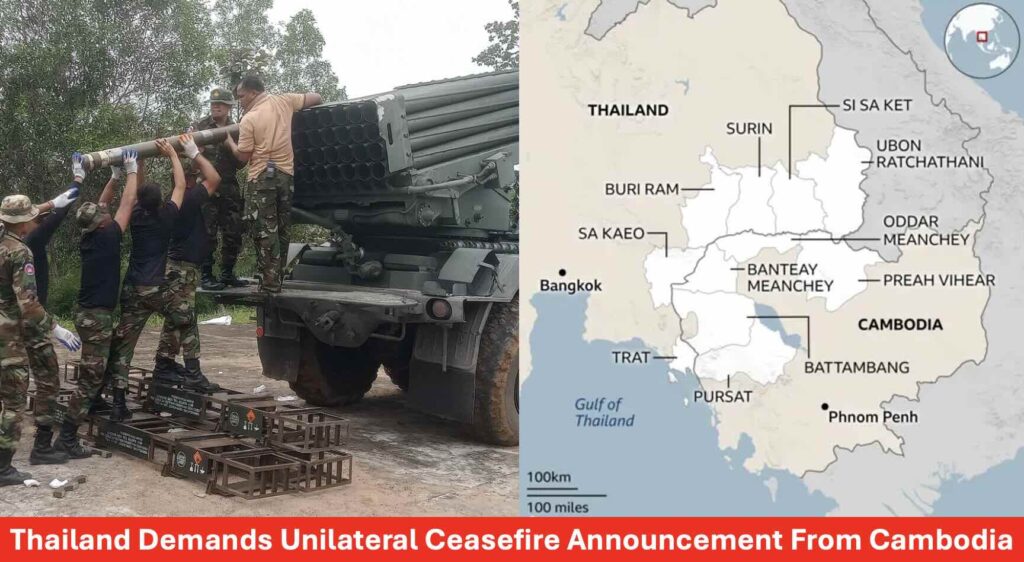
Thailand Cambodia War: Ceasefire Dispute Deepens
Bangkok Pushes Back on Trump Claim
Tensions along the Thai–Cambodian frontier remained high on Tuesday as Bangkok publicly demanded that Cambodia be the first to declare a ceasefire, even while firmly rejecting former US president Donald Trump’s assertion that a new truce or peace deal is already in place. The episode has highlighted the growing disconnect between political messaging and the realities of fighting on the ground, as well as the fragility of externally brokered arrangements in mainland Southeast Asia.
Clashes along the disputed border have intensified since December 7, killing at least 32 people and displacing an estimated 800,000 civilians, according to regional officials. Both sides continue to accuse the other of initiating hostilities and targeting civilian areas near contested zones.
Thailand Demands Ceasefire and Demining Commitment
At a briefing in Bangkok, Thailand’s Foreign Ministry stated that Cambodia, which it described as the “aggressor”, must formally announce a ceasefire before any de-escalation could take place. Thai officials also insisted that Phnom Penh must demonstrate genuine commitment to demining operations along the 817-kilometre shared border, where landmines from past conflicts remain a persistent threat to both civilians and troops.
The ministry stressed that trust could not be rebuilt without concrete steps on the ground, arguing that repeated Cambodian strikes near populated areas had made unilateral restraint by Thailand untenable. Cambodian authorities have rejected the accusation, maintaining that Thai forces fired first and carried out air strikes near border villages.
Thailand Cambodia Border Dispute Rooted in History
The current escalation is the latest chapter in a century-old border dispute stemming from colonial-era maps and conflicting interpretations of frontier demarcation. The disagreement includes areas surrounding historic temples and resource-rich land claimed by both sides. Efforts to resolve the dispute through joint surveys and development projects have repeatedly stalled, often collapsing amid renewed fighting.
Earlier clashes in 2025 had already strained diplomatic channels, and analysts note that domestic nationalism in both Bangkok and Phnom Penh has made compromise politically risky. ASEAN has continued to encourage dialogue, but its influence has been limited by the depth of mistrust between the two militaries.
Trump’s ‘Historic’ Thailand Cambodia Peace Deal Under Scrutiny
The latest standoff has revived questions about the durability of a Trump-brokered Thailand Cambodia agreement announced in October on the sidelines of an ASEAN summit in Malaysia. Trump had described the Kuala Lumpur pact as a “historic” breakthrough, presenting it as a decisive step toward ending the border conflict.
However, the agreement was widely seen as a joint declaration rather than a binding treaty, committing both sides to withdraw heavy artillery, accept ASEAN-monitored demilitarisation in sensitive zones, and facilitate the return of Cambodian prisoners of war. Thai officials at the time characterised it only as a “pathway to peace”, warning that major issues around demarcation and verification remained unresolved.
Collapse of the Trump Framework
By early November, Thailand had already suspended participation in Trump-backed peace talks, citing continued skirmishes and lack of progress. Analysts cautioned that the Kuala Lumpur framework relied heavily on personal diplomacy and economic pressure, including US tariff threats, rather than on a detailed settlement acceptable to both armed forces.
The resumption of large-scale fighting in December has further undermined claims that the October accord delivered lasting peace, exposing the limits of externally driven mediation without strong local ownership.
Bangkok Rejects Claims of a New Deal
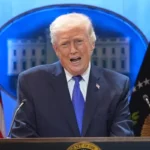
Against this backdrop, Trump’s assertion this week that he had secured another ceasefire or peace deal prompted swift rejection from Thai leaders. Prime Minister Anutin Charnvirakul stated that there was “no ceasefire yet” and confirmed that the military had received no instructions to halt operations.
He reiterated that Thailand was not the aggressor and insisted that any genuine truce would require a formal Cambodian proposal and verified cessation of attacks. Cambodian officials, meanwhile, accused Thai F-16 aircraft of continuing strikes inside Cambodian territory even hours after Trump’s announcement, reinforcing perceptions of a widening credibility gap between diplomatic claims and battlefield realities.
Humanitarian Toll and Regional Pressure
The fighting has triggered a growing humanitarian crisis, with tens of thousands sheltering in evacuation camps and hundreds of thousands displaced along both sides of the border. ASEAN members and the United Nations have renewed calls for an immediate halt to hostilities and a return to structured negotiations.
For now, Thailand’s insistence that Cambodia take the first step toward a ceasefire has hardened positions, raising concerns that without a reworked, enforceable border agreement, each new clash risks further destabilising mainland Southeast Asia and exposing the limits of great-power mediation.